




 EDINBURGH, UK: three years in the making, The Crow Hill Company is proud to introduce G.U.M (GORGEOUS UNIVERSAL MIDI) — readily rewriting the rulebook on recording, developing, and sharing sounds as a result of effectively grafting 128 instruments played, engineered, and developed by humans into its associated single GUM plug-in variants… for humans, having felt duty-bound to the original founders of MIDI (Musical Instrument Digital Interface) to give GM (General MIDI) another go, but, in the spirit of MIDI, making it accessible to all by being functional for songwriters and performers, as well as being broadcast-grade-ready for producers, composers, and all professionals, courtesy of FREE (‘lite’) and paid PRO (fully spec’d) versions, respectively, the latter launching at the lowest price it will ever be (because every month a new bank of eight instruments will be added and so the pricing adjusts accordingly) — as of November 27…
The Crow Hill Company’s G.U.M. — unlike yesteryear’s crudely-sampled GM sound set that it is, in effect, setting out to contemporarily carry into the 21st Century — is recorded very much in the Edinburgh-based enterprise’s signature style, with all samples being produced in-situ at Castlesound Studios, situated itself in beautiful countryside just 20 minutes from Edinburgh as one of the leading recording studios in the UK. Ultimately, the associated single GUM plug-in variants are full of character whilst being eminently usable and tweak-able for numerous musical styles and applications. But by being duty-bound to the original founders of MIDI to give GM another go, G.U.M. is designed so that songwriters can instantly access the sounds they need without spending precious session time scrolling through endless lists, then wasting creative energies trying to make non-characterful sounds resemble modern recordings — providing producers and composers with instant gratification and sonic consistency across all their sounds, whether workhorse pianos or lesser-used bottle blows, in other words!
What really resonates with their creators the most, though, is that the FREE version of the GUM plug-in — its superlative sound eventually extending to 128 instruments in 16 banks of eight with 5ths zones and 1-2 dynamic layers functionality — and its fully-spec’d PRO-grade software sibling — eventually extending to 128 instruments in 16 banks of eight with diatonic zones, 3-15 dynamic layers, release triggers, round robins, and pedal up/down functionality — on offer will both usher in a new opportunity for music-makers wanting to collaborate with ease via the .mid (MIDI File) protocol, itself storing musical performance data like notes, timing, velocity, and tempo as the classic three-letter extension originally shaped by older operating system limits, albeit still widely used by many DAWs (Digital Audio Workstations) and tools. The Crow Hill Company collectively believes that MIDI — with its small footprint and DAW agnosticism — still holds the key to true creative collaboration potential amongst music-makers from all walks of life and at all stages of their career.
An appreciation of the truly amazing achievement that is G.U.M. benefits, beyond any doubt, from an appreciation of where its concept came from historically, so let us collectively cast our minds back to 1983 when a consortium of music tech manufacturers presided over an unprecedented announcement — namely, MIDI, a universal system for electronic musical instruments to speak to and control each other, regardless of manufacturer. Musically transmitting instructions such as which notes are played, how hard they are hit (velocity), note length, pitch bends, and knob or slider movements, those protocols remain intact to this day. Fast forward to 1991 and the General MIDI list was additionally agreed upon — 128 instruments and sounds, each with their own program change number, enabling people to exchange MIDI files that play the same notes on the same instruments totally agnostic to whichever GM-compatible device was being used and whatever the music sequences were programmed on originally. And although there were some valiant efforts to embrace the music production possibilities of that GM list — most notably by Japanese giant Roland with its so-called ‘Sound Canvas’ series, the constraints of the technology of the time delivered sonic results that lacked merit, particularly when delivering broadcast-grade masters.
“MIDI changed everything,” explains The Crow Hill Company’s Christian Henson, himself no stranger to the vagaries of music tech as a largely self-taught musician who ended up as an award-winning media composer with some interesting innovations of his own along the way, having hitherto founded a world-leading, multi-award-winning orchestral sample company before going on to found the Edinburgh-based enterprise he helms today. “The advent and universal employment of MIDI paved the way for the dominance of computers within music production, which further accelerated its democratisation and renegade spirit,” he continues, getting into his technological stride: “However, this huge disruption to the music industry at the hands of the MMA (MIDI Manufacturers Association) developed an attitude and approach to music production that would almost guarantee the abject failure of a further development in MIDI — General MIDI, a list of 128 instruments designed to additionally allow for sound selection, too. It seemed like a natural evolution of the protocol, but, to many, felt like an unnecessary overstep in the level of ‘control’ and ‘conformity’. Who picked this list? Who determined what instruments would be worthy to make Noah’s Ark of 128? Case in point; this being the end of the Eighties meant that of those 128 precious slots, four were sacrificed to saxophones and two to slap bass!”
Continues Christian Henson: “It would take technological advancements beyond those available in the late-Eighties — namely, sampling technology — to make microchip-controlled instruments sound realistic. Saying that, GM devices and their inherent implication of encouraging users to rely on factory-made presets were always going to be lambasted for their ‘lame-ness’. This is why accusations of something sounding ‘GM’ became the worst of all insults in the Nineties and why the badge — despite the immense efforts any manufacturer would have to adhere to in order to obtain it — went from one of honour to one of ridicule. Indeed, if people saw the dreaded ‘GM’ insignia on a sparkly new piece of kit then it was to be avoided as the very antithesis of street credibility.”
Cue Christian Henson’s eventual entry into the wonderful world of music tech. “Having inexplicably or — as I prefer to borrow from Withnail & I — ‘by mistake’ become a music tech entrepreneur, I feel that I have contributed to this renegade car-kit nature of making music,” he admits, adding: “Whilst I will never shy from expanding on my desire to create and develop sounds that break all the rules of sonic production and performance — that music homogeny should be avoided at all costs — with the best way of achieving that goal being by having choice, and masses of it, I do feel that I have, however, in some way contributed to entry into music production being a totally mystifying ocean of choice, with alarming peaks and troughs in quality. Whilst I feel that my attempts at making orchestral music more affordable and more accessible with my ALBION concept and more inclusive and welcoming with my LABS invention were a success, I have been thinking for some time now that these two decades of sampling experience could be used to make music production more appealing to a broader spread of musicians, music-makers, and enthusiasts — ones that maybe don’t want to approach it with this car-kit mentality.”
Mirroring this thinking, Christian Henson eventually ended up posing a series of pertinent questions to The Crow Hill Company: “What if we were to make a sample set to get people started? One that provided professionals with a pantry of essential sounds that were consistently good, reliable, and inspiring? One that everyone can use and stick on their hard drives, so anyone — on any system, using any DAW — can share ideas, and learn from and inspire one another just by exchanging MIDI files? But also — using all of my experience in making samples — prove that the worst idea to come out of MIDI could actually be brilliant? What if we were to make GM sound gorgeous? Which is how we came up with G.U.M. — GORGEOUS UNIVERSAL MIDI. Planning and curating this has not only been daunting but difficult. For me, it meant going back to the sample instrument drawing board and removing all of my experience as a professional. Put it this way: the GUM plug-in just needs to play — no fader movements, no weird mappings, no fancy controllers, one mode of employment for this sound and another for that.”
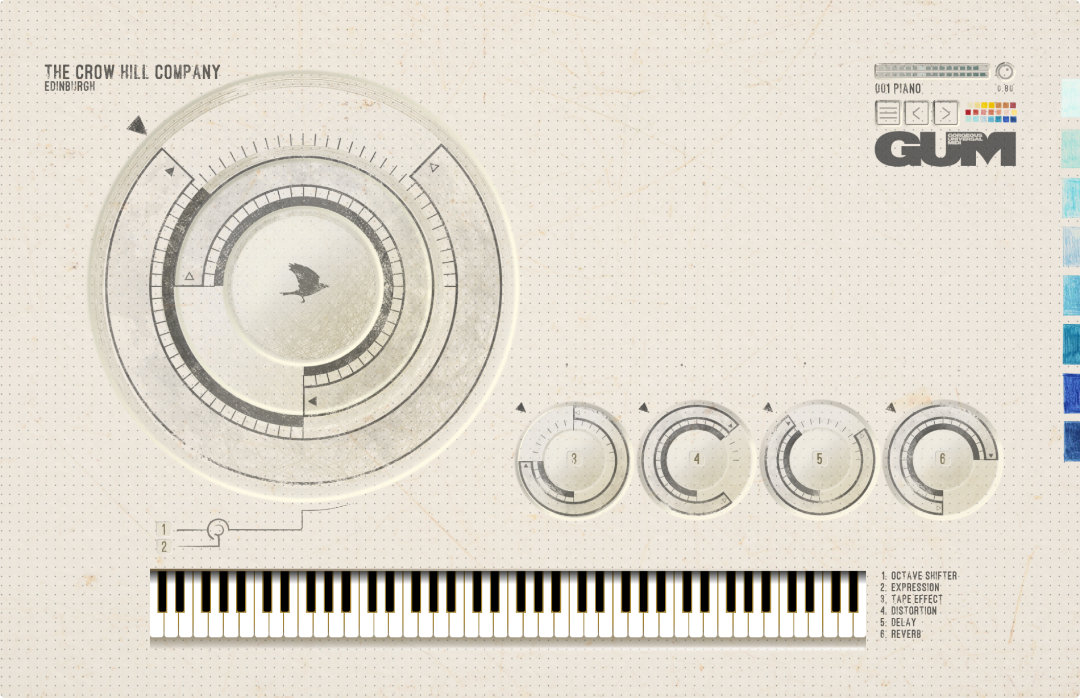
That being said, GUM’s no-nonsense and, admittedly, gorgeous GUI (Graphical User Interface) allows users to ‘play’ with its self-explanatory OCTAVE SHIFTER, EXPRESSION, TAPE EFFECT, DISTORTION, DELAY, and REVERB effect controls — operation of which should be reassuringly familiar to owners of other sample-based virtual instrument plug-ins from The Crow Hill Company — to quickly alter the characteristics of any sound being played. “Gazillions of MIDI files online should work with G.U.M.,” gushes Christian Henson, ending on a high note: “If you want to share and collaborate with others in a more exact musical manner than a GM set of sounds allows, we recommend you encourage them to grab a FREE copy of GUM; even if you’re on PRO, the result at the other end is going to be remarkably similar!” Surely it’s time for a (program) change, either way?
Until December 1, 2026, GUM PRO is initially available to purchase for £75.00 GBP/$99.00 USD/€90.00 EUR — which works out at £0.59 GBP/$0.77 USD/€0.70 EUR per instrument when all 16 banks become available — as a sample-based virtual instrument supporting AAX-, AU-, VST-, and VST3 plug-in formats for macOS 12 through to 15 (Apple Silicon and Intel compatible) and Windows 10 through to 11 from The Crow Hill Company’s online Shop here: https://thecrowhillcompany.com/shop/ (Absurd as it may seem, this investment is going to grow in value as a new bank of eight sounds are added on a monthly basis — generously giving users more chew out of their GUM, in effect — until all 128 sounds are available, with GUM PRO subsequently being priced at £85.00 GBP/$112.00 USD/€102.00 EUR — which works out at £0.67 GBP/$0.88 USD/€0.80 EUR per instrument when all 16 banks become available — in December 2026, rising thereafter to £95.00 GBP/$125.00 USD/€114.00 EUR — which works out at £0.74 GBP/$0.98 USD/€0.89 EUR per instrument when all 16 banks become available — in January 2027, and so on, eventually finishing up at £199.00 GBP/$256.00 USD/€235.00 EUR — which works out at £1.52 GBP/$2.00 USD/€1.82 EUR per instrument when all 16 banks are available — in November 2027, by which time The Crow Hill Company anticipates the completed library totalling between 60-100 GB.)
As implied by name, GUM FREE is available for free as a sample-based virtual instrument supporting AAX-, AU-, VST-, and VST3 plug-in formats for macOS 12 through to 15 (Apple Silicon and Intel compatible) and Windows 10 through to 11 from The Crow Hill Company’s online Shop here: https://thecrowhillcompany.com/shop/ (Again, a new bank of eight sounds are added on a monthly basis until all 128 sounds are available in November 2027, by which time The Crow Hill Company anticipates the completed library totalling between 10-20 GB.)
For more in-depth information, including some superb-sounding audio demos from The Crow Hill Company co-founder Christian Henson himself, please visit the dedicated GUM webpage here: https://thecrowhillcompany.com/gum/
Both GUM PRO and GUM FREE installation and activation require installation of The Crow Hill App — an easy-to-use app designed by the best in the business to provide seamless download, installation, integration, calibration, and organisation of The Crow Hill Company tools available for free from here: https://thecrowhillcompany.com/crow-hill-app/ — and update either Plug-in when there is an option to do so; the new sample content will then download along with the new bank(s).
Watch The Crow Hill Company’s live launch of the G.U.M. concept and its associated single GUM plug-in variants here:
Become better acquainted with the G.U.M. concept and its associated single GUM plug-in variants while watching The Crow Hill Company’s official walkthrough with Christian Henson here:
About The Crow Hill Company (www.thecrowhillcompany.com)
Achievable as a result of selling some of the best and most interesting sample-based virtual instrument plug-ins available today, The Crow Hill Company represents realisation of company co-founder and professional media composer Christian Henson’s heartfelt dream of encouraging people to make music and help them on their journey, regardless of whatever point they were at and wherever their journey began by providing access to challenges, content, networking opportunities, and resources. Always abiding by its Make Music, Your Music motto, every month the Edinburgh-based enterprise drops a new VAULTS… release, ready for all to download and make music with for the rest of their lives — free for those who value sound, while 2026 introduced its G.U.M. (GORGEOUS UNIVERSAL MIDI) concept — “…certainly the most ambitious project of my entire professional career,” to quote Christian Henson himself — and associated GUM plug-in variants as being the primary reason why The Crow Hill Company was set up in the first place.
© 2026 Crow Hill Productions Ltd