




An ultra-compact and versatile tool giving players access to the latest tonesand software for advancing on their instrument
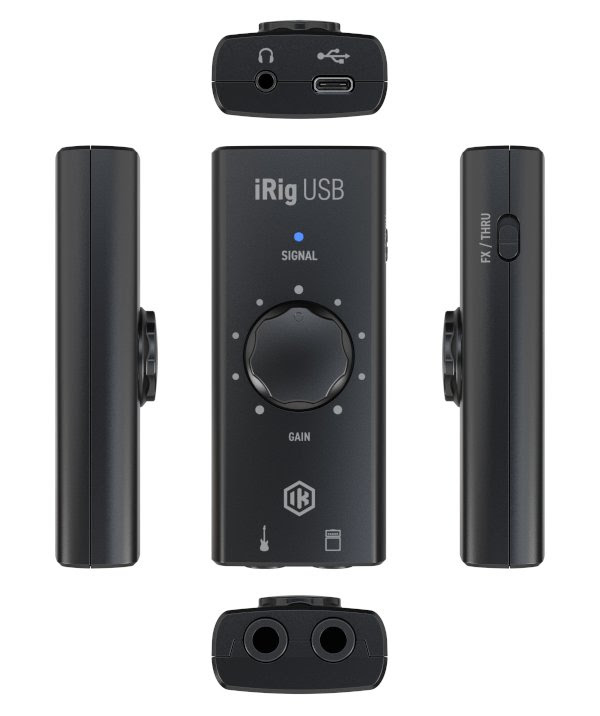
October 12, 2023 – IK Multimedia releases iRig USB, the newest member of the bestselling iRig guitar interface line. iRig USB gives guitar and bass players an affordable and easy way to practice, play and record, sporting a sleek enclosure with USB-C connectivity and bundled with IK’s latest amp and effects modeling technology.
iRig USB makes it easy for anyone to record ideas or jam along to their favorite backing tracks with killer tones and without the need of any other gear. When it’s time to get loud, there’s a dedicated Amp Out to connect the best virtual gear and tones to a real rig for playing and performing. Whether it’s through headphones or loudspeakers, iRig USB makes jamming fun and inspiring.
Key Features
Ultra-compact with Big Sound
iRig USB is small enough to fit in a pocket, yet features a wide frequency response and dynamic range on the instrument input to work with any guitar or bass, active or passive. Adjusting the input level is easy by using the large gain control knob with a convenient clipping indicator. And for listening back, both the Headphone Out and Amp Out offer exceptional sound quality for a device this size.
Jamming Out with Friends
There’s no longer the need to carry a pedalboard to practice spaces or someone’s garage. Users can bring all their cherished tones for performing live with iRig USB. Its Amp Out jack is specifically designed to connect directly to an external amplifier or powered monitor and send an optimized audio signal of amazing-sounding AmpliTube presets or TONEX Tone Models from any laptop or compatible iPad or iPhone.
A World of Great Tone
iRig USB is ideal for exploring new sounds for guitar and bass. With Mac/PC and iOS versions of both AmpliTube and TONEX included, dream rigs are always within reach for practicing and recording.
AmpliTube 5 SE for Mac/PC and AmpliTube CS for iOS offer 80 gear models each for the ultimate tone processing and recording studio. Both versions feature sought-after amps, effects and speaker cabs to create amazing guitar and bass tones. Users can play, practice and record on a desktop or mobile device with the most authentic and hyper-realistic gear models ever made.
TONEX SE offers the power of AI Machine Modeling and comes loaded with 200 Premium Tone Models, which are captures of real amps and pedals. Plus users can browse, demo and download unlimited Tone Models from ToneNET, and even use TONEX software for capturing their own amps and pedals to use at home, on the go and inside AmpliTube 5.
Software and Apps In-the-box
iRig USB is the gateway to a universe of inspiring guitar and bass tones. Included are AmpliTube 5 SE for Mac/PC (a $149.99 value) and AmpliTube CS for iOS with the “AmpliTube Essentials Bundle” (a $29.99 value) offering 80 “must-have” gear models, and TONEX SE for Mac/PC and iOS (a $149.99 value) with 200 Premium Tone Models plus unlimited user Tone Model downloads from ToneNET.
Whatever level or style of music, iRig USB will keep players connected to the newest and best tools for sounding great, learning new songs, advancing as a player and recording ideas. Sound better, play more and improve faster throughout a lifetime of guitar with iRig USB.
Pricing and Availability
iRig USB is shipping now and available from the IK Multimedia online store and from IK authorized dealers worldwide.
iRig USB $/€69.99* – Includes iRig USB, USB-C to USB-C cable.
*Pricing excludes taxes.
For more information about iRig USB or to see it in action, please visit:
www.ikmultimedia.com/irigusb
www.ikmultimedia.com/irigusb/

 London, 12.10.23 – GForce Software are delighted to present Oberheim OB-X, the world’s first officially endorsed emulation of this famous 80s synth that was adopted by some of the biggest names in the business: Queen, Rush, Paul McCartney, Prince, Depeche Mode, Simple Minds, Herbie Hancock, Chick Corea, Tangerine Dream, Jean-Michel Jarre, Susan Ciani, Japan, Eurythmics and many, many more.
GForce’s OB-X preserves the much loved classic hardware tones while, through the addition of a huge array of additional features, sounds fresh and modern lending itself superbly to Electronica, EDM, Drum and Bass, Ambient, Rock, Prog Rock, Hip Hop and more.
Using decades of experience, GForce’s engineers painstakingly modeled their original OB-X in all its glory. Like the original, per voice, there are two oscillators, a 2-pole resonant lowpass filter, amplifier, and two envelope generators. There’s also the classic modulation section with sources and destinations. But as you’d expect from GForce Software, they’ve taken the opportunity to enhance this classic with a set of potent new features.

An authentic OB-X with vast sound design possibilities
GForce’s OB-X has up to 16 voices with mono, legato, poly and unison modes with unison detune. It features a vintage control for adding subtle analog imperfections, four programmable Macros, new intro, retrigger, phase and smoothing features for the LFO, new level destination for the LFO, separate PWM1 and 2, discrete levels, discreet tracking, an arpeggiator, a chord mode with scaler, individual pan of 8 pairs of voices, Chorus, Stereo Delay and Reverb effects, and more. Finally, GForce’s OB-X has been augmented with X-Modifiers, dedicated LFOs, and ADSRs for almost all parameters that take OB-X to the next level of sound design.
Inspiration At The Speed Of Sound
Oberheim OB-X features their new, highly flexible preset browser, providing the power to organize sounds in a way that suits individual workflows. With extensive tagging, sorting, and search possibilities, it’s quick and easy to find the presets you want. The Oberheim OB-X includes more than 400+ brand-new production-ready presets from an array of diverse sound designers and artists including; Lightbath, GEOsynths, Christian Laffitte, Richard Veenstra, and Ramon Kerstens (K/V), Tontario, Stuart Thomas, Zardonic, Drew Schlesinger, Drew Neumann, Noyzelab, Sonic Space lab, Dave Spiers, Tom Wolfe, Graeme Rawson and more. The presets range from resolutely modern to passionately classic with a lot of recreations that you may have heard on more than one timeless hit.

The new Oberheim OB-X plug-in from GForce is a wonderful tribute to a classic vintage synth. GForce has vastly expanded its capabilities with the XLFO, XADSR, Macros, Velocity and Aftertouch, Arpeggiator, FX, and more. It is also much lighter and requires less maintenance than the originals!” Drew Neumann – Composer (Aeon Flux, The Wild Thornberrys)
Oberheim OB-X – key features
Images
More info
https://www.gforcesoftware.com/products/ob-x
Price
Oberheim OB-X £99.99+VAT with an intro price of £59.99+VAT
Upgrade from Oberheim Bundle intro price of £39.99 +VAT
Oberheim Bundle intro price of £169.99 +VAT (instead of £249.99)
Compatibility
Mac: Standalone Application, AudioUnit, AAX, VST and VST3
PC: Standalone Application, AAX, VST and VST3
About GForce Software Ltd.
Specializing in vintage synthesizer modeling, GForce Software offers a range of products with the most authentic sonic and musical quality in the virtual arena. Our mission is to inspire composers and producers by providing well-crafted instruments and sounds; and to nurture those aspiring to learn and grow during their musical journey.

Tucson, AZ – Cloud Microphones has grown to prominence over the last decade with the rise of the original Cloudlifter Mic Activator, a high quality, no compromise audio tool that turns phantom power into ultra-clean gain for low output dynamic, ribbon, and tube microphones. The venerable Shure SM7B is one such microphone that benefits greatly from the gain of a Cloudlifter, and this combination has become a standard for many audio applications including music recording, podcasting, broadcasting, and voiceover work.

Activated by Cloud. Optimized by Shure.
For the first time, Cloud has licensed their patented Cloudlifter technology, collaborating with Shure for the worldwide launch of the next generation of this great microphone, the SM7dB. This new mic incorporates a custom-designed built-in active preamp with technology licensed from Cloud Microphones and tuned by Shure specifically for the SM7dB, ensuring great audio for a variety of sources, from a whisper to a scream.

“The SM7B and Cloudlifter have been used in the same breath for many years now,” said Rodger Cloud, Founder and CEO of Cloud Microphones. “This license to Shure brings the quality and convenience of the technology into one package for the customer. We’re honored to be a part of the lineage of the iconic SM7 microphone.”
For more info on Shure products, visit www.shure.com.
For more info on Cloud products, please visit www.cloudmicrophones.com.

 PRESS RELEASE – October 10, 2023: Cherry Audio is proud to announce the launch of PS-3300, an exactingly faithful virtual analog emulation of the Korg semi-modular analog polyphonic synthesizer released in 1977. With only around 50 units produced, the original PS-3300 has often been cited as a holy grail of gear – a mythical monster synth so powerful that Bob Moog said it was “the best synthesizer for fat sounds.” Cherry Audio has pulled out all the stops to accurately recreate and update this massive instrument, from its stacked sonics and signature multiple‑resonator sweeps to the considerable patching capabilities that distinguished the PS-3300 from all other polysynths of the era.
Cherry Audio’s PS-3300 virtual instrument replicates the functionality and sonic characteristics of the original’s three signal generator panels, essentially three complete polyphonic synthesizers that each included six-waveform oscillators; two modulation generators (LFOs); dynamic lowpass filters, envelopes, and amps; its distinguishing triple-peak resonators; independent per-note “temperament” tuning knobs; and patchable jacks (with virtual cables) for signal routing. Cherry Audio has respectfully updated its features for the modern studio environment with PS- or MS-style filter options, tempo sync, copy/paste between panels, and temperament tuning presets.

The original PS-3300’s master panel included a signal mixer, sample & hold, a general envelope generator, and modular jacks for advanced sound shaping and control. Cherry Audio has elegantly expanded this section with continuously variable CV control of level, per-channel panning, bend range, and studio-quality integrated chorus, delay, and reverb effects. With additional touches including Cherry Audio’s unique Focus zoom-in feature, unlimited cables and multiples per jack, and versatile MIDI mapping, Cherry Audio’s PS-3300 will satisfy both vintage synth enthusiasts and modern music producers.

Cherry Audio is thrilled that the Electronic Music Education and Preservation Project (EMEAPP) allowed them full access to their exemplary vintage PS-3300, celebrating this preeminent piece of synthesizer history. EMEAPP is an independent 501(c)(3) non-profit organization and stewards of a privately held curation of rare vintage electronic instruments and stage-used gear. EMEAPP’s mission is to “share the history, artists, sounds, equipment, and technology of electronic and rock music, keeping it relevant and accessible for future generations.”

“We are delighted to have the opportunity to bring this genuinely unique instrument back to life and to raise awareness of EMEAPP,” said Cherry Audio CTO Dan Goldstein. “It’s a great opportunity to spotlight both the place of the PS-3300 in synthesizer history and EMEAPP’s goals of preservation and education.”
“EMEAPP is proud to have been involved in another Cherry Audio project,” added Drew Raison, the Executive Director of EMEAPP. “It is our honor to help bring this rare and dynamic instrument to the masses. Being regular users of our original PS-3300, we must admit that the new Cherry Audio version blows us away! We hope that this is the next of many projects with the good people of Cherry Audio.”
PS-3300 includes over 360 professionally designed presets by sound designers James Terris, INHALT, and Drew Schlesinger, including a Legacy collection of patches diagrammed in the original PS-3300 owner’s manual. Even more extraordinary sounds are available in the Resonation Preset Pack (sold separately) by James Dyson, with 100 additional presets further showcasing PS-3300’s awe-inspiring and otherworldly tones.
The original PS-3300’s high production cost meant only the wealthiest musicians could afford it, and it is now so rare and coveted that one recently sold for nearly $100,000. Cherry Audio is thrilled to make its PS-3300 virtual instrument available at the extraordinary price of only $49 (list $69), available now from cherryaudio.com and authorized resellers worldwide. In addition, Cherry Audio will be donating 10% of profits from its October website sales of PS-3300 to EMEAPP, and customers purchasing through Cherry Audio will have the option to add a direct donation to EMEAPP at checkout.
PS-3300 is available in AU, VST, VST3, AAX, and standalone formats for macOS (10.13 and above) and Windows (7 or above, including Windows 11). It includes native support for Apple’s M1 processor, including Apple M1 Ultra. A free 30-day demo is available. Visit cherryaudio.com for additional product details, system requirements, and an extensive collection of awe-inspiring sound demos.

 SAN CLEMENTE, CA, USA: Q-Bit Electronix is proud to announce the availability of the Mojave module as its latest Daisy platform-based Eurorack entry — effectively kicking up a granular sandstorm as a live granular processor drawing inspiration from vast swathes of its American Southwest desert namesake by using microscopic bits of audio to create beautifully-crafted sonic landscapes while reinventing the way we interact with sound, seriously backing up the self-proclaimed ‘Future Coast’ modular synth-maker’s philosophy of building bespoke devices that push the boundaries of design beyond what is presently possible in the process — as of October 10…
It is fair to say that Mojave is a stereo live granular processor at its creative core, but, in reality, it is capable of so much more — not least when being pressed into play as a stochastic event generator. Mojave makes it possible for explorative users to patch together feedback-driven glitch textures or compose harmonic symphonies from a single droning oscillator. Other possibilities include creating a granular delay or scrubbing a locked audio buffer to create time-stretching effects — and all directly from the front panel of this 14HP-wide module.

Mojave can — in many ways — behave exactly like other granular processors, but what sets it apart in this realm is its ability to take complex granular manipulations and make then accessible to even the most novice of users. “Our first module ever was Nebulae, a granular looper; we’ve always wanted to do a fully-committed, live granular processor but with a ‘New-Bit’ twist,” confirms Qu-Bit Electronix CEO — and company co-founder — Andrew Ikenberry. Indeed, that ‘New-Bit’ moniker really reflects the company’s collective internal name for its new design philosophy of focusing on hands-on, approachable devices that leave room for users to push their own technique and explore sound design in new ways.
With this in mind, Mojave is no exception to this rule; for its front panel includes the fundamental controls for generating and manipulating grains — themselves the tiny building blocks of granular synthesis. Adjust a grain size, shape, and generation rate while also having control over the grain pitch, the position in time where the grain grabs audio, and the audio playback direction. Though these controls are essentially found in any granular processor, they only scratch the surface of Mojave’s potential.

Put it this way, then: the key to Mojave’s magic resides in the controls at the center of the module. The two larger knobs there are absolute attention-grabbers — and for good reason, providing aleatoric grain manipulations in exciting, unquestionably ‘Qu-Bity’ ways. Turn the distribute knob to add rhythmic displacement to the grain rate; depending on which Mojave mode is selected, distribute’s displacement can either be asynchronous movements through time or quantized ratchets, repeats, and rolls that liven up the simplest of rhythms. Representing the flip side of the granular coin, as it were, the structure knob adjusts each grain’s pitch within a defined system. structure can — at its smallest setting — provide subtle semitone pitch changes, perfect for thickening up a sound, creating chorus/flanging effects, and more. But by turning up structure beyond halfway, Mojave begins to sing. structure starts to play through a quantized scale, introducing arpeggios and trills as the knob ventures further up; with the grain size large enough for grains to overlap, Mojave effortlessly transforms into a polyphonic sound generator — regardless of input.
Said structure knob and its rate (speed) neighbor are connected to Mojave’s Sky Mode — itself selected using the button in between distribute and structure — that determines what scale Mojave is quantized to. The default modes include major, minor, and chromatic scales, as well as the aptly-named, non-quantised Twilight Mode. Moreover, each mode will be fully customizable — alongside a host of configurable settings — within Narwhal, Q-Bit Electronix’s module web app (https://narwhal.qubitelectronix.com/) for custom settings.
Since Mojave boasts true stereo I/O, it includes a couple of controls that emphasize this characteristic. drift does exactly as its name implies; it drifts the grains through the audio buffer, and the more the knob is turned, the more Mojave begins to slip into the past, grabbing random bits of audio from both signal channels to fill its grains. An adjacent whirl control provides random stereo panning to each generated grain; the more this knob is turned, the more frequent and wider the grains are panned, creating huge stereo sounds from any sound source — stereo or monophonic.
Mojave has more than one way to inject sound into its granular sandstorm, speaking of sound sources. Indeed, it even has an onboard, high-quality MEMS (Micro-Electro-Mechanical System) microphone that is positioned just above its USB port; simply removing any patch cables from Mojave’s audio inputs makes the microphone active, ready to pick up any acoustic audio! Try talking or singing into Mojave — or even play an acoustic instrument in a live setting — to bring granular flair to compositions.
Clearly, then, Mojave is primarily designed for live granular processing, yet users are afforded the ability to not only freeze the grains in place for glitch stutter effects, but also lock the audio buffer in place, thereby using Mojave as a granular buffer scrub; Mojave — at the right settings — can even mimic the time-stretching effects of its bigger granular sampler and DSP (Digital Signal Processing) platform sibling, Nebulae, now benefitting from v2.1.2 firmware itself. It is worth noting here that future firmware updates and alternative firmware for Mojave are accessible via its USB drive.
Meanwhile, Mojave’s granular engine can generate a plethora of audio effects that will transform any sound. Saying that Q-Bit Electronix even included one final end-of-chain control to add some sparkle to an already dazzling device — namely, the gust knob. Which way it is turned determines control over either an internal feedback loop designed to tear grains apart in the best way or a lush reverb effect to fill the voids between the audio — alternatively, granular-textures-into-a-wash-of sound-morphing.
“Mojave is the module that’s gotten me excited about patching again,” admits Andrew Ikenberry, alluding to its configurable dune CV/Gate output and more connectivity besides, before enthusiastically continuing towards a natural conclusion: “There is something to be said about designing individual aspects of a module, not fully knowing how each part will interact with another; as such, Mojave has created sounds that I’ve never heard before, and it’s this journey into the unknown that — as a designer — gives me the opportunity to sit down and discover every corner of this amazing device along with everyone else.”
Mojave is available worldwide from Qu-Bit Electronix’s growing global network of distributors (https://www.qubitelectronix.com/distributors) with an MSRP (Manufacturer’s Suggested Retail Price) of $399.00 USD or directly via its dedicated webpage (which includes more in-depth information) here: https://qubitelectronix.com/shop/mojave (Note that with each Mojave purchased, a portion of the proceeds will go towards converting a portion of the Mojave desert that the company collectively holds dear to its heart through the Joshua Tree National Park Association: https://www.joshuatree.org/)
A sandstorm is brewing… watch Qu-Bit Electronix’s launch premiere of Mojave here:
Follow the brains behind the Mojave manual patch examples bringing them to life on screen here:
About Qu-Bit Electronix (www.qubitelectronix.com)
Qu-Bit Electronix makes modular synths for sonic explorers. Established by Andrew Ikenberry, the company was formed out of a desire to bridge the worlds of computer music and analog modular synths. Subsequently referred to as purveyors of ‘Future Coast’ synthesis, it is always aiming to find new sounds and techniques that have yet to be fully explored. Fast forward 10 years, and the company continues to thrive as a frontrunner in the exploratory modular world. While currently based in southern California, it prides itself on its in-house manufacturing; from automated electronics assembly to testing and calibration, the company continues to uphold the standards and specifications that would be expected of a bespoke modular brand.
© 2023 Qu-Bit Electronix

 GRENOBLE, FRANCE: Auburn Sounds, setting itself up as a plug-in company committed to originality, reliability, simplicity, and sound, is proud to announce the availability of INNER PITCH — pitching it as a fun-to-use pitch-shifting plug-in with a very high-quality, natural sound staying true to the source material, prioritizing the intent of the input performance with destruction as an option only — in both self-explanatory INNER PITCH FREE and INNER PITCH FULL versions, the latter including additional features for unlocking the best possible pitch-shifting quality and lowest CPU (Central Processing Unit) usage at the best possible price, as of October 6…
As a colorful effect that preserves movement and life in its users’ tracks — unless they are intentionally hellbent on destroying them, that is, Auburn Sounds’ spectral pitch-shifting plug-in, INNER PITCH, was explicitly created to be equally at home when working with any sound source — be that a single instrument, two voices, or a full mix with next to no trade-off when it comes towards favoring either monophonic or complex material — since the company succeeded in effectively applying the brakes to the internal parameters that would otherwise impose this (unnecessary) choice.

Clearly, INNER PITCH can typically be used for pitch shifting — settings range between -24 (-2 octaves) to 24 (+2 octaves), but also formant shifting — similarly, settings range between -24 (-2 octaves) to 24 (+2 octaves), as well as synthesizing hellish-sounding soundscapes, reinforcing bass or treble, track-doubling, and creating endlessly ascending or falling sounds, for instance.
INNER PITCH is as easy to use as it is fun to play with two octaves of pitch, thanks to its no-nonsense GUI (Graphical User Interface) implementation. Its unmissable PITCH control clearly sets that all-important pitch shifting to taste and an associated L/R SHIFT setting shifts the left and right channels with an offset difference to enlarge the stereo image by creating anti-phase and width, while the pitch settings panel boasts TONAL BOOST — with TRANSIENT or non-transient (TONAL) settings that can also be BALANCED; STEREO LINK — keeps the phase aligned in the left and right channels while pitch-shifting, FULL fully preserving the existing stereo image and 0 providing a cleaner but ghostlier-sounding result (without a ‘center’), and FORMANT allows for shifting formants between those -2 to +2 octaves. On top of that, COLOR adds three distortions that can all be used at once: RATE — simulates a lower sampling rate; GAME — goes through an ADPCM game codec called QOA (Quite OK Audio), resulting in a subtle video game-like sound; TUBE is a simple parallel wave-shaper that sounds good on just about anything.
A feature-rich DELAY panel is also at hand, helping users to dive deeper into exploring the creative possibilities on offer with INNER PITCH — delay time being set with either the TAP button or an associated 2D panel where feedback can also be set; DIF (diffusion) adds reflection to the delayed sound, turning it slightly into reverb, while the panorama of the delayed sound can also be affected, as can alternating it between the left and right channels (ping-pong).
It is also possible to change the three-band gain and two-band crossovers to modify the EQ shape of the wet signal using the SPECTRUM panel, and, last, but by no means least, the OUTPUT panel’s WET slider mixes the delayed, distorted, and pitch-shifted wet signal with the unaffected and compensated dry input, while GAIN is a final output volume gain slider that applies to both.
Only on the INNER PITCH FULL version, QUALITY provides an additional quality mode for pitch-shifting with three modes: MAX — preserves more transients at the expense of being more CPU hungry, STD — balanced default, and SOFT — economical mode with a more noisy mode that is still sometimes the best-sounding mode that is the most CPU friendly. Again, available only on the INNER PITCH FULL version, TIME DIV sets the STFT (Short-Time Fourier Transformation) overlap as another quality pitch-shifting mode — IIx overlap can be used to save CPU usage, sounding less reverberant yet useful for transients at the expense of tonal parts, though it sometimes ends up being the best-sounding setting, surprisingly; IIIx overlap is the default and most balanced-sounding setting; IVx overlap sounds more precise when working with transients and high-end material, albeit at the expense of more reverberation and CPU usage; Vx overlap is even more precise when working with high-end material, albeit at the expense of even more reverberation and CPU usage; and VIx overlap, which does not appear to be best for any application in particular.
Put it this way: who better to position both versions of INNER PITCH in the Auburn Sounds plug-in pantheon, then, than company CEO Guillaume Piolat. “While the GRAILLON pitch-shifting engine is still competitive in 2023, its Digital Signal Processing core was created almost seven years ago — in 2016, then left untouched so as not to break sessions,” he reasons, before continuing: “Although our DSP process has continuously improved with the release of COUTURE, PANAGEMENT 2, RENEGATE, and LENS, we knew we could do much better. As a result, INNER PITCH provides state-of-the-art pitch-shifting quality for any type of source material — not only voice — with an incredible 17ms of latency. This is a milestone for us, and a testament to AUBURN SOUNDS’ unique know-how in audio DSP. We believe that it is possibly the best-sounding pitch-shifting engine available today. That said, you don’t have to trust us blindly, but rather test our claim for yourself by using INNER PITCH FREE on any project without a time limit or any added noise; needless to say, it has a lower maximum quality, but you can get a feel for what the INNER PITCH FULL version would be like.”
INNER PITCH FREE is available for free, while INNER PITCH FULL is available to purchase at an attractive (time-limited) introductory promo price of only $29.00 USD until October 20, 2023 — rising thereafter to its regular price of $38.67 USD — in AAX, AU, LV2, VST2, and VST3 plug-in formats for macOS (10.12 or newer), Ubuntu (18.04 or newer), and Windows (7 or newer) with supported sampling rates ranging from 11,025 Hz to 192 kHz directly from Auburn Sounds, via the dedicated INNER PITCH webpage, here: https://www.auburnsounds.com/products/InnerPitch.html
Watch with intrigue as an animated Auburn Sounds-created video introduces INNER PITCH here:
About Auburn Sounds (www.auburnsounds.com)
Auburn Sounds is a plug-in company committed to originality, reliability, simplicity, and sound. Indeed, its mission is to have the largest impact on electronic music production possible by building meaningful products with unprecedented attention to quality and no stone left unturned in pursuit of doing so, each product painfully crafted in utmost detail. Its inaugural product, PANAGEMENT, found its way into thousands of studios worldwide as a spatialization laboratory letting raw power reign over stereo tracks, while GRAILLON not only found itself sitting comfortably alongside the world’s best pitch corrective products but was also the first plug-in to provide PTM (Pitch Tracking Modulation) for real-time voice transformation. The company is far from afraid of taking the technical lead — first in the audio market to use real-time PBR (Physically Based Rendering), a computer graphics approach that seeks to render images in a way that models the flow of light in the real world, and working with the ultra-productive D, a multi-paradigm system programming language — while often other developers make use of its Dplug open-source plug-in framework.
© 2023 Auburn Sounds

 Vienna, Austria – Austrian Audio is proud to announce MiCreator Studio, an ultra-flexible pocket recording system that seamlessly combines a condenser microphone and a USB-C audio interface in a compact, rugged design that lets you record what you want, where you want, and when you want.
First and foremost, MiCreator’s microphone maintains the top-notch audio quality that Austrian Audio has become known for. Add to this an audio interface with an additional input for quick-and-easy multi-tracking and optional stereo recording, higher SPL handling than other USB mics on the market, intuitive on-board controls and you have an eye-catching, compact and plug-and-play recording studio in your pocket.
“Many times a quick riff, a scratch vocal, or unplanned content creation is the best performance, so why not capture everything with studio quality sound,” says Martin Seidl, CEO of Austrian Audio. “Whether you’re at home or on the go, MiCreator Studio always keeps Austrian Audio recording quality within reach.”

Bryan Bradley, President of Group One Limited, Austrian Audio’s US distributor, adds: “This is an exciting new direction for Austrian Audio and we’re excited to put this high-quality mic into the hands of musicians, songwriters, and content creators, making it easier for them to record premium audio whenever and wherever they feel inspired.”
Key Features:

More information at https://austrian.audio/micreator
Prices, Accessories & Bundles:
MiCreator Studio – MSRP € 199 / $ 199 / £ 179
MiCreator System Set – MSRP € 299 / $ 299 / £ 269
The ultimate recording toolkit for music and content creation. Record high-quality audio with MiCreator Studio and Satellite microphones. Achieve perfect stereo recordings with the MiniBar stereo bar. Even customize your look with swappable faceplates. And when it’s time to hit the road, keep your set protected with the custom case. It’s everything you need to record how you want, where you want.
Both MiCreator Studio and MiCreator System Set come with Steinberg Cubase LE digital audio workstation or Wavelab Cast for podcasts and social media. Plus, Cubase LE is unlocked as soon as the MiCreator Studio is connected to an iOs device.

MiCreator Satellite – MSRP € 99 / $ 99 / £ 89
Satellite is a powerful microphone that pairs seamlessly with MiCreator Studio to expand your creative possibilities. Link Satellite and MiCreator Studio via the in/out ports to track two sound sources. Achieve true stereo recordings and capture the energy of the moment.
MiCreator Y-Lav – € 49 / $ 49 / £ 49
Lavalier Microphone with an additional headphone jack. Y-Lav turns your MiCreator Studio into a mobile content creation powerhouse. Record two speakers simultaneously by tethering Y-Lav to your Studio. Hear your audio in realtime thanks to the additional headphone output. Make sure your content sounds as good as it looks with Y-Lav.
US Dealer Info:
Austrian Audio products are available in online and brick-and-mortar stores throughout the US. Current and interested Austrian Audio retailers in the US should contact Michael Huckler at Group One Ltd., the exclusive US distributor of leading professional audio and lighting brands from around the world such as Solid State Logic, Klang, DiGiCo, Calrec and more.
About Austrian Audio
Austrian Audio opened its doors in 2017 following the closure of the AKG offices in Vienna and set out to create something new, challenging, and respectful to its heritage. The new company started with a core team of previous AKG personnel from management, acoustics, electronics, test and measurement, mechanical design, RF/wireless, and software/firmware, bringing 350 years of cumulative engineering experience to the new company. More information at https://austrian.audio/

 PRAGUE, CZECH REPUBLIC: MeldaProduction is proud to announce availability of MGuitarArchitect as a powerful guitar chain simulator environment — effectively encompassing everything anyone could conceivably need to sculpt a professional guitar sound, beautifully bundled into a single plug-in that creatively combines virtual amps from MTurboAmp and virtual cabs from MCabinet with a notable number of additional stompbox effects and selected studio-type effects like the music production and audio processing advanced tool-maker’s MTurboComp, MTurboDelay, or MTurboReverb (if licenses are already owned), together with mixing utilities providing almost endless routing options, as well as advanced POLYTUNER, Doubler, and Analyze input level (auto-input) functionality, all adding up to the most powerful plug-in for building stacks that has ever been built — as of September 25…
Created with guitarists of all styles in mind
As a powerful guitar chain simulator environment, MGuitarArchitect was created to suit all styles of guitarists; with that in mind, many effects are arranged by Genre, so users can quickly reach for a Country-, Metal-, or even Experimental-style processor when sculpting a professional guitar sound suited to their needs. Needless to say, the music production and audio processing advanced tools-maker is well aware that there are many artists who choose to record guitar or bass using direct inputs rather than amps, which is why this plug-in provides the creative tools needed to sculpt a dry sound into exactly what is needed — not that it cannot be used on tracks recorded using amps, of course. MeldaProduction’s MGuitarArchitect comes complete with all the effects needed to heighten the mixing process, regardless of how the signal was recorded.

Chain smokin’
MeldaProduction’s MGuitarArchitect Input interface includes three smokin’ — fully-customizable — chains with no fewer than 16 spaces each, as well as a fourth for Sidechain, but, by utilizing a modular component that allows for multiplying the number of effects for each space, users can effectively run as many effects in series or parallel across the four different groups as their computer’s CPU (Central Processing Unit) can handle! Helpfully, clicking on one of the free spaces results in an option to choose between Guitar, Stomps, Studio, and Utility effects; all are laid out by category, so users can quickly access whatever sound they want.

Lavish library
All amps from MTurboAmp and cabs from MCabinet are included with a notable number of additional stompbox effects, all served up in MGuitarArchitect’s lavish library alongside several studio-style processors and utility processors; all are fully customizable, so users can carefully control the gain, tone, and filtering of their signal, as well as make any necessary changes to each effect’s individual parameters. All adds up to an almost infinite amount of options for finding optimal sounds.

Elegant interactive effects interfaces
Musically, MGuitarArchitect comes complete with hundreds of effects; all are laid out by category and name, and, when selected, are displayed as an elegant interface with which users can quickly and easily interact with full control over each effect’s provided parameters for producing the best possible results. Each effect also ships with varied presets for quick customization; ultimately, users can save their own presets for each effect or even each chain. It is well worth pointing out here, however, that — unlike any other guitar chain-simulating plug-in platform out there — MGuitarArchitect allows users to add any (already-owned) other MeldaProduction effect at any point of the guitar tone chain-creating process!
Feeling impulsive?
Anyone adventurous enough to find themselves feeling the need for even more extensions when working with MGuitarArchitect could consider using the third-party Neural Amp Modeller (available as a free amp profiler plug-in from Steven Atkinson) or, closer to home, turning to MeldaProduction’s MConvolutionEZ (included as an effect that uses impulse responses to add amazing reverb and microphone processing to signals); users can choose from countless reverb samples — from plates and rooms to churches and halls, as well as responses from microphones, in the case of the latter.
Key features:
∙ Includes all amps from MTurboAmp and cabs from MCabinet with a notable number of additional stompbox effects, served up in a lavish library alongside studio-style processors and utility processors
∙ Provides creative tools needed to sculpt a dry sound into exactly what is needed
∙ Includes three fully customizable chains with 16 spaces each, as well as a fourth for Sidechain — run unlimited effects in series or parallel across four different groups
∙ Comes complete with hundreds of effects laid out by category and name, each shipping with varied presets for quick customization and displayed as an elegant interactive interface when selected
∙ Add any (already-owned) other MeldaProduction effect at any point of the guitar tone chain-creating process
∙ Includes MConvolutionEZ to add amazing reverb and microphone processing to signals
MGuitarArchitect is available to purchase via its dedicated webpage (https://www.meldaproduction.com/MGuitarArchitect) for a time-limited introductory promo price of only €99.00 EUR until the end of October 2023 — rising thereafter to its regular price of €299.00 EUR; a 15-day, fully-functional trial version of MGuitarArchitect is also available by downloading the latest (MAudioPlugins 16.08) universal installer of MeldaProduction tools — to include all virtual effect and instrument plug-ins in 64-bit AAX-, AU-, VST- and VST3-compatible formats for macOS (10.14 or newer) and 64-bit AAX-, VST-, and VST3-compatible formats for Windows (8/10/11) — from here: https://meldaproduction.com/downloads (Choose which ones to install and purchase licenses later with free-for-life updates.) Owners of MTurboAmp (https://www.meldaproduction.com/MTurboAmp) and/or MCabinet (https://www.meldaproduction.com/MCabinet) can upgrade to MGuitarArchitect at a discounted price.
Watch MeldaProduction’s informative introductory video for MGuitarArchitect here:
About MeldaProduction
MeldaProduction was founded in 2009 by Vojtech Meluzin and is based in Prague, Czech Republic. Inspired by ancient analog gear right through to the latest digital developments, it makes advanced tools for music production and audio processing with 100-plus products — including more than 30 available for free — to its notable name. Needless to say, applying innovative thinking to create sounds that matter with inspiring user interfaces that are as easy to use as they are versatile with never-ending improvements neatly sums up the company’s gifted game plan. It is also a premier partner brand of fellow Prague-registered Limited Company United Plugins, a federation of independent development teams comprised of individuals involved in the music industry.
© 2023 MeldaProduction

 BRNO, CZECH REPUBLIC: software application, software effect, and hardware processor developer Audified is proud to announce availability of its 1A Equalizer effect plug-in — creatively combining vintage schematics with modern technological know-how to teach an old Pultec® new sonic tricks as a virtual homage to and evolution of electronics engineer Eugene Richard Shenk’s trailblazing tube-based EQ design dating back to the mid-Fifties, featured on countless hits as a recording industry staple to this day — as of September 25…
Appreciating Audified’s 1A Equalizer effect plug-in perhaps involves an appreciation of the fact that it effectively has history to thank for its very existence. Electronics engineer Eugene Richard Shenk’s trailblazing tube-based EQ design dates back to the mid-Fifties, initially available as Pulse Techniques, Inc.’s EQP-1 Program Equalizer, evolving into the Pultec® EQP-1A that featured on countless hits as a recording industry staple to this day. Fast-forward through to today and Audified’s appreciation of tube-based devices collectively comes across in its own studio work while manifesting itself in the technology involved in developing the plug-ins for which it is now known, enabling endless inspiration for creating tools for musicians worldwide. With that in mind, though, its latest 1A Equalizer effect plug-in should not be thought of as an ‘exact replica’ — if, indeed, there is such a thing — of what went before, but rather a virtual homage to and evolution of that trailblazing tube-based EQ design.

Creatively combining vintage schematics with modern technological know-how to teach an old Pultec® new sonic tricks, Audified avoided playing by the rules when crafting its 1A Equalizer effect plug-in as a perfect tube-based EQ emulation — one where innovation meets tradition. That said, boosting and attenuating lows or highs in a signature way — achieving perceived loudness and fullness by boosting a frequency and attenuating it slightly less than it was boosted — is quintessential to the sound of the original units; ultimately, this is nailed in 1A Equalizer’s perfectly balanced BOOST and ATTEN controls. Continuing in a similar vein, nailing perfect saturation for the tracks being processed is perfectly possible thanks to 1A Equalizer’s unrelenting and precise CALIBRATION capability; since saturation is the heart and soul of this effect plug-in, users are advised to use it wisely! It is always worth keeping an eye on the THD (Total Harmonic Distortion) meter to clarify how much of that sweet saturation is being applied. After all, the devil is in the details.
But beyond that old boost-and-attenuate trick, 1A Equalizer works well with drums — add a bit of low-end boost to the kick and snare for much tighter-sounding, in-your-face drums; bass — boosting the lows and cutting the harsh highs will make the bass stand out, while adding punch, weight, and definition will enhance its groove; and guitars — add or remove the guitar’s low end as needed, or add a bit of chime and clarity at the top end to make them more defined and cut through in a mix.
Make no mistake: it is now 2023 — not 1955, of course, so today’s 1A Equalizer users are free to seize control over their soundstage with the effect plug-in’s welcomed M/S (Mid/Side) processing feature. For the benefit of the uninitiated, that M/S processing separates audio into Mid and Side components, providing users with an ability to separately sculpt the centre of their mix and edges of the stereo signal, so they can forge the ultimate mix or master, as well as enhancing overall colour with linkable parameters and switchable L/R (Left/Right) and M/S modes.
It is clearly apparent, then, that by creatively combining vintage schematics with modern technological know-how, Audified has succeeded in teaching an old Pultec® new sonic tricks with 1A Equalizer effectively acting as its present-day, devilishly-detailed virtual homage to and evolution of Eugene Richard Shenk’s trailblazing tube-based EQ design of yesteryear.
1A Equalizer is available to purchase for a discounted introductory price of $49.00 USD until October 8, 2023 — rising thereafter to its regular price of $69.00 USD — from its dedicated webpage, which also includes some superb-sounding audio examples, here: https://audified.com/products/1a-equalizer/
Boutique Studio Bundle (https://audified.com/products/boutique-studio-bundle/) — updated to now include 1A Equalizer (alongside RZ062 Equalizer, U73b Compressor, and U78 Saturator) — is discounted at the same time to $149.00 USD, rising thereafter to $219.00 USD.
Become better acquainted with 1A Equalizer while watching Audified’s walkthrough video here:
About Audified (www.audified.com)
With more than 20 years of R&D, education, and collaboration connected with its notable name, Audified actively develops software applications, software effects, and hardware processors for musicians, audio engineers, and installed audio. As such, the company’s collective vision is to improve and streamline music production workflow, adding a new aesthetic value to their customer’s work while helping them to achieve the best possible results.
© 2023 Audified s.r.o.

 GRENOBLE, FRANCE: audio software company XILS-lab is proud to release Ring’X — readily representing the latest addition to its lengthening line of virtual effects as an inspiring and musical multi-effect plug-in par excellence — as of September 28…
Duly developed as an inspiring and musical multi-effect plug-in for seriously satisfying anyone’s needs, Ring’X is certainly worthy of the oft-overused French phrase par excellence — literally translated into English as ‘by excellence’ — as evidenced by its feature-packed GUI (Graphical User Interface) that is as easy on the eye as it is easy to use.
Ultimately, it is anchored around a six-slot so-called ‘Effect Ring’ that allows anyone to insert the effects they need in the order they want, choosing from a selection of deeply-modifiable classic analogue effect emulations: ANALOG FILTER — modelled from the CMS 3320 chip, used in the exciting-sounding (early-Eighties-era) Elka Synthex subtractive synthesis-based polytimbral powerhouse (much loved by the likes of famous French electronic music pioneer Jean-Michel Jarre, who still uses it to this day to create the distinctive sound of his onstage laser harp), providing five (LP24 — 24db Low-Pass, LP12 — 12db Low-Pass, HP12 —12db High-Pass, BP12 — 12db Band-Pass, or BP6 — 6db Band-Pass) self-oscillating filter types; ANALOG 18db FILTER — modelling the specific sound and behaviour of an 18db self-oscillating filter from the breakthrough British EMS VCS3, which made musical history upon its introduction in 1969 by being the first commercially portable synthesiser available anywhere in the world, thanks to its innovative modular matrix-based patchboard dispensing with the telephone exchange-like cabling of other (much larger) modular systems in favour of making space-saving connections with (removable) coloured pegs; CHORUS (BUCKET BRIGADE DELAY); DELAY — stereo delay that copies the input signal to the left and right channel; DISTORTION; PARAMETRIC EQ — a three-band affair with each band type selectable from six standard filter types; PHASER; and REVERB — with three (L — Large, M — Medium, and S — Small) algorithms. Each effect provides four MODULATION points with a SOURCE and DESTINATION menu associated with an AMOUNT knob.

Standard STEP and specific LOC locator sequencers for modulating effects are also available — the loop goes through a defined number of steps and each time the internal clock is fired the next step is triggered, in the case of the former, while the latter is designed to be synchronised to the DAW (Digital Audio Workstation) with the loop being synchronised to the DAW bar (or a multiple of the bar).
But that’s not all. Another area well worth highlighting here features four input followers; a TRANSIENT tracker ‘module’ — detects the transients present in the input sound, each transient triggering a simple envelope without attack and release controlled by the RELEASE knob; S-DETECTION ‘module’ — detects sibilance present in the input sound, and also useful for separating high-frequency parts from those with more middle and bass frequencies; GATE ‘module’ — removes all the parts from the input sound that are below a specified threshold; and a STEREO SPACE ‘module’ — powerful stereo processing that allows users to dynamically position their audio signal into a true stereo space.
By being so flexible in both operation and resulting effects, it stands to reason, therefore, that Ring’X should come complete with a raft of presets. All are accessible via an integrated (single-window) Preset Manager, making it easy to find the right patch in seconds, manage presets, sound banks, and create custom tags. That being said, then, inspiring and musical multi-effects are only a click away, but those wishing to dig deeper to seriously satisfy their needs are always free to do just that! After all, as the latest addition to XILS-lab’s lengthening line of virtual effects, Ring’X is, indeed, an inspiring and musical multi-effect plug-in par excellence — in the literal sense of those (French-originating) words.
Who better, then, to put Ring’X in its rightful place than the Frenchman primarily responsible for bringing it into existence — namely, XILS-lab CEO Xavier Oudin (credited in the multi-effect plug-in in question’s user manual with: Concept of Ring’X and original UI design; Digital Signal Processing and plug-in coding; [and] the graphical user interface). “For a number of years, customers have been regularly asking me to create an effect featuring filters extracted from our synthesizers,” he begins, before adding: “This idea grew into providing a sort of Swiss army knife-style tool capable of sculpting audio with modulation fully independent of its content, and also able to create any kind of de-esser and transient shaper with far more possibilities than standard such effects. Eventually, Ring’X was born.”
Ring’X is available to purchase as an iLok-protected virtual effect plug-in (installable in up to two independent locations) at an introductory promo price of only €69.00 EUR until October 31, 2023 — rising thereafter to an MSRP (Manufacturer’s Suggested Retail Price) of €179.00 EUR — directly from XILS-lab via its dedicated webpage, which also includes more in-depth information and several must-see video demonstrations, here: https://www.xils-lab.com/products/ringx-p-172.html#
A time-limited full version of Ring’X can be requested for pre-purchase evaluation purposes here: https://www.xils-lab.com/products/ringx-p-172/download.html#AskDemo
Ring’X is downloadable in 64-bit AAX (native)-, AU-, VST2.4-, and VST3-compatible formats for macOS (10.9+) and 64-bit AAX (native)-, VST2.4-, and VST3-compatible formats for Windows (7/8/10) directly from XILS-lab.
About XILS-lab (www.xils-lab.com)
Based in Grenoble, France, XILS-lab is an audio software company, created, and managed by Xavier Oudin. Having created some of the best known virtual instruments and effects plug-ins on the market for various companies over the last 20-plus years, today he focuses on bringing his passion for audio, instruments, and music to bear on his own company. Working with highly-skilled professional musicians and sound designers, the company collectively believes that a virtual instrument or effect is not simply a series of mind-boggling mathematical algorithms designed and scrutinised over by bookish PhD engineers but rather a useful and useable musical tool made for musicians. Moreover, XILS-lab loves to create virtual instruments and effects that inspire its users to create more imaginative music than they ever dreamed possible!
© 2023 XILS Audio sarl


