



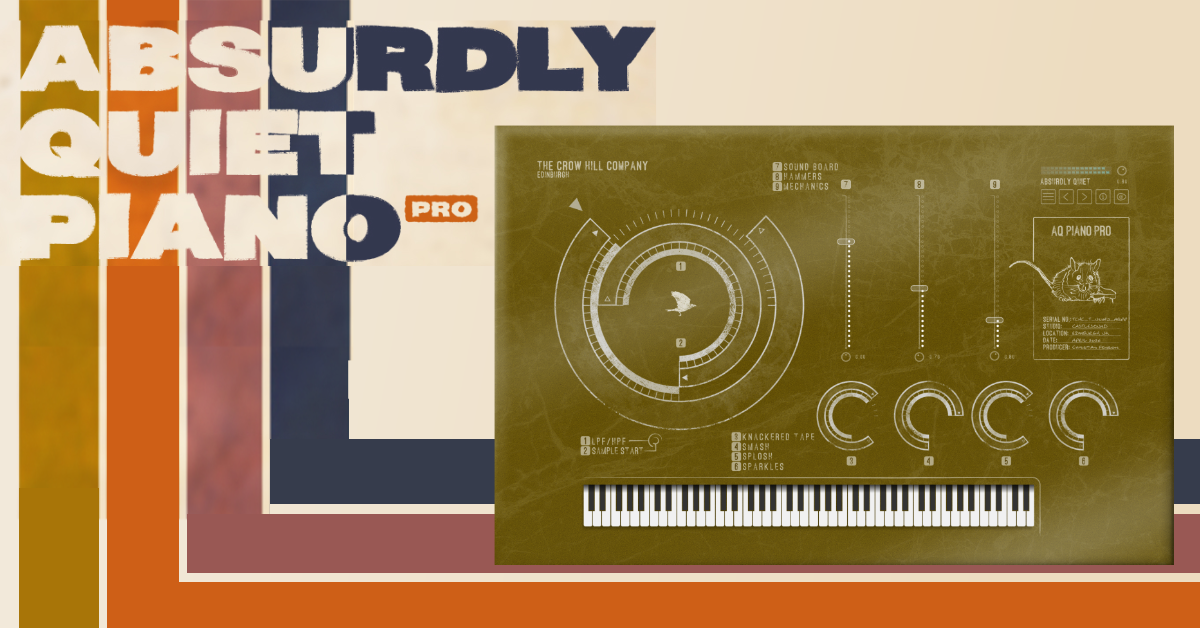
 EDINBURGH, UK: following in the foundational footsteps of the recently released VAULTS – ABSURDLY QUIET PIANO, cunningly creating the seemingly impossible sensation of playing a grand piano impossibly quietly as the latest downloadable drop in the Edinburgh-based enterprise’s free virtual instrument collection, The Crow Hill Company is proud to announce availability of ABSURDLY QUIET PIANO PRO — produced beyond the possibilities afforded in live performance on the very verge of silence as a mellow, soft, and alluring piano that hits all the right (sampled) notes without having its resonance hindered by being based on a felt or celeste-pedal piano — as of May 20…
It is fair to say that The Crow Hill Company has, quite literally, gone ‘pro’ after scoring a hit with its insanely popular VAULTS – ABSURDLY QUIET PIANO release — recorded during the dead of night in company founder and media composer Christian Henson’s front room, sampling a grand piano at the quietest dynamic possible to create a beguiling effect that is impossible to recreate when playing piano in a regular fashion — by creating an even quieter, more intimate version, this time recorded at Castlesound Studios, situated in beautiful countryside just 20 minutes from Edinburgh as one of the leading recording studios in the UK, with a much chunkier spec sheet including dynamic layers, a brace of round robins, pedal up and down samples, release triggers, and more. Maintains Christian Henson himself, setting the scene for its inventive introduction that is, in itself, surely set to inspire: “It is designed for intimacy, but doesn’t have the ‘thonk’ of a felt piano — that sound that I’ve got very tired of, and is part of my ORIGINS range, building my sample palette up from scratch. I’m hoping that ABSURDLY QUIET PIANO PRO is going to be my workhorse.”
With ABSURDLY QUIET PIANO PRO, The Crow Hill Company is intent on taking things to the next level — as evidenced by that ‘pro’ addendum. After all, VAULTS – ABSURDLY QUIET PIANO is effectively an ‘R&D’ version of its turned-professional, full-blown followup, arising from the fact that the Edinburgh-based enterprise had been carrying out a bunch of research and development surrounding pianos at the time — albeit, admittedly, distracting itself with a simple question: how quietly can you actually play a piano? In itself, this begs the followup question of how does the ‘pro’ version differ from its ‘R&D’ predecessor? An answer is anchored around ABSURDLY QUIET PIANO PRO’s introduction of both pedal up and down resonance samples — think two (super-soft and almost-silent-soft) dynamic layers, a brace of round robins, release triggers, damper samples, and two distinctive mic positions to balance resonance with the mechanics of the instrument. And all recorded at Castlesound Studios with top-tier microphones and super-quiet mic preamps, achieving hitherto-thought-impossible tones by playing the piano at an absurd level of quietness not possible in live performance. Clarifies Christian Henson: “We released VAULTS – ABSURDLY QUIET PIANO about three weeks ago, and our site is still so overwhelmed that it thinks it’s having a denial of service attack! It was a hastily done bit of R&D — the lid was down, it was a pair of tiny DPA mics, so it had a kind of muffled quality. What’s more, it was so quiet that the setting — being my front room — was so unprofessional that the noise reduction required to make it useable rubbed out all of the character. I wanted that sound that you get — when you’re playing so quietly — of the hammer actually kissing the string. So we went into Castlesound, and we made ABSURDLY QUIET PIANO PRO, but little did I know that I was entering into a noise reduction nightmare!”
Creatively, Christian Henson found the exact point at which the key produced a tone for each and every note. Needless to say, every note and every round robin became a game of searching, finding, and ushering out something beyond just a quiet thud. This, however, created a problem in that the notes were whisper quiet, meaning managing even the slightest movement in the room resulted in a somewhat rigid, ache-and-pain-inducing week in Edinburgh’s esteemed Castlesound Studios. Saying that, even with the quietest microphones and preamps, the noise floor was always going to prove problematic, as the nightmarish level of noise reduction required meant that the subtle, bright harmonic characteristics of the piano were lost; all was not lost, though, as a solution was found during the post-production process — painfully time consuming as it was — that involved going into each and every one of the 2,000 samples recorded and meticulously etching out every harmonic from the ‘shash’ that surrounded it. “It has a pianoforte element to it that belies the quietness at which I recorded this thing,” continues Christian Henson, adding: “Also, it’s an Estonia, which is a relatively modern piano that has a very modern action; when you play it quieter there’s a load of resonance and warmth because it’s new and young, so, because of the characterful nature of the sampling, we did a bunch of round robins. We recorded it two different ways; it’s got release triggers that give it that real intimate sound — fully controllable; and the damper pedal has a beautiful, shimmering noise to it, alongside some really good functionality on the front end.”
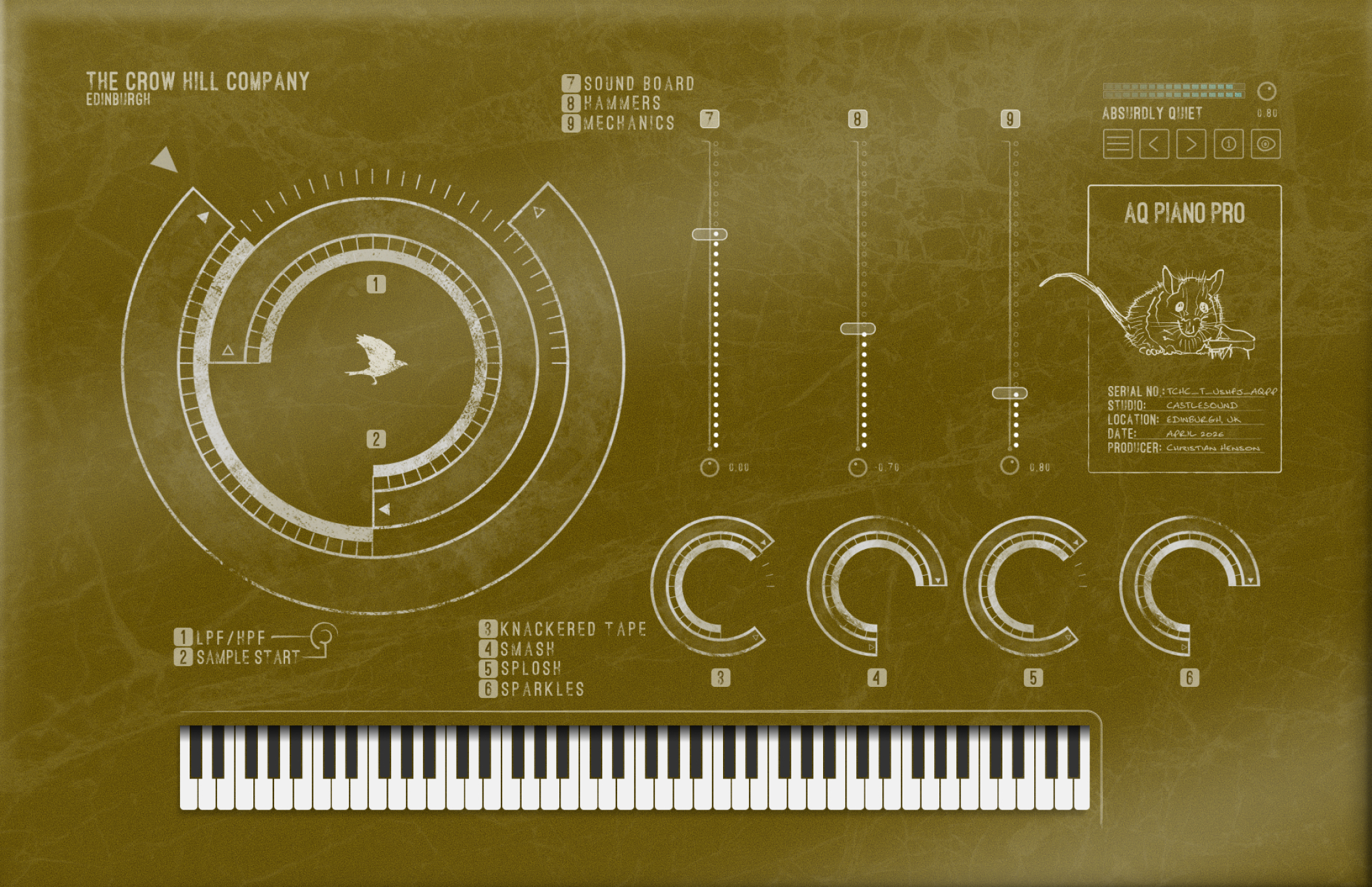
Explaining how it works, Christian Henson has this to say: “For every note you play, you have two events — the first being your note on event. This triggers two sets of samples — two microphone positions, and is controlled by the smaller inner dial; what this controls is the position at which the sample starts. So, depending on the setting of this dial, you can start the samples just before the main transient, or you can start it way back, so catch more of the action, or the point at which the fundamental occurs. For each note event, there’s a note on and a note off, and what we’ve done is meticulously record the release triggers; it sounds like such a subtle thing, but it’s so fundamental to the characteristics and character of the piano. So, for each note on event we trigger two samples, controlled by the SAMPLE START dial, and then when we release those notes we also trigger two samples; these are, basically, exactly the same note — the same moment in time, but recorded by different microphones. We came up with a novel way of recording this piano — the more standard way of mic’ing the soundboard, which is where the sound actually comes from, and mic’ing the actual hammers. So, if you miss your funky piano, then HAMMERS is the fader you’ll want to play with. The release triggers are all fed through the third [MECHANICS] fader, so you can balance the release triggers against the sound of the damper pedal being depressed and let go. So each sample goes into its own dedicated channel where you can control the volume, as is also the case with the release trigger samples; however, at the other end, the note on samples are routed directly to the effects bus, these being macros that are combinations of effects, accessible with a single encoder for each macro — namely, KNACKERED TAPE, SMASH, SPLOSH, and SPARKLES. One final piece of the trigger puzzle is the damper pedal; this triggers damper down and damper up samples that are fed through into the MECHANICS channel, along with the release triggers from the SOUND BOARD and MECHANICS channels — post fader, so the level of the first two channels also controls the level of their release triggers. Basically, what this means is that you can balance the damper pedal against the release triggers. Once attenuated, we have all of the signals leaving the MECHANICS channel going through the macros. And the final piece of the signal chain path is our large encoder, which is a LPF/HPF hybrid; neither the LPF — Low Pass Filter, which lets low stuff pass through — or the HPF — High Pass Filter, which lets high stuff pass through — is engaged at the 50/50 position, but the further back it is dialled then the duller, darker, or ‘low-passy’ it will get.”
Although a lot of work went into making ABSURDLY QUIET PIANO PRO what it is, the end result is, without question, a staggeringly personal and intimate piano with all the warmth of a felt piano, but also with a effervescent fizz of the hammers hitting the keys without being muted. Moreover, the rest of the strings are tickled and resonating with the down pedals, while a mic selection enables users to get into ABSURDLY QUIET PIANO PRO like they would when physically playing an upright piano, hearing the charm and character of all the moving parts involved in its inner workings — without losing their music to a crudely suppressed tonal range. Reality should surely dictate, then, that this will become Christian Henson’s hoped for workhorse. And anyone else’s, for that matter — all the more so if seeking an intimate piano sound without the tiresome ‘thonk’ of felt.
ABSURDLY QUIET PIANO PRO is available to buy for £29.00 GBP as a sample-based virtual instrument plug-in supporting AAX-, AU-, VST2-, and VST3 formats for macOS 11 through to 15 (Apple Silicon and Intel compatible) and Windows 10 through to 11 directly from The Crow Hill Company here: https://thecrowhillcompany.com/tools/absurdly-quiet-piano-pro/
For more in-depth information, including some superb-sounding audio demos from The Crow Hill Company co-founder Christian Henson himself, please visit the dedicated ABSURDLY QUIET PIANO PRO webpage here: https://thecrowhillcompany.com/tools/absurdly-quiet-piano-pro/
ABSURDLY QUIET PIANO PRO installation and activation requires installation of The Crow Hill App — an easy-to-use app designed by the best in the business to provide seamless download, installation, integration, calibration, and organisation of The Crow Hill Company tools — available for free from here: https://thecrowhillcompany.com/crow-hill-app/
About The Crow Hill Company (www.thecrowhillcompany.com)
Achievable as a result of selling some of the best and most interesting sample-based virtual instrument plug-ins available today, The Crow Hill Company represents realisation of company co-founder and professional composer Christian Henson’s heartfelt dream of encouraging people to make music and help them on their journey, regardless of whatever point they were at and wherever their journey began by providing access to challenges, content, networking opportunities, and resources. Always abiding by its Make Music, Your Music motto, every month the Edinburgh-based enterprise drops a new VAULTS… release, ready for all to download and make music with for the rest of their lives — free for those who value sound.
© 2026 Crow Hill Productions Ltd