




 LONDON, UK: Spitfire Audio Books, an imprint of Spitfire Audio Holdings Limited (‘Spitfire Audio’), is proud to publish award-winning media composer and company co-founder Paul Thomson’s THE PROFESSIONAL COMPOSER’S GUIDE as a must-read eBook via the Issuu self-service content creation and distribution platform — pitched as a comprehensive guide to business and creativity aimed at composers of any age at any stage of their composing journey, itself a lengthy labour of love that the multi-talented author originally began back in 2006 before being promptly shelved (as his own creative career tangentially took off in a different direction that originally saw Spitfire Audio providing exclusive composing tools for A-list composers, eventually experiencing exponential growth to become today’s market leader in soundware with a global following), with writing finally resuming in 2021 after a global pandemic helped the tome to eventually emerge blinking into the light — as of May 17…
Who better to write some wise words outlining THE PROFESSIONAL COMPOSER’S GUIDE’s gestation and raison d’être than its author, award-winning media composer and Spitfire Audio co-founder Paul Thomson — truly no stranger to the wonderful world of music-to-picture scoring himself as an English composer for film, television, and video games, as well as a music technologist to boot: “When I was studying music back in the early 1990s, there was no public internet, and very few books about film or television scoring. I would have loved a no-nonsense book that explained in a concise and clear style how to go about the business of being a professional composer. So in 2006 I sat down to write it. I got as far as a general plan and outline of the contents — then life and composing intervened. Over the past year, I returned to this project and started to write about this labour of love, imagining that I was writing to my younger self.”
Saying that, then, the 244-page tome that is THE PROFESSIONAL COMPOSER’S GUIDE looks at both the business and creativity of composing music. As an informative and engaging eBook, it is split into two sections; the first half (PART A: BUSINESS) explores elements of the music business (Chapter 1: An overview of the opportunities available through to Chapter 8: Registrations and royalties), while the second (PART B: CREATIVITY) covers creativity, including strategies to develop the craft of composing and producing music (Chapter 9: Creativity in composition through to Chapter 15: Down time and how to use it effectively). Wonderfully written, this comprehensive eBook is ideal for anyone who is interested in becoming a professional composer, or anyone who would like to refine or develop their technical and creative skills when writing music. Moreover, exclusive tips from Paul Thomson’s creative colleagues out on the frontline of media composition are interwoven thoughtfully throughout to lend credence to the author’s wise words, which themselves take in important advice proffered professionally from the recording engineer and orchestral contractor perspective.

Put it this way: while writing THE PROFESSIONAL COMPOSER’S GUIDE from the heart, the perfectly positioned Paul Thomson could creatively draw from a deep well of proven professionalism dating back to childhood piano playing, starting his musical training at an early age and touring the world as a chorister in Worcester Cathedral Choir; while still at school he achieved the highest grades of the Associated Board of the Royal Schools of Music in four instruments, including Grade 8 in the piano with distinction at the tender age of 11, quickly followed by further ‘8s’ in organ, clarinet, and singing, subsequently creating his first theatrical score for a piece by acclaimed French playwright Henri Ghéon, and writing the official fanfare for the 900th anniversary of the granting of Worcester’s Royal Charter. Continued studies with Dr Donald Hunt OBE (Officer of the Order of the British Empire), former Organist and Director of Music at Worcester Cathedral and authority on the music and life of Sir Edward Elgar; Dr Wyndham Thomas at Bristol University; and Professor Stephen Deutsch at Bournemouth University ultimately led Paul Thomson to achieving an MA (Master of Arts) graduate-level degree in Music. Making a move thereafter to London, he quickly established himself as a versatile composer and producer, working with most major and large independent record labels for whom he has produced albums for a number of artists.
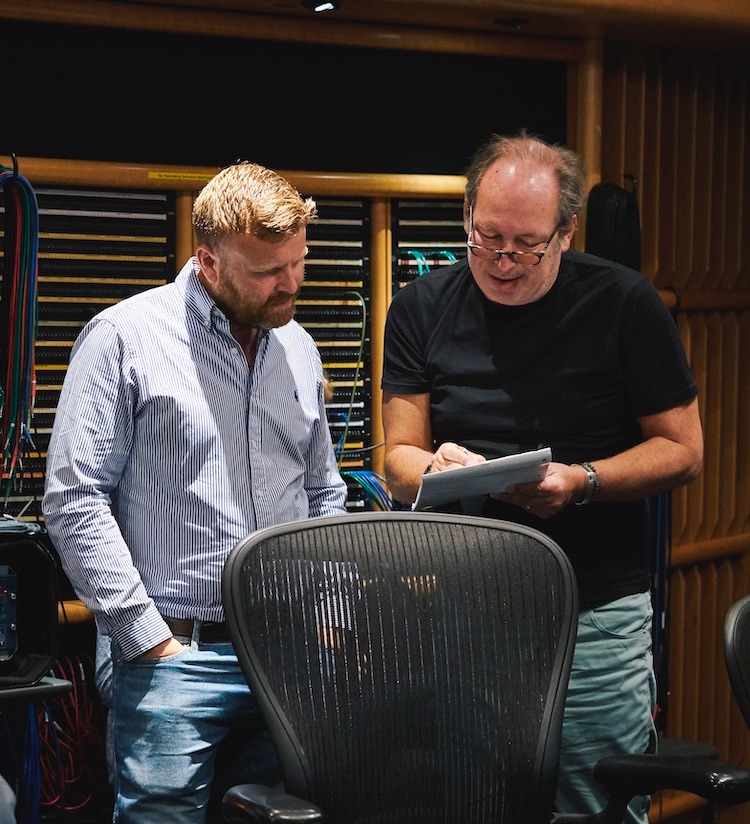
As a commissioned composer, Paul Thomson has created music for feature films, including the multi-award-winning independent movie Love, Sex, and Missed Connections (2012) and the Slate Films/BFI production Half of a Yellow Sun (2013). He has also scored the BAFTA-winning BBC Drama — coproduction with BBC America — television mini series The Fades (2011), for which he won the RTS Award for Best Original Theme Music; the BBC One Drama television mini series The Interceptor (2015); The Marvellous World of Roald Dahl television movie for BBC Scotland (2016); Ways to Save the Planet — an episode from Discovery: Project Earth (2008), itself billed as being the most expensive production ever undertaken by Discovery Networks in association with Bank of America; and the acclaimed RDF documentary The Genius of Charles Darwin (2008). Even earlier, Paul Thomson was busy composing for six series of the popular ITV television drama Where the Heart Is (2000-2005). It is fair to say that there is huge demand for Paul Thomson’s music, making itself heard in so many top-rated television shows — spanning chat shows (Alan Carr: Chatty Man), gameshows (America’s Got Talent; Britain’s Got Talent; I’m a Celebrity, Get Me Out of Here!; The X Factor), and reality TV (Keeping up with The Kardashians; Snoop Dogg’s Father Hood; The Apprentice/Celebrity Apprentice, in which Paul Thomson himself appeared as the composer for the advertising task several times).
He has also composed and produced for Extreme Music, a production music arm of Sony Music Publishing that creates and licenses music for use in television, film, advertising, and online media, starting with a number of albums’ worth of content for Hollywood high-flyer Hans Zimmer’s Director’s Cuts collaboration, creating his own label later under the now-familiar name of Spitfire Audio (also through Extreme Music). Moving into video games, Paul Thomson has worked extensively with British developer Media Molecule and owners Sony Computer Entertainment in Europe and the USA as lead composer on the LittleBigPlanet franchise.
Far from last but not least in this whistle-stop tour through the edited highlights of his highly-creative career, co-founding Spitfire Audio with fellow media composer Christian Henson had Paul Thomson tangentially taking off in a different direction that originally saw the sound-specialising British music technology company concerned providing exclusive composing tools for A-list composers, eventually experiencing exponential growth to become today’s market leader in soundware with a global following. For Spitfire Audio, he has collaborated with musicians and soundsmiths as diverse as GRAMMY® Award-nominated American electronic music composer, software developer, DJ, film composer, and technologist Brian Transeau (a.k.a. BT); BAFTA-winning Icelandic composer and producer Ólafur Arnalds; renowned Red Hot Chilli Peppers drummer Chad Smith; classy Queen drumming deity Roger Taylor; GRAMMY® Award-winning American composer, conductor, and speaker Eric Whitacre; and multi-award-winning German film composer, record producer, and orchestral sampling godfather Hans Zimmer; plus, posthumously, English composer, ethnomusicologist, and self-styled musical explorer David Fanshawe. As a sought-after music technologist himself, he has also created bespoke sounds for American composer, conductor, and orchestrator James Horner’s score to the highest-grossing film of all time, Avatar (2009), and for the aforesaid Hans Zimmer’s score to director Christopher Nolan’s notable Oscar-winning Dunkirk (2017).
It is only fitting, therefore, that the genuinely heartfelt closing commentary concerning his achievements ably aiding authorship of THE PROFESSIONAL COMPOSER’S GUIDE should surely come from the markedly multi-talented man himself: “The act of creativity has many benefits, and composing can enrich your life in so many ways; at Spitfire Audio, our mission is to inspire a generation of composers, so I really hope that this book will help you towards that goal.”
Award-winning media composer and Spitfire Audio co-founder Paul Thomson’s THE PROFESSIONAL COMPOSER’S GUIDE is available to purchase as a must-read eBook via the Issuu self-service content creation and distribution platform for £49.00 GBP (inc. VAT)/$49.00 USD/€49.00 EUR (inc. VAT) here: https://www.spitfireaudio.com/the-professional-composers-guide/
Spitfire Audio Books — an imprint of Spitfire Audio Holdings Limited (‘Spitfire Audio’) — is also offering a 50% educational discount on THE PROFESSIONAL COMPOSER’S GUIDE eBook, details of which can be found on its dedicated webpage here: https://www.spitfireaudio.com/the-professional-composers-guide/
Watch Spitfire Audio’s premiere of THE PROFESSIONAL COMPOSER’S GUIDE — including its must-see interview with author Paul Thomson, providing further insight as to what is in the eBook itself as well as himself — here:
About Spitfire Audio (www.spitfireaudio.com)
Spitfire Audio is a British music technology company that specialises in sounds — sample libraries, virtual instruments, and other useful software devices. It collaborates with the best composers, artists, and engineers in the world to build musical tools that sound great and are exciting to use.
© 2022 Spitfire Audio Holdings Limited

Now shipping the award-winning analog synthesizer in a limited-edition finish
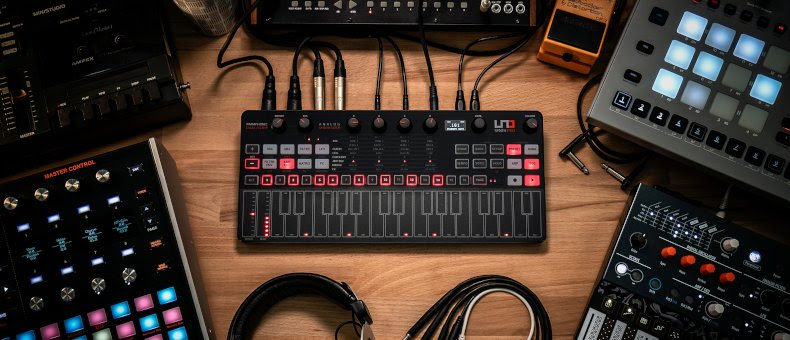
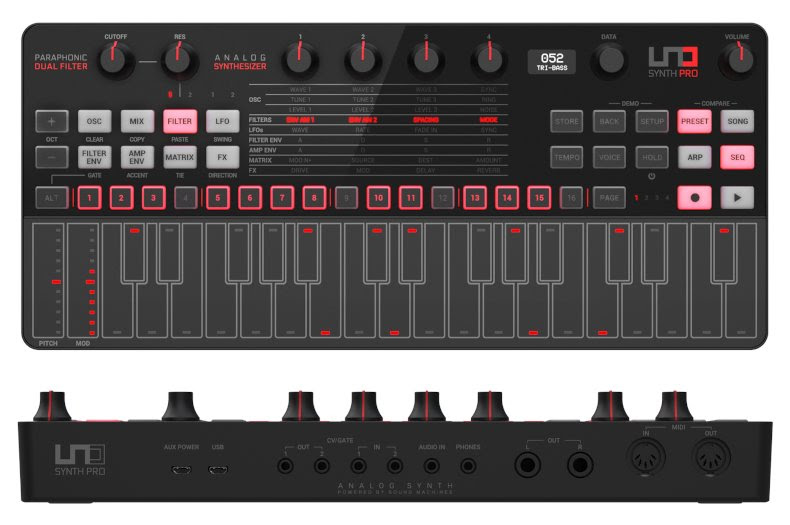
May 12, 2022 – IK Multimedia releases UNO Synth Pro Black Edition. IK’s award-winning true analog synthesizer now sports a bold new look. Featuring classic analog sound, incredible flexibility, an inspiring workflow and complete connectivity, this little black synth is perfect for every occasion.
Inside and out are all the sound-shaping features that users and reviewers loved in 2021, only back in black. No matter what genre or workflow, whether the rig is PC-based or outboard, whether on stage or in the studio, UNO Synth Pro Black Edition is guaranteed to make users look and sound their best.
Classic sounds
Incredibly adaptable
Fits in anywhere
The perfect foundation
Same thrill, but dressed to kill
Just like for the original, the UNO Synth Pro Editor makes it easy to create classic or new sounds or load any of the FREE artist’s preset packs at UNO Sounds.
With its compact size and sleek looks, UNO Synth Pro Black is destined to inspire new sounds and be part of any performance.
Pricing and availability
UNO Synth Pro Black Edition is available while supplies last from the IK Multimedia online store and from IK authorized dealers worldwide at a special price of $/€349.99* (reg. $/€399.99).
An optional USB power bank for UNO Synth Pro Black is available for $/€29.99.**
*All pricing excluding taxes
**Check availability for your territory
For more information about UNO Synth Pro Black or to see it in action, please visit:

 OLSZTYN, POLAND: forever focused on unveiling new possibilities in music for creative musicians, Polyend proudly presents Play as its latest product to definitively do that — thanks to its open sandbox approach to playing, performing, and sequencing quite possibly making for the most fun sample- and MIDI-based groovebox ever, enabling endless possibilities for fingertip-accessible beats by offering over 30 top sound designer-created sample kits to play with straight out of the box, creatively combined with eight audio tracks and eight polyphonic MIDI tracks for flexible sequencing and control over outboard devices to act as a compact centerpiece of any studio or stage setup, far from the restrictive realms of an average sample-based groovebox — as of May 12…
Play (partly) gives its groundbreaking game away by name alone. At first glance it looks superficially similar to Polyend’s previous product release — Tracker (https://polyend.com/tracker/) effectively extracted the best bits of yesteryear’s tricky tracker software classics and rebooted them with forward-looking functionality as the world’s first hardware tracker, deftly designed as an easy-to-use compact standalone workstation with immediacy and simplicity at its creative core — with which it shares the same (282 mm/11”: W x 207 mm/8”: D x 45 mm/1.8”: H) footprint and focus (unveiling new possibilities in music for creative musicians), yet Polyend positions Play as quite possibly being the most fun, flexible, and inspirational sample- and MIDI-based groovebox yet created, complete with over 3,000 samples and eight tracks of audio sequencing so users can create beats straight out of the box and make them their own with a wide variety of playback tools and effects.

Entering Play Mode makes it easy to pick a sample — simply use the Sample knob to browse through samples in the project’s sample pool, then double-tap that knob (for Folder) or use the dedicated screen buttons to toggle between Sample and Sample folder — and place it anywhere on the 16×8 step sequencing grid that dominates Play’s easy-to-follow faceplate to start building tracks. Thanks to Play’s positioning of familiar sample-based controls (such as Sample Start, Sample End, Sample Attack, and Sample Decay) well within reach, it is equally easy to independently adjust step parameters, as well as providing ownership of each track courtesy of that Play Mode (numbering no fewer than 35 custom choices), a Chance and Action combo (to set up some automated actions, with the former being an algorithmic or percentage-based probability of the latter), Randomize (to choose what and how much, whereby one knob can make a lot of changes at once), and Step Repeater (capable of making short stutters, pitch effects, volume fades, and more). If inspiration fails to strike straight away, a smart Fill tool is also at hand to automatically fill any area chosen with an entire beat, a random placement of steps, or even a Euclidean spread. Simple Select, Copy, and Paste controls make moving data — steps, tracks, track pages, variations — around a breeze. But why not keep it musical with scale filtering forcing Play to input and output only notes that fit the selected scale. Seriously impressive as all of that already is, it’s far from game over of course!
Play’s Perform mode makes non-destructive changes to tracks via performance effects including Filter Cutoff, Resonance, Microtune, Overdrive, and much more, while an array of — delay, limiter, reverb, saturator, and sound enhancer — Master FX are managed with a bunch of professionally presented presets to spice up entire mixes. It is perfectly possible to live record automation (using the onscreen Live Rec button) or change individual step values on the fly, as well as record monophonic or polyphonic MIDI data (using the Note knob, the View controller function, or an external controller). Customizable chaining of Patterns permit mapping out entire sequences anywhere on the grid for live performance, while it is possible to Save and Reset patterns — perfect for getting out of a tight spot, musically, if things end up going awry during a live performance.

It is already apparent that Play is far from the restrictive realms of an average sample-based groovebox, but its standout sequencing abilities are surely second to none with eight internal audio tracks and eight individual polyphonic MIDI tracks combining for powerful integration with external instruments. Indeed, there are 30,000 track variations available, thanks to 128 Patterns holding 16 tracks, with up to 16 variations in each individual track! Track Length ranges from one to 64 steps, while each track can also benefit from different BPM-related Tempo, and even Swing values, as well as various types of playback, so letting loose with pain-free polymeters and polyrhythms is also perfectly possible! Polyend’s Play also makes it easy to control external synths and drum machines on individual tracks with the ability to output a separate set of MIDI values per track — not forgetting flexible MIDI CC mapping per track for its individual rotary knobs, so users can connect an external controller for MIDI note input. It is possible to output chords, arpeggios, program and bank changes, pitch bend, clock, and much more.
Polyend’s Play is built around a sturdy anodized aluminum faceplate featuring a split-screen high-resolution display with 15 durable touch-capacitive knobs (that can be tapped once to select and preview a parameter or twice to switch between upper and lower screen values) alongside high-quality mechanical keys and silicone pads (powering that 16×8 sequencing grid and an associated 4×8 control grid with flexible — Mute, Solo, Variation, and Select — functionality). Meanwhile, MIDI Out and MIDI In are available via 3.5 mm mini-jacks — mini-jack to MIDI DIN (Type B) adapter included — on its slimline back panel alongside a 3.5 mm mini-jack stereo Out(put), plus a Micro SD slot — 16GB card with microSD to USB-A adapter included — with (5V/1A) Power provided over a USB-C connection that is easily powered by a portable power bank, computer, or included wall adapter.
Those 3,000 carefully curated samples shipping with Play should seriously satisfy anyone wishing to play, perform, and sequence with it. And although its internal engine works with uncompressed 16-bit mono PCM Wave files with different sample rates, Play can import WAV files in any sample rate — 16-, 24-, or 32-bit, mono or stereo — and automatically convert them to the supported format, which will then be turned into a monophonic mixdown of both the left and right stereo sample channels. It is worth noting here that the overall per-project sample pool memory is six minutes of monophonic 16-bit/44.1 kHz sample files, yet halving the sample rate will double the sample pool capacity since Play can clearly work with different sample rates with the greatest of ease.
Everything plays nicely together, then, to make Play possibly the most fun, flexible, and inspirational sample- and MIDI-based groovebox ever, enabling endless possibilities for fingertip-accessible beats as a compact centerpiece of any studio or stage setup. Far from the restrictive realms of an average sample-based groovebox, its open sandbox approach definitely does Polyend proud, pushing on with winning while focusing on unveiling new possibilities in music for creative musicians as another groundbreaking game-changer in the making.
Play is available to preorder through Polyend’s growing global network of authorized dealers (https://polyend.com/where-to-buy/) at an MSRP (Manufacturer’s Suggested Retail Price) of €799.00 EUR/$799.00 USD or directly via its dedicated webpage (which includes more in-depth information) here: http://polyend.com/play/
See and hear Play in action in its play-on-words-motivated ‘Made In Polyend’ preview video here:
About Polyend (www.polyend.com)
Polyend was founded by Piotr Raczyński, and bolstered by a team of dedicated professionals. Forever focused on unveiling new possibilities in music for creative musicians, it is located in the Land of a Thousand Lakes in northeastern Poland.
© 2022 Polyend

 SAN CLEMENTE, CA, USA: ‘Future Coast’ modular synth-maker Qu-Bit Electronix is proud to announce Aurora — a powerful spectral reverb that continues to push the envelope of what is possible in modern synthesis using a potent phase vocoder engine to split the time and frequency domains of incoming audio, allowing for complex spectral manipulations to create beautiful time-stretched tails ad infinitum or smear the frequency domain to conjure up alien timbres that will haunt an ever-expanding space, likely invoking a hunger for exploration like that which was felt when first encountering Eurorack — as of May 10…
Thanks to the extraordinarily powerful prowess of its time- and frequency domain-splitting phase vocoder engine, it is fair to say that Qu-Bit’s hotly-anticipated Aurora introduces new sonic territory to the modular synthesizer landscape — easier said than done in today’s ever-widening Eurorack marketplace. Aurora’s additional onboard sound-shaping tools include a dedicated pitch shifter (warp) — useful for building lush-sounding shimmer reverbs or harmonic textures to accompany a percussive input. Its internal engine includes input reflection (reflect) that morphs between multi-delay time zones; it is perfectly possible to create infinitely long reverbs using even the shortest of sound sources, lending itself to incredible dynamics.

An aurora is a natural electrical phenomenon characterized by the appearance of streamers of reddish or greenish light in the sky — especially near the northern or southern magnetic pole — and caused by the interaction of charged particles from the sun with atoms in the upper atmosphere. Aurora also has an atmosphere affecting its character; clearly more than just a filter, it allows Aurora to actually add harmonic content to the spectral field, fashioning a wide range of possible timbres — and all from a single knob!
Alongside Aurora’s front panel-positioned ‘knobular’ functionality is its immediately available ability to reverse and freeze the input signal, a creative combination that effectively enables Aurora to be a highly-playable reverb — one that encourages use outside of the conventional CV/Gate set-and-forget approach.
All such functions become all the more apparent when taking into account Aurora’s foundational feature — namely, its lovely LED (Light-Emitting Diode) UI (User Interface) artwork. As such, each function has a corresponding LED UI effect — from reverb direction to atmosphere position, plus more besides. Better still, Aurora’s seamless visual feedback helps users to focus on the patch without having to second-guess where Aurora is at.
All well and good, clearly, but configurability extends far beyond Aurora’s fanciful front panel. Put it this way: Aurora uses FFT (Fast Fourier Transformation) to determine its spectral resolution, and users are afforded an ability to cycle through four different settings — each changing Aurora’s sound completely into its own unique variation. Various user spectral resolutions range from smooth, blooming, lush timbres to comb filter-like territory, and even extraterrestrial languages yet to be comprehended!
Configurability can also be further found on Aurora’s (included) USB drive, duly representing an exciting addition to Qu-Bit’s hardware design that has hitherto not made another appearance since the Nebulae v2 granular sampler and DSP (Digital Signal Processing) platform. Ultimately, users can change a multitude of internal settings to tailor Aurora to their needs. Needless to say, Qu-Bit is intent on making more settings available. Accessibility and ease of use also lend the USB drive to facilitate firmware updates and alternative firmware already hinted at.
As such, Qu-Bit’s latest Eurorack entry undoubtedly upholds its meritorious mantra: to push what is possible in the hardware synthesizer realm. Reality has already seen to it that this philosophy shines through for all to see and hear in the ‘Future Coast’ modular synth maker’s modules such as the aforesaid Nebulae v2 and the Scanned organic wavetable VCO (Voltage-Controlled Oscillator) based on scanned synthesis, the latter of which had not existed outside of software until Qu-Bit’s innovative implementation was released.
“We wanted to design an audio processor that merged the worlds of spectral processing and traditional reverb algorithms,” asserts Andrew Ikenberry, founder and CEO of Qu-Bit Electronix, ending on a high note: “Our dream was to be able to incorporate techniques such as time-stretching, spectral warping, and frequency blurring into a reverb-centric workflow; the result wound up being a new type of audio effect altogether — one which continues to surprise and excite us with each use.”
Ultimately, Aurora has come a long way from its initial announcement at The 2020 NAMM Show — and all for the better. By implementing it with a new look, a powerful sound, and an almost infinite list of possibilities, Qu-Bit has designed and delivered a welcome addition for anyone looking to break the mold and push their sound to the next level — and perhaps even beyond that. After all, it readily pushes the (Eurorack) envelope of what is possible in modern synthesis as a powerful spectral reverb.
Officially released on May 24, 2022, Aurora is available to preorder from Qu-Bit Electronix’s growing global network of distributors (https://www.qubitelectronix.com/distributors) with an MSRP (Manufacturer’s Suggested Retail Price) of $359.00 USD or directly via its dedicated webpage (which includes more in-depth information) here: https://www.qubitelectronix.com/shop/aurora
Watch Qu-Bit Electronix’s ear-opening Aurora demo video here:
About Qu-Bit Electronix (www.qubitelectronix.com)
Qu-Bit Electronix makes modular synths for sonic explorers. Established by Andrew Ikenberry, the company was formed out of a desire to bridge the worlds of computer music and analog modular synths. Subsequently referred to as purveyors of ‘Future Coast’ synthesis, it is always aiming to find new sounds and techniques that have yet to be fully explored. Fast forward 10 years, the company continues to thrive as a frontrunner in the exploratory modular world. While currently based in southern California, Qu-Bit prides itself on its in-house manufacturing; from automated electronics assembly to testing and calibration, the company continues to uphold the standards and specifications that would be expected of a bespoke modular brand.
© 2022 Qu-Bit Electronix

 LOS ANGELES, CA, USA: Modbap Modular by BeatPPL, a black-owned developer of Eurorack modular synthesizers and instruments made in America, is proud to announce Transit — thoughtfully packaged as an uncomplicated, compact (6HP), dual-channel stereo audio mixer module for Eurorack with an all-analog signal path providing performable control over routing and mixing within smaller or larger modular system setups alike, and all without forsaking flexible features with which few small-format mixers can comfortably compete — as of May 10…
Transit takes two stereo — dual-mono — lanes of audio with an all-analog signal path and embellishes each of them with its own input gain control (CH1 GAIN and CH2 GAIN), mute button (CH1 MUTE and CH2 MUTE), and ducking input (CH1 DUCK and CH2 DUCK), the latter operating like traditional side-chaining on a compressor, whereby an input signal, CV (Control Voltage), or trigger input — i.e. LFO (Low-Frequency Oscillator), Clock, Gate — modulates the gain reduction of the audio. Applying this well-known production technique to the ever-widening world of Eurorack should appeal to audio professionals, beat-makers, and musicians to whom it is already familiar from a wide variety of music genres where an effect is activated by an audio track.
Transit also boasts a 3.5mm headphone (PHONES) jack with its own independent volume (PHONES GAIN) control knob, while its all-analog signal path’s final destination is a left and right stereo output (LEFT OUT and RIGHT OUT) with an associated MASTER volume knob.
Needless to say, Transit is as easy on the eye as it is in use, with digitally-controlled LEDs (Light-Emitting Diodes) for each stereo channel lane indicating level via white, blue, and pink illumination, while engaging the CH1 MUTE and/or CH2 MUTE buttons illuminate those LEDs in red. Meanwhile, MASTER and PHONES levels also have their own LEDs for level indication using the same illumination color scheme.
It is fair to say, then, that Transit is a rather full-featured compact (6HP) dual stereo channel lane Eurorack-formatted mixer that offers easy signal mixing, gain staging, ducking, and performance-oriented mutes. It is just as at home in a small Eurorack system as one Transit or more would be in a larger system.

Says Modbap Modular by BeatPPL designer and founder Corry Banks: “The idea for Transit came about because our Per4mer quad performance FX unit sat perfectly in one of our Modbap20 powered Eurorack pods. Indeed, in this configuration, it comfortably resided on the desktop amongst all my tabletop synths, drum machines, and samplers, but I found that I wanted a bit more control over the signal into Per4mer — plus, perhaps, a headphone jack — and I definitely wanted a master volume level control for live sets. So it made perfect sense to subsequently design a module that could fill the empty 6HP next to the Per4mer in the 20HP Modbap20. Together, Transit and Per4mer make for a perfect pairing while complementing the tabletop synth and beat-maker desktop.”
Well worth mentioning is the fact that Transit also pairs well with Modbap Modular by BeatPPL’s sensational-sounding BI-FIDELITY™ WAVETABLE OSC (oscillator) module, Osiris — or, indeed, any other Eurorack entry that could conceivably benefit from a compact analog dual-channel stereo ducking mixer, sub-mixer, or final output mixer. Making some space for one Transit or more is clearly making a wise decision to enhance Eurorack systems — bigger or smaller — with some seriously flexible features with which few small-format mixers can comfortably compete.
Expected to ship in mid-June 2022, Transit is available to preorder at an MSRP (Manufacturer’s Suggested Retail Price) of $249.00 USD via San Clemente, CA, USA-based distributor Electro Distro’s growing global network of dealers (https://www.electro-distro.com/dealers) or directly via its dedicated webpage (which includes more in-depth information) here: https://www.modbap.com/products/transit
See and hear Modbap Modular by BeatPPL designer and founder Corry Banks introducing Transit here:
About Modbap Modular (www.modbap.com)
Modbap Modular is a black-owned line of Eurorack modular synthesizers and instruments made in America by BeatPPL, a boutique sound design and music label established in 2014 as a beat-maker’s lifestyle and e-commerce brand by Bboytech. Founded in 2020 by Corry Banks, it was born out of the Modbap movement with a simple mission: to develop tools for beat-driven modular hip-hop artists. As such, its goal is to develop Eurorack modules from the beat-maker’s perspective, while also adding value for music-makers of all genres.
© 2022 Modbap Modular by BeatPPL

A new professional mobile interface featuring 4 mic/instrument preamps for musicians and content creators to always be ready in the field
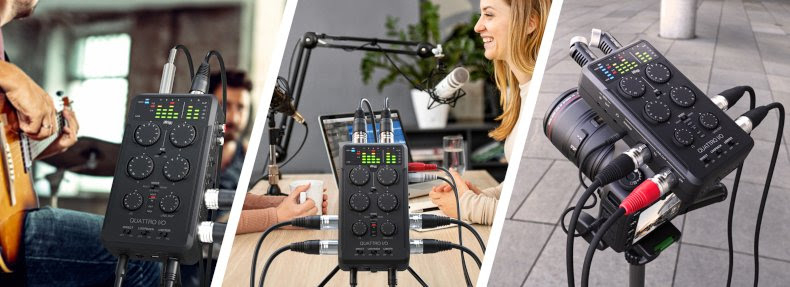
May 5, 2022 – IK Multimedia releases iRig Pro Quattro I/O, a professional-quality 4-in / 2-out field recording audio and MIDI interface. With up to 24-bit, 96kHz conversion and a MEMS mic onboard for instant recording, iRig Pro Quattro I/O is ready to deliver broadcast-quality results anywhere and anytime. A deluxe bundle is also available with custom iRig XY stereo mic capsules and complete accessories.
The iRig Pro Quattro I/O offers 4 high-quality, low-noise mic preamps with phantom power; Hi-Z and line-level instrument, RCA and TRS inputs; plus XLR balanced, 3.5 mm stereo and headphone outputs; and full MIDI I/O. It works with everything out of the box, including iPhone, iPad, Android, Mac, and PC, but can also serve as a standalone mic preamp or line mixer, with a built-in limiter and direct monitoring.
Ready for Any Scenario
iRig Pro Quattro I/O connects to a computer or mobile device and works as a high-quality, multi-channel audio and MIDI interface with a full array of inputs and outputs so users will always be prepared for any recording or situation. Fully MFi-certified to work seamlessly with iOS devices, no adapters are required for iPhone or iPad for reliable field performance.
No need to worry about managing and formatting storage media. iRig Pro Quattro I/O records pristine, digital audio directly to any mobile device, computer, or even DSLR camera. No more digging around gig bags for an SD card. Start recording instantly then simply back up audio files to the cloud seamlessly to share with others.
Field Recording Interface or Standalone Mixer
With its onboard digitally enhanced MEMS microphone and optional stereo mic capsules, iRig Pro Quattro I/O turns any mobile device or Mac/PC laptop into a full-featured, professional field recorder. It also works as a standalone preamp and mixer powered via 4x AA batteries, USB, or DC IN. The full set of inputs/outputs can be used to capture and mix multiple sources to DSLR cameras or send their mix to a PA system with professional quality.
| Broadcast / Podcast Interface In Stereo mode, iRig Pro Quattro I/O mixes all sources down to stereo for streaming or recording. Monitoring is easy thanks 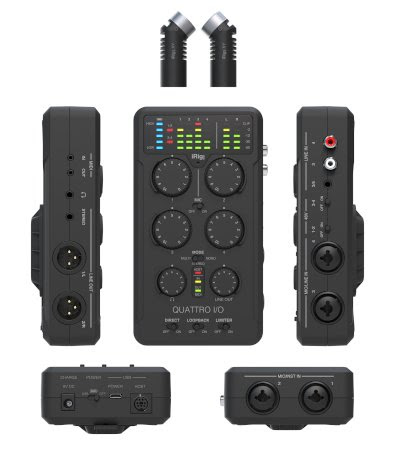 to a dedicated headphone output with independent volume control and direct monitoring. Mono mode extends compatibility for streaming to social media. A Loopback feature lets users easily duet with favorite videos, plus iRig Pro Quattro I/O can also keep the device under charge for long streaming sessions, using its power supply unit.Stereo and Mono modes pre-mix up to 4 audio sources (RCA / 3.5 mm stereo line inputs (+ Loopback), XLR combo inputs and MEMS microphone) down to a stereo or mono track, which can be sent to streaming apps, DSLR cameras, or sound systems. In Multichannel mode, the XLR mic/Hi-Z instrument and mic/line combo jacks or RCA / 3.5 mm stereo line inputs are routed to channels 1 to 4 respectively, giving users 4 channels of audio to send to recording apps such as GarageBand or any DAW. to a dedicated headphone output with independent volume control and direct monitoring. Mono mode extends compatibility for streaming to social media. A Loopback feature lets users easily duet with favorite videos, plus iRig Pro Quattro I/O can also keep the device under charge for long streaming sessions, using its power supply unit.Stereo and Mono modes pre-mix up to 4 audio sources (RCA / 3.5 mm stereo line inputs (+ Loopback), XLR combo inputs and MEMS microphone) down to a stereo or mono track, which can be sent to streaming apps, DSLR cameras, or sound systems. In Multichannel mode, the XLR mic/Hi-Z instrument and mic/line combo jacks or RCA / 3.5 mm stereo line inputs are routed to channels 1 to 4 respectively, giving users 4 channels of audio to send to recording apps such as GarageBand or any DAW. |
Always Perfect Recordings
A built-in limiter keeps sound levels optimal and avoids clipping on inputs 1 and 2. In Stereo and Mono mode, inputs 3 and 4 can be used as safety channels: recording the same signal as inputs 1 and 2, but reduced by 12 dB as a backup in case the sound source unexpectedly overloads the main channels.
Streaming with Effects
iRig Pro Quattro I/O also comes with Loopback+, a powerful feature that lets users select either or both channels 3 and 4 to route microphones or line-level signals to audio apps such as MixBox, AmpliTube, or VocaLive for processing and then route their outputs through the Loopback feature and into channels 1 and 2 going to their streaming app. Now any app on iOS or Android devices can work as a front-end processor for all streaming apps. It’s like using them as a plug-in for more creative and professional-sounding streams.
Software and Apps In-the-box
iRig Pro Quattro I/O comes complete with over $/€450 of software for Mac/PC. Users get AmpliTube 5 SE with over 80 essential gear models for guitar and bass, and T-RackS 5 SE with 10 analog-modeled and digital processors. Plus, there’s the choice of 2 additional SE/CE titles. Choose from SampleTank, Miroslav Philharmonik, MODO BASS, MODO DRUM, or Syntronik 2.
And for iPhone/iPad, iRig Pro Quattro I/O includes over $/€100 of audio production apps including fully-loaded versions of iRig Recorder 3 and MixBox for iPad, must-have effects and mixing app for pro-sounding audio on the go.
Pricing and Availability
iRig Pro Quattro I/O is shipping now and available from the IK Multimedia online store and from IK authorized dealers worldwide. iRig Pro Quattro I/O Deluxe is available for preorder with units expected at the end of June.
iRig Pro Quattro I/O $/€ 349.99* – Includes USB and Lighting cables, batteries, ¼” thread camera adapter.
iRig Pro Quattro I/O Deluxe $/€ 449.99* – Adds 2 x iRig MIC XY stereo microphones, iRig MIC XY windscreen, carrying case, 9V power supply unit.
*All pricing excluding taxes.
For more information about iRig Pro Quattro I/O or to see it in action, please visit:

 LONDON, UK: Spitfire Audio is proud to announce availability of ORIGINALS INTIMATE GRAND PIANO — pitched around a vintage Steinway Model A recorded in the intimate acoustics of Scotland’s celebrated Castlesound Studios outside of Edinburgh with a range of bespoke microphones, including a notable Neumann KU 100 dummy head, capturing the rich timbre, delicate nuance, and wide dynamic range of the instrument in pristine detail for breathtaking realism as an up-close-and-personal addition to the sound-specialising British music technology company’s ORIGINALS series of instant writing tools with an adaptable approach almost providing two pianos in one, offering a fresh alternative to today’s TV- and film score-dominating felt piano in an award-winning AAX-, AU-, VST2-, and VST3-compatible, NKS (NATIVE KONTROL STANDARD®)-ready plug-in powering a sample library that is inspiring straight out of the box by loading into all major DAWs (Digital Audio Workstations) without the need for any additional software — as of May 3…

Inaugurated in 2019 as an affordable series of inspiring sample libraries making rare and classic instruments accessible to all — and all meticulously sampled in authentic detail without compromising on recording quality, ORIGINALS INTIMATE GRAND PIANO is, impressively, this series’ 16th release, representing the sixth piano to receive Spitfire Audio’s acclaimed ORIGINALS approach — albeit one which will make musical waves while welcoming a change of tact. “When I say: intimate piano score, do you think felt piano? Or, more specifically, felt upright piano? At least I do. That’s what’s dominated TV and film scores over the last few years. And I wonder why that is. At least, for me, I think there’s a familiarity to having an upright piano in the home; it’s what some people have been fortunate enough to grow up learning how to play. Pressing the celeste or practice pedal lowers a layer of felt between the strings; because it’s a deadened sound, and an ultra-fundamental frequency, it becomes even more intimate, even more vulnerable — even more dramatic, perhaps. And that’s why I think felt pianos have dominated film and TV scores over the last few years. I think we’ve all grown accustomed to it — I certainly hear it on most dramatic TV scores, so I think it’s time we put it back in our toolkit and consider a new approach.” So says Spitfire Audio in-house composer Dan Keen as a composer, musician, and producer posing pertinent questions and much musical food for thought prior to providing an answer: “ORIGINALS INTIMATE GRAND PIANO is our answer to that question of what might replace the felt piano.”

Providing a more in-depth introduction — and background — to the ORIGINALS INTIMATE GRAND PIANO production, Dan Keen continues thus: “It was recorded in Castlesound Studios — same recording venue that we used for ALBION SOLSTICE, so if you like that sound you’re going to love this, and it was recorded intimately, as the name would suggest, taking off that top dynamic layer and giving us something that is ultimately very playable, very gentle, and kind of soft and pensive. Grand pianos are traditionally concert instruments, intended for larger audiences in larger rooms. Their soundboards are mounted horizontally, so — unlike the upright — you’re relatively far away from the sound projection. Traditionally, the lid is used almost like a funnel to collect and then fire the sound out to the audience. So we’ve removed the lid.”

Carefully capturing the lidless vintage Steinway Model A in question involved returning to the intimate acoustics of Scotland’s celebrated Castlesound Studios, a state-of-the-art digital and analog recording, mixing, and mastering facility famed for its huge, day-lit recording areas and control room, with a reputation built from working with leading artists in all fields of music, as well as many film, TV, radio, and advertising clients — plus, of course, a certain sound-specializing British music technology company! Careful curation by Spitfire Audio co-founder Christian Henson has helped shape the three bespoke signals that are available to all now — namely, Ribbon and Condsr (Condenser), capturing the close detail and mechanical artifacts of the instrument itself, and Binaural, captured using a notable Neumann KU 100 dummy head microphone to provide its ambient, reverberant quality as a true-to-life image of the piano in the room, resulting in almost two pianos in one.

Digging deeper, Dan Keen is initially drawn to highlighting the former: “It’s got a very soft and warm sound; this is a vintage pair of [Coles] 4038 [Studio Ribbon] microphones. Then the condensers pay a little bit more attention to those mechanical hits — the hammers and the pedal noises. And then, finally, we’ve got our beautiful Binaural, which is the most ambient perspective of these signals. This was recorded from the perspective of the player; as I’ve mentioned already, grand pianos tend to project the sound outwards and away from the player, so — especially if you listen to this with headphones on — you’re really going to hear that perspective of just sitting, playing a quiet grand piano. It’s still a very dry acoustic environment, but this Binaural signal really takes to reverb very well.”

It is just as well, then, that ORIGINALS INTIMATE GRAND PIANO provides a REVERB control — accessing a realistic hall-style impulse response, bespoke to this piano. Thereafter, three further controls include TIGHTNESS — cuts further into the note to make it tighter and offer a more responsive feel; HAMMERS — controls the volume of the piano’s hammers, and PEDAL — controls the volume of the sustain pedal noise. Needless to say, all four levels can be freely adjusted to suit — as, indeed, can the three bespoke signals themselves. “By bringing up the condensers and the ribbons, they offer a really lovely, warm combination when combined; with REVERB, it sounds nice, but it definitely sounds like a closely recorded piano, plus reverb,” reflects Dan Keen, adding: “As soon as we bring Binaural in — and I tend to turn this up a little bit louder than the other signals, it just puts it in that space.”
Anyone already familiar with any other ORIGINALS… sample library will readily recognize the ‘expression’ slider (which is the general volume of the instrument) and its neighboring ‘dynamics’ slider (which, when turned up, allows access to the loudest sampled recordings without the user having to increase the velocity of their playing). As always, the award-winning AAX-, AU-, VST2-, and VST3-compatible, NKS-ready plug-in powering ORIGINALS INTIMATE GRAND PIANO is as easy on the eye as it is easy to use.

Ultimately, there are seven presets provided: Direct — close condensers with reduced mechanical sounds of hammers and pedal; Intimate — dry and characterful mix of the two close microphones with increased mechanical sounds of hammers and pedal; Soft Drama — a combination of all three signals to provide a dramatic and characterful sound; Subdued — upper dynamic layer removed to decrease piano brightness, useful for gentle and pensive moods; Reverberant Ribbons — ribbons, KU 100, and a generous helping of REVERB for a colorful, cinematic sound; Ambient — Binaural signal with REVERB turned up; and Dynamic — variance of the three dynamic layers emphasized to allow for greater control over piano expression and nuance… surely something for anyone — as anyone seeking a fresh alternative to today’s TV- and film score-dominating felt piano will likely testify.
That said, ORIGINALS INTIMATE GRAND PIANO is so versatile that it will suit a range of styles, whether for solo composition, accompaniment or as part of a larger ensemble. As Dan Keen concludes: “We’ve recorded this as three dynamic layers and three round-robins, so there’s quite a lot of detail there, but I also think of this as two pianos in one, really, because you’ve got your ribbon and condenser signals that act as the close microphones, and can capture that dry acoustic with the detailed mechanical artifacts, but then you’ve also got that slightly more ambient, binaural perspective, which takes to reverb really well.”
ORIGINALS INTIMATE GRAND PIANO is available as an AAX-, AU-, VST2-, and VST3-compatible plug-in supporting Native Instruments’ NKS (NATIVE KONTROL STANDARD®) for Mac (OS X 10.13 – macOS 12) and Windows (7, 8, 10, and II — latest Service Pack) that loads directly into any compatible DAW (Digital Audio Workstation) for an RRP (Recommended Retail Price) of only £29.00 GBP (inc. VAT)/$29.00 USD/€29.00 EUR (inc. VAT) — from here: https://www.spitfireaudio.com/originals/#intimate-grand-piano
Spitfire Audio’s namesake Spitfire Audio application allows anyone to buy now and download anytime and is available for free from here: http://www.spitfireaudio.com/info/library-manager/
For more in-depth information, please visit Spitfire Audio’s ORIGINALS Frequently Asked Questions webpage here: https://www.spitfireaudio.com/info/faq/spitfire-originals/
Watch Spitfire Audio’s premiere of ORIGINALS INTIMATE GRAND PIANO — with welcomed walkthrough by Spitfire Audio in-house composer Dan Keen — here:
About Spitfire Audio (www.spitfireaudio.com)
Spitfire Audio is a British music technology company that specializes in sounds—sample libraries, virtual instruments, and other useful software devices. It collaborates with the best composers, artists, and engineers in the world to build musical tools that sound great and are exciting to use.
© 2022 Spitfire Audio Holdings Limited

 ECHT, THE NETHERLANDS: Rob Papen Inspiration Soundware is proud to announce the availability of RP-Distort 2 — pushing distortion to a whole new level of creativity courtesy of new and expanded features fronted by a whole new look to take the place of the virtual instrument and effect plug-in developer’s popular RP-Distort offering after impressive innings of over a decade — as of April 28…
As an aptly-named virtual effect mainstay of the Rob Papen plug-in stable for over a decade, RP-Distort duly took distortion to a new level when let loose upon an appreciative music technology world; well worth the wait as a worthy successor is RP-Distort 2, with which Rob Papen pushes distortion to a whole new level of creativity courtesy of new and expanded features fronted by a whole new look.
Looking closely at RP-Distort 2, it becomes apparent that it shares some similarities with one of Rob Papen’s more recently released plug-ins — namely, the stereo delay that is DelSane (https://www.robpapen.com/DelSane.html), to which it owes its innovative DISRUPT ‘sphere’. Says Rob Papen himself: “This allows you to control several different modulation parameters at once, and it gets even more exciting if you use the newly-added AUDIO FOLLOWER to take control of the DISRUPT ‘sphere’!”

Saying that the DISTORTION module remains at RP-Distort 2’s heart, however, but now boasts no fewer than 52 Distortion types, including Lo-Fi; 2 Band Distortion; Amp/Cab models, and much more. Moreover, it has been expanded with a four-band PRE-DISTORT EQ and a four-band POST-DISTORT EQ with variable frequency and bandwidth control, both of which can be operated graphically or, alternatively, with knobs (by activating the original RP DISTORT 1 EQ setting), and is rounded out with a noise GATE. Another addition well worth noting here are the double WAVE SHAPER editors — having first selected Dual Wave-Shaper as a WaveShaper distortion type — to create custom distortions.
An analogue-modelled ‘Filter’ module — expanded to include ZDF (zero-latency) options for its HI-PASS FILTER and LOWPASS FILTER — sits alongside a COMPRESSOR module, now with a dB (logarithmic) mode and a LIN (linear) mode, while the original WIDEN module has also been expanded to include a CHORUS mode. It is now possible to rearrange the order of these modules in the PATH section; once selected, the audio signal path order is instantly visualized in the new user interface.
Meanwhile, modulating various parameters has been taken to a new level with the MOD MATRIX & LFO section, allowing users to choose from a regular (MOD MATRIX) or ADVANCED MODE modulation matrix, complete with four LFOs (Low Frequency Oscillators) — LFO 1 through to 4 — that can be tempo-based and triggered in various ways.
What’s more, RP-Distort 2’s easy-to-use MANAGER makes light work of organizing presets and BANK FOLDERS. Fortunately for those taking a trip into its wonderfully-creative world of ear-opening distortion, RP-Distort 2 comes packed with perfectly pitched presets — “…fantastic for any style of music, and for those that aren’t afraid to experiment!” So says self-confessed synth freak and world-renowned sound designer Rob Papen as someone who should surely know what he is talking about.
RP-Distort 2 is available as a 64-bit AAX-, AU-, VST- and VST3-compatible effect plug-in for Mac (OS X 10.13 – macOS 12) and as a 32- and 64-bit VST- and VST3-compatible effect plug-in for PC (Windows 7/8/10/11) — with 64-bit AAX compatibility available for PT 12 or higher (PC) — priced at €49.00 EUR/$49.00 USD from authorized Rob Papen resellers worldwide or as a download directly from Rob Papen itself for the same pricing from here: https://www.robpapen.com/rp-distort-2.html
Anyone who purchased the original RP-Distort directly from Rob Papen will have received a free upgrade to RP-Distort 2 via e-mail while anyone who purchased the original RP-Distort from an authorized Rob Papen reseller in either February, March, or April 2022 should simply e-mail their receipt to info@robpapen.com to claim their free upgrade to RP-Distort 2; purchases prior to those months qualify for the regular upgrade price of €19.00 EUR/$19.00 USD.
RP-Distort 2 is included in the latest version of eXplorer-7 (https://www.robpapen.com/eXplorer-7.html), an inspirational bundle of 28 Rob Papen products.
A 30-day demo version of RP-Distort 2 with disabled preset loading/saving functionality is available from here: https://www.robpapen.com/rp-distort-2-demo.html
For more in-depth information, including some superb-sounding audio demos, please visit the dedicated RP-Distort 2 webpage here:
https://www.robpapen.com/rp-distort-2.html
Watch a revealing RP-Distort 2 introductory video — featuring a voice-over from Rob Papen himself — here:
About Rob Papen (www.robpapen.com)
Self-confessed synth freak and world-renowned sound designer Rob Papen started working with synthesizers at the tender age of 15 when purchasing an analogue Korg MS-20 semi-modular monosynth and accompanying analogue SQ-10 sequencer. Suitably inspired, he subsequently released several albums as part of Dutch electronic music groups Peru and Nova — the latter featuring the same members as Peru, but with a more commercial slant — with whom he enjoyed number one hit singles in The Netherlands (Nova) in 1982 and Austria (Peru) in 1988. Peru disbanded in 1993, by which time Rob had already established himself as a sought-after sound designer, creating presets for the likes of Waldorf, Access, Ensoniq, and E-mu, before going on to found his namesake company in pursuit of creating a sound designer’s dream synth. That software dream soon became reality when Rob formed the RPCX (Rob Papen ConcreteFX) partnership with music software developer Jon Ayres to develop new Rob Papen virtual instruments and effects plug-ins, starting with BLUE — an exciting-sounding, self-styled ‘Crossfusion Synthesis’ affair (combining FM, Phase Distortion, Wave Shaping, and Subtractive synthesis into one powerful dream synth) — in 2005. Today Rob Papen soundware defines cutting-edge contemporary music production: powerful virtual instruments and effect plug-ins that intermix innovative design, uncompromising sound quality, and musical, production-grade presets to make tracks truly shine, whatever the musical genre… Inspiration Soundware, indeed!
© 2022 Rob Papen Inspiration Software

 BATON ROUGE, LOUISIANA, USA: United Studio Technologies is proud to unleash UT Twin87 to capably capture the essence of both the original classic and modern incarnations of the ‘87-style’ microphone design — duly creating a must-have microphone that duplicates both circuits, capable of being reconfigured on the fly for the first time ever, affording anyone an exceptional reproduction of the sonic qualities of both microphones by literally toggling between two discrete ‘87-style’ circuit topologies separated by nearly half a century to effectively end the vintage-verses-modern debate in an instant — as of April 28…

Unsurprisingly, United Studio Technologies took time bringing UT Twin87 to market — mere ‘EQ/boost’ circuitry or digital gimmickry would not cut it. Instead, component values, types, and circuit differences between ‘golden reference’ specimens of the very earliest available microphones of this style and some of the latest revisions produced were meticulously measured; variations were subsequently studied, documented, and audible differences teased out.
As a result, UT Twin87 features United Studio Technologies’ UT-K87 capsule, a custom-made K87-style, dual-diaphragm/dual-backplate affair that is precision milled from brass, skinned with 6 μm (micron) Japanese Mylar — a polyester film made from stretched PET (polyethylene terephthalate) — in a laboratory-clean room environment, and has a 24k gold-sputtered membrane. Capably capturing the essence of both the original classic and modern incarnations of the ‘87-style’ microphone design comes courtesy of the twin circuit topology involved. In VINTAGE mode, UT Twin87 polarizes its capsule directly by normal (+ 48V, optimal) phantom power voltages, taking advantage of an insulated dual-backplate design — as was the case with the earliest ‘87-style’ microphones. Meanwhile, the Hi-Z (high impedance) and de-emphasis circuitry use all of the same component choices as the original, yielding a slightly warmer, softer, and forgiving sound. Switching UT Twin87 into MODERN mode polarizes its capsule at a higher voltage using a FET (Field-Effect Transistor) oscillator circuit — as found on later revisions of the classic mic, making for higher sensitivity that feeds a hotter signal into the amplifier circuitry. And, again, the Hi-Z and de-emphasis circuitry use all the same component choices as much later ‘87-style’ designs, delivering a louder, slightly brighter, and more articulate response, with an extended top-end reach and more ‘up-front’ character.
Custom capsule capabilities notwithstanding, many iterations of the original German output transformer used in this type of microphone were also assessed with some of the older, larger frame designs proving particularly inspirational in doing so. Since the size of a transformer can sometimes be a limiting factor, United Studio Technologies then developed its own custom-wound transformer built with large, all-nickel laminations resulting in almost four times the metal mass found in any existing ‘87-style’ microphone. Moreover, this part positively ensures that there are no bottlenecks or weak links in the design, so nothing is lost in translation as the signal is passed out of the microphone and down long cable runs.
Most modern ‘87-style’ microphones incorporate an output filter designed to block RF (Radio Frequency) and FM (Frequency Modulation) interference, influencing much debate over the years as to whether this filter enhances or harms the sonics of the microphone concerned. Clearly, United Studio Technologies has effectively ended this debate, since its HPF (High-Pass Filter) can be engaged/disengaged at any time, whether working in VINTAGE or MODERN mode.

It is well worth noting that another boutique modification — the so-called ‘true-cardioid mod’ — is quietly engaged when switching UT Twin87’s polar pattern to cardioid, whereby it will disengage the pattern select circuitry altogether and decouple from the rear diaphragm of the capsule to provide a cardioid function that is slightly hotter, purer, and boasts a better signal-to-noise ratio, rather than operating in an active (switched) cardioid mode as per the standard design.
An assortment of selected premium components — such as polystyrene, tantalum, multilayer ceramic, WIMA film capacitors, metal, and carbon fit resistors, and hand-selected transistors — collectively play a significant part in making UT Twin87’s stellar specification what it is, with some notable numbers on offer: 20 Hz – 20 kHz (frequency response); 117dB — no pad, 127dB — with pad (SPL @ 5% THD); 27 Ω (output impedance); <10dB — cardioid setting, no pad, no HPF (SPL); 80 Hz — 12dB down point (High-Pass Filter); and -10dB (pad).
Put it this way: with its extra features and high-end components, UT Twin87 is indisputably an exceptional microphone to behold. But its real strength is its accuracy in providing the same sound that engineers have grown to love in every variation of the ‘87-style’ circuit, capably capturing the essence of both the original classic and modern incarnations as a must-have microphone capable of being reconfigured on the fly for the first time ever.
The time that United Studio Technologies spent bringing UT Twin87 to market is clearly time that has been well spent, as the raft of recordings that will surely be made with this exceptional microphone will truly testify for many years to come.
Distributed worldwide by RAD Distribution (http://www.raddist.com/), UT Twin87 is expected to ship before the end of May 2022 with a MAP (Minimum Advertised Price) of $699.00 USD and an SSP (Suggested Selling Price) of €699.00 EUR (including VAT).
For further information, please visit the dedicated UT Twin87 webpage here: https://unitedstudiotech.com/en/products/ut-twin87
About United Studio Technologies (www.unitedstudiotech.com)
Incorporated in 2018, with over 50 years of combined audio industry experience, Baton Rouge-based United Studio Technologies’ mission is to create the best products money can buy — at a price that recording engineers can actually afford.
© 2022 United Studio Technologies L.L.C.

 SHATTERFORD, UK: having spiritedly (and successfully) reimagined what an analogue super-synth could contemporarily become with the 2019-premiered, premium 12-VCO (Voltage-Controlled Oscillator) original Colossus taking its inspirational design cues from the colossal classic personified by the rarefied Seventies-vintage Synthi 100, bravely built by British trailblazing entity EMS (Electronic Music Studios) as one of the largest (and most expensive) examples ever birthed by anyone anywhere, British boutique electronic instruments innovator Analogue Solutions is proud to announce that it is accepting orders for Colossus AS200 Slim — shedding some pounds as a ‘space-saving’ version of its now-named Colossus AS100 Classic predecessor, pitched as being a perfect fit for those with a little less studio space to spare or more restricted access for installation, yet compromising very little to achieve a 53% reduction in its footprint depth to a comparatively slimline 330 mm measurement as well as an associated 33 lb (15 kg) weight loss (and comparative £3,000.00 GBP price tag drop) in doing so, but beautifully designed, nonetheless, to elegantly stack on top of a Colossus AS100 Classic to form a dreamlike ‘double-height’ Colossus Double system, the likes of which has to be seen (and heard) to be believed — as of April 26…

As a ‘space-saving’ version of its Colossus AS100 Classic super-synth sibling, the comparatively slimline Colossus AS200 Slim’s so-called ‘VCO Panel’ is identical, including no fewer than 12 VCOs (OSCILLATOR 1 through to OSCILLATOR 12), each boasting high-quality multi-turn vernier dials acting as a very high FREQ (pitch) range control that also allow them to be pressed into service as additional LFOs (Low-Frequency Oscillators), a four (sawtooth, reverse sawtooth, square, and triangle) WAVEFORM count, PULSE SHAPE (allowing the pulse width of the square wave to be manually changed), and (output) LEVEL controls; associated VOLTAGE CONTROLLED OSCILLATORS jack points include pitch CV (control voltage), SYNC in, and audio OUT for each VCO, while odd-numbered VCOs have SUB (sub-oscillator) outputs and even-numbered VCOs have PW (pulse width) CV inputs. In addition, NOISE GENERATOR 1 and NOISE GENERATOR 2 each have a pink and white noise-mixing COLOUR control and an associated output LEVEL control, complimented by a RANDOM VOLTAGE GENERATOR with RATE and LEVEL controls alongside a SAMPLE AND HOLD generator with SOURCE and LEVEL controls for further flexibility.
Design differences — albeit, admittedly, of a purely visual functional nature — between the two super-synth siblings’ so-called ‘VCO Panel’ are apparent as Colossus AS200 Slim ships with a two-channel LCD (Liquid Crystal Display) oscilloscope as standard, so it is clearly capable of displaying two waveforms at once, although a CRT (Cathode Ray Tube) oscilloscope is available as an option (for an additional £500.00 GBP, excluding VAT). Thereafter, this panel’s two triangle and square wave-featuring LFOs (LFO 1 and LFO 2), four discrete VCAs (VCA 1 through to VCA 4) — used to change the level of audio and CV signals, and four A(D)SR envelope shapers (ENVELOPE 1 through to ENVELOPE 4) are implemented identically.
Implementation of Analogue Solutions’ next-to-no-compromise Colossus AS200 Slim design involved no changes being made to its well-stocked so-called ‘VCF Panel’ central to its colossal sound — where FILTER 1 through to FILTER 4 are a 12dB multimode VCF (Voltage-Controlled Filter) design while FILTER 5 through to FILTER 8 are a 24dB low-pass design, all sitting comfortably with four ADSR envelope generators (ENVELOPE GENERATOR 1 through to ENVELOPE GENERATOR 4) each with three trigger modes, as well as two spring reverbs (REVERBERATION 1 and REVERBERATION 2) with three real mechanical springs each, two RING MODULATORS, and two SLEW LIMITERS — and so-called ‘Sequencer Panel’ — itself featuring four backlit moving-coil SIGNAL METERS together with a 64-step CV/Gate SEQUENCER capable of operating in four different playback modes.

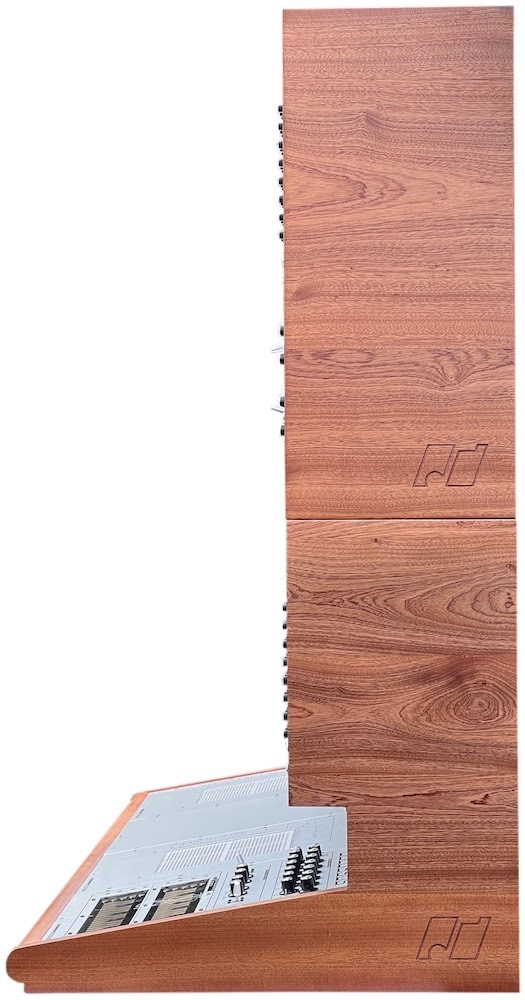
Achieving a 53% reduction in Colossus AS200 Slim’s footprint depth to a comparatively slimline 330 mm to accommodate more restricted access for installation in comparison to the 700 mm depth allowed by the Colossus AS100 Classic — tilting the latter by 45 degrees effectively reduces that dimension diagonally to around 620 mm, however, which may well help with gaining access through unusually narrow doorways — meant making some design changes; at 750 mm in height, Colossus AS200 Slim is a little taller than the 655 mm-high Colossus AS100 Classic, therefore takes some of the features found in the Colossus AS100 Classic’s horizontal console and flips them vertically into one orientation. On the face of it, then, this inevitably involved some small compromises — not least that, though fully independent (as they are not internally wired to anything), Colossus AS200 Slim’s two vertically-mounted broadcast-quality 31 x 15 ANALOGUE PIN MATRIX ROUTING panels are somewhat smaller than those horizontally mounted in the Colossus AS100 Classic, while the latter’s two TOUCH KEYBOARD CONTROL / SEQUENCERS dominating its horizontally-mounted so-called ‘Touch Panel’ have had to be forsaken entirely in favor of a new vertically-mounted ‘Mixer Panel’ incorporating a 10-input stereo mixer, two fixed sub-mixers, and two joystick controllers. As a result, Colossus AS200 Slim actually provides more mixer inputs than Colossus AS100 Classic, which is no bad thing. That said, Colossus AS200 Slim’s four so-called ‘Jack Socket Patch Panels’ providing I/O from all circuits are the same as those implemented in Colossus AS100 Classic — other than now being vertically orientated, of course.
Clearly, when it comes to Analogue Solutions’ spirited Colossus concept, there are now choices to be had. Having said that, those lucky enough not to be in a constrained financial position necessitating making a choice between buying a Colossus AS100 Classic or Colossus AS200 Slim could always consider taking the Colossus Double stairway to (analog) heaven; after all, Colossus AS200 Slim has been beautifully designed to elegantly stack on top of a Colossus AS100 Classic to form a dreamlike ‘double-height’ Colossus Double system, the likes of which has to be seen (and heard) to be believed! Bearing in mind that a Colossus Double system ships as two separate units, at least two people are needed to lift a Colossus AS200 Slim on top of a Colossus AS100 Classic, with a third person highly recommended for moral support! The two super-synths concerned are safely secured together thanks to a selection of (provided) bolts to form one rigid unit. Ultimately, a Colossus Double system is as awe-inspiring to stand and look at as it is to play with.
Whatever way anyone might choose to approach achieving awe-inspiring Colossus Double system status — given that a Colossus AS200 Slim, of course, can be added to a Colossus AS100 Classic at a later date, it is incontrovertibly so much more than a powerful analog ‘workstation’ with 100%-analogue voice and modulation circuits that steer well clear of MIDI and USB; it is also art and architecture incarnate, incorporating beautifully engraved wood cabinetry creating exquisite studio furniture in itself! After all, high-quality constructed synthesizers such as these only come around once in a decade — or, possibly, a generation!
Colossus AS200 Slim is available to order, priced at £23,500.00 GBP (excluding VAT and delivery) — directly from Analogue Solutions here: https://www.colossus-synth.com/buy — with delivery direct to the customer, complete with a selection of patch pins, 3.5 mm ‘mini-jack’ patch cables, and a IEC mains cable. Current delivery time is around two to three months after receipt of a £7,000.00 GBP deposit (excluding VAT and delivery) — payable to Analogue Solutions here: https://www.analoguesolutions.com/colossus-1 — with balance and shipping costs required shortly before despatch, though waiting will decrease down to around two weeks once Analogue Solutions has handled initial demand. (Should shipping be required, packing in a large wooden crate — can be completely ‘flat-packed’ for safe storage, should the customer wish to do so — is £320.00 GBP, with delivery by truck to most European countries estimated to be in the range of £300.00 GBP to £500.00 GBP and air freight to the USA estimated to be in the range of £1,700.00 GBP to £2,500.00 GBP.)
For more in-depth information (including variants, images, video, upgrades, support, and more), please visit the dedicated Colossus website here: https://www.colossus-synth.com/colossus
Watch Analogue Solutions’ short but sweet-sounding Colossus AS200 Slim introductory video here: https://youtu.be/VBPbbPMbEaQ
Watch an awe-inspiring Colossus Double system — showcasing a Colossus AS200 Slim stacked on top of a Colossus AS100 Classic — teaser video, as captured through the magical musical lens of Analogue Solutions here:
About Analogue Solutions (www.analoguesolutions.com)
Analogue Solutions is a UK-based boutique electronic instruments innovator that specializes in true analog synthesizers, sequencers, and Eurorack modules. More than 25 years of experience in the industry means that it was right there at the start of the Eurorack revolution — the third company to start producing modules, in fact. Furthermore, Analogue Solutions products are all hand-built in England — many being tested by founder Tom Carpenter himself, who has hands-on involvement in all aspects of the company. Characterful to boot, Analogue Solutions’ innovative instruments are applauded for proudly possessing a truly vintage sound — synthesizers featuring fully-analog audio paths with analog LFOs (Low-Frequency Oscillators) and EGs (Envelope Generators) are the order of the day here. Having no memories means that nothing is being made to sound sterile by CPU (Central Processing Unit) control; conversely, turning a knob directly changes the voltage or current in an actual synth circuit to audible affect. As implied by name, Analogue Solutions consistently constitutes proof of Tom Carpenter’s genuine passion for analog synths, drawing upon his years of owning and using vintage analog synths and drum machines that he still uses in his own music productions… alongside Analogue Solutions products, predictably. Put it this way: with its present-day music electronics for electronic musicians mantra ringing true as always, Analogue Solutions has certainly come a long way with its boutique electronic instrument innovations!
© 2022 Analogue Solutions (UK) Ltd