




 LONDON, UK: Spitfire Audio is proud to announce availability of ABBEY ROAD ONE: THEMATIC TRUMPETS — taking another step further forward in its ongoing ABBEY ROAD ONE: FILM SCORING SELECTIONS series of smaller standalone orchestral libraries capturing the iconic sound of cinema in one of the finest acoustic spaces in the world by building upon its creative partnership with world-famous Abbey Road Studios starting with the trailblazing 90-piece symphonic orchestra-utilising ABBEY ROAD ONE: ORCHESTRAL FOUNDATIONS, this time featuring four players performing a range of pre-orchestrated techniques to offer everything needed to create big screen-ready themes, including the sound-specialising British music technology company’s easy-to-use legato techniques that are helpfully housed in its award-winning (AU-, AAX-, NKS-, VST2-, and VST3-compatible) plug-in designed by composers for composers that loads directly into all major DAWs (Digital Audio Workstations) without the need for any additional software — as of March 10…
Who better, then, to formally introduce Spitfire Audio’s ABBEY ROAD ONE: FILM SCORING SELECTIONS series’ latest addition than company co-founder Paul Thomson — truly no stranger to the wonderful world of film scoring himself as an English composer for film, television, and video games, as well as a music technologist to boot: “This one is …THEMATIC TRUMPETS, with that full section trumpet sound — that singing and soaring melody sound — that you know so well from the scores of John Williams, Alan Silvestri, and Jerry Goldsmith. This really packs a punch. As with all of our [FILM SCORING] SELECTIONS, it does this one thing incredibly well.”

With a particular focus on lead lines and fanfare, this inimitable trumpet collection offers a commanding presence without being piercing or clichéd, and allows anyone to establish signature themes as a heroic accompaniment to Spitfire Audio’s ABBEY ROAD ONE: FILM SCORING SELECTIONS series. The ‘Thematic’ wording in its title suggests infinite possibilities for developing narrative structure in compositions, combined with the exquisite acoustics of the world-famous recording studio to which it partly owes its notable name to propel this brass offering above and beyond. These trumpets exquisitely conjure up pomp and circumstance while providing a wide spectrum of lush dynamics — perfect for inspiring timeless motifs and creating majestic soundscapes with effortless beauty. Better still, the harmonically rich library that is ABBEY ROAD ONE: THEMATIC TRUMPETS can invigorate its users’ scores while providing a truly distinct character inspired by the singing lead lines of those legendary Hollywood A-listers listed by Paul Thomson.

The ABBEY ROAD ONE: THEMATIC TRUMPETS library features four first-call London players — the same first-call players performing on globally successful movies, in fact, and all recorded by GRAMMY® Award-winning engineer Simon Rhodes (Avatar, Hugo, Harry Potter) — performing a range of pre-orchestrated techniques to offer everything needed to create big screen-ready themes, including Spitfire Audio’s easy-to-use legato techniques. The iconic sound of cinema is literally at anyone’s fingertips, for ABBEY ROAD ONE: THEMATIC TRUMPETS users are effectively entering the room most composers can only dream of — namely, Abbey Road Studios’ Studio One. Of course, Studio One is considered to be one of the finest acoustic spaces in the world, with its history having an indelible connection with the scores recorded there, embedding emotion, mood, and magic into many of the most renowned films ever made. Musical matches made in heaven, classics such as Star Wars, Lord of the Rings, Harry Potter, and Avengers: Endgame were all recorded in Studio One. Thanks to its rich tonality and famed reverb, Studio One’s sound is widescreen and epic — truly the iconic sound of cinema.
Carefully captured acoustics from Abbey Road Studios’ famed Studio One, of course, can clearly be heard when playing ABBEY ROAD ONE: THEMATIC TRUMPETS’ easy-to-use legato techniques-exploiting LEGATO patch. Paul Thomson is — as might be expected — enthused, expanding thusly: “You’ve got that huge dynamic range — really fabulous — right down at the bottom end, but also you’ve got that full singing tone at the top of the dynamic range that is always powerful but never gets shrill or aggressive; it’s just beautiful, heroic — get your superhero vibe on, it’s so much fun! Also right down at the bottom of the dynamic range, you’ve got this beautiful tone. So it’s not just a one-trick pony; you can really get these fabulous, warm, soft things going, as well as the full-tilt, epic, adventure stuff.”

Saying that there is more to the ABBEY ROAD ONE: THEMATIC TRUMPETS library than that flexible LEGATO alone, as Paul Thomson continues: “We have our straightforward LONG notes if you want to play a kind of chordal part, or, indeed, if you want to get a really full and very vibrant sound up there. We got a couple of different articulations to help you round out the kind of things that these trumpets would typically play. The first is the sforzando [LONG SFZ] part; this is where you have an attack at the beginning of the note, then it quickly kind of dies away into a warmer sound, which is incredibly useful for when you want that accent at the start of a note, but you don’t want the trumpets to keep blasting through — you want them to drop away quite quickly to give you the light and shade in the note. We’ve got a variety of short notes; the first one is STACCATISSIMO — really good for very short parts, so that gives you the tightest shortest sound, but we’ve also got normal STACCATO as well — not quite as tight, but, because the players are playing for slightly longer, it gives you a slightly fuller tone. The other one is short and pointed; this one is still short, but it’s a full kind of sound. We go even fuller on the TENUTO, and then last, but not least, we have the MARCATO sound. That’s the full complement of sounds in …THEMATIC TRUMPETS.”
As a riveting asset and enduring addition to Spitfire Audio’s ABBEY ROAD ONE: FILM SCORING SELECTIONS series, the robust ABBEY ROAD ONE: THEMATIC TRUMPETS duly delivers a vast array of thematic potential — from valiant, emotive tropes to menacing, antagonistic identifiers. And as a fully-fledged standalone library building upon the trailblazing 90-piece symphonic orchestra-utilizing ABBEY ROAD ONE: ORCHESTRAL FOUNDATIONS, it is recorded the same way as anyone’s favorite film composer would: with the unmistakable acoustics of Abbey Road One, exceptional players, award-winning sound engineers, and priceless microphones — albeit allowing for film score creation convenience. Indeed, it is perfectly possible to use ABBEY ROAD ONE: THEMATIC TRUMPETS to elevate an already owned symphonic orchestra toolkit or pair it with Spitfire Audio’s aforesaid ABBEY ROAD ONE: ORCHESTRAL FOUNDATIONS to create soaring, heroic themes.

ABBEY ROAD ONE: THEMATIC TRUMPETS is available as an AAX-, AU-, VST2-, and VST3-compatible, NKS (NATIVE KONTROL STANDARD®)-ready plug-in that loads directly into a DAW (Digital Audio Workstation) at an attractive RRP (Recommended Retail Price) of only £49.00 GBP (inc. VAT)/$49.00 USD/€49.00 EUR (inc. VAT) from here: https://www.spitfireaudio.com/shop/a-z/abbey-road-one-thematic-trumpets/
ABBEY ROAD ONE: THE COLLECTION, comprising all seven ABBEY ROAD ONE: FILM SCORING SELECTIONS series sample libraries to date — namely, the inaugural ABBEY ROAD ONE: ORCHESTRAL FOUNDATIONS, plus the ABBEY ROAD ONE: SPARKLING WOODWINDS, ABBEY ROAD ONE: LEGENDARY LOW STRINGS, ABBEY ROAD ONE: WONDROUS FLUTES, ABBEY ROAD ONE: GRAND BRASS, ABBEY ROAD ONE: VIBRANT REEDS, and ABBEY ROAD ONE: THEMATIC TRUMPETS followup releases, is available as a series of AAX-, AU-, VST2-, and VST3-compatible, NKS-ready plug-ins that load directly into a DAW at an attractive RRP of only £523.00 GBP (inc. VAT)/$554.00 USD/€554.00 EUR (inc. VAT) — representing a substantial saving when priced against purchasing all seven sample libraries individually, and available as such until the next ABBEY ROAD ONE: FILM SCORING SELECTIONS series sample library is launched — from here: https://www.spitfireaudio.com/shop/a-z/abbey-road-one-the-collection/
Spitfire Audio’s namesake Spitfire Audio application allows anyone to buy now and download anytime and is available for free from here: http://www.spitfireaudio.com/info/library-manager/
For more in-depth info, including some superb-sounding audio demos, please visit the dedicated ABBEY ROAD ONE: THEMATIC TRUMPETS webpage here: https://www.spitfireaudio.com/shop/a-z/abbey-road-one-thematic-trumpets/
Watch Spitfire Audio’s launch premiere of ABBEY ROAD ONE: THEMATIC TRUMPETS — including its tantalizing trailer video and Paul Thomson’s ‘traditional’ walkthrough — here:
About Spitfire Audio (www.spitfireaudio.com)
Spitfire Audio is a British music technology company that specializes in sounds—sample libraries, virtual instruments, and other useful software devices. It collaborates with the best composers, artists, and engineers in the world to build musical tools that sound great and are exciting to use.
About Abbey Road Studios (www.abbeyroad.com)
Abbey Road Studios is the most famous recording studio in the world and a global music icon. It was declared an English Heritage Grade II listed site in 2010, but the focus continues to be on the future and helping to spread the expertise and knowledge present within the building to a new generation of musicians, engineers, and producers around the world.
© 2022 Spitfire Audio Holdings Limited

 REMAGEN, GERMANY: having introduced Iridium as a high-class synthesizer in a compact desktop form factor with welcomed added extras building upon the high-quality synthesizer developer’s demanding design standards set by its Quantum keyboard flagship’s futuristic functionality and advanced tonality, Waldorf Music is proud to take the concept further forward by announcing the availability of its Iridium Keyboard counterpart — radically redesigning its desktop synthesizer namesake around an all-new 49-key FATAR TP/8SK semi-weighted polyphonic aftertouch pressure-providing keyboard as the first such implementation of that keyboard in the world, with an expanded front panel proffering one-knob-per-function control as a workflow-raising result of this high-class synthesizer’s palpable physical makeover, also allowing for six freely-programmable Macro buttons with which users can define functions from a wide range of features for additional performance control — as of March 4…
It is, however, hardly surprising that Waldorf Music has chosen to name its latest high-quality synthesizer Iridium Keyboard since the instrument in question is physically designed around award-winning Italian digital piano, organ, and synthesizer keybed manufacturer FATAR’s all-new TP/8SK keyboard, configuring 49 semi-weighted sensitive keys with polyphonic aftertouch and three contacts as possibly one of the best synthesizer keyboards money can buy. Best of all, tremendous tonal changes flow freely when playing the Iridium Keyboard live since polyphonic aftertouch is transmitted individually for each note played. Performers can conceivably play and hold down any number of keys simultaneously, subsequently moving each finger individually. In other words, individual keys are affected by the pressure applied by each finger, thereby creating, for instance, individual data streams for modulation purposes, whereas with monophonic (Channel) aftertouch all notes played will respond in the same way. With a powerful Mod Matrix offering 40 independent modulation assignments, each with individual settings for Source, Amount, and Destination, Iridium Keyboard far from disappoints when it comes to powerful modulation options, of course — just like its Iridium desktop synthesizer namesake. Notably, Iridium Keyboard is also capable of processing MPE (MIDI Polyphonic Expression) data, duly making multiple parameters of different notes separately controllable to effectively enable it to behave more like an acoustic instrument in terms of spontaneous, polyphonic sound control.

Clearly, the 851 mm (W) x 355 mm (D) x 110 mm (H) physical dimensions of the Iridium Keyboard has resulted in some marked differences to the original Iridium desktop design, with a one-knob-per-function control approach afforded by its naturally expanded front panel, albeit aided still by its industrial-grade highly-responsive touchscreen display to provide an interactive overview of the Mode page selected (via associated LFOS, OSC 1, OSC 2, OSC 3, FILTERS, MOD, and EFFECTS buttons), parameter changes, and additional information. Indeed, Iridium Keyboard also incorporates six freely-programmable Macro buttons adjacent to the Pitch and Mod (modulation) wheels with which users can define functions from a wide range of features for additional performance control, combining to further enhance its performance pedigree.
Put it this way: while Iridium Keyboard — duly described by Waldorf Music as “…a high-class synthesizer with an extraordinary polyphonic aftertouch pressure keyboard featuring a wide range of unique sounds with approved Waldorf quality — made in Germany!” — ships with specifically created new sounds and samples in addition to all those included in the Iridium desktop from the likes of Kurt Ader, BT (Brian Transeau), Richard Devine, Thorsten Quaeschning (Tangerine Dream), and Howard Scarr, to name but a notable few, its impressive specification otherwise mirrors that of the original Iridium — itself described by Waldorf Music as “…a high-class desktop synthesizer featuring a wide range of unique sounds with approved Waldorf quality — made in Germany!” — as a 16-voice digital synthesizer. Sounds from Waldorf Music’s Quantum synthesizer flagship — an eight-voice, hybrid affair as a result of offering two analog low-pass filters per voice — can conveniently be loaded into Iridium Keyboard and vice-versa.
As another entry fit for Waldorf Music’s rich history, Iridium Keyboard — with its industrial design bearing the high-class hallmarks of Axel Hartmann, one of the most respected synthesizer designers in the industry who was also responsible for the company’s wavetable synthesis-based Microwave debut back in 1989 — takes pride of place in the high-quality German synthesizer developer’s distinctive family tree as another direct descendent of the legendary PPG Wave synthesizer series that made their mark throughout the Eighties by bringing the distinctive sound of wavetable synthesis to the musical masses. Musically, though, the Iridium Keyboard — like its Iridium desktop synthesizer sibling — brings much more to the production table than its acclaimed ancestor, featuring five different synthesis models for each of its three oscillators (OSC 1, OSC 2, and OSC 3): Wavetable — a table consisting of single-cycle waveforms; Waveform (virtual analogue) — a standard oscillator model to create typical analogue waveforms; Particle (sampling and granular sampling) — allowing for extensive manipulation of sample-based sounds; Resonator — manipulates multi-samples from the internal (2GB) sample flash memory or noise via an exciter and various spectral parameters that can be modulated, matchless for generating awe-inspiring animated sounds and drones, which can, for example, easily be integrated into a Eurorack modular synthesizer environment via the Iridium Keyboard’s integrated control voltage connections (CV In1, CV In2, CV In3, and CV In4); and Kernels — effectively enabling one oscillator to become up to six sub-oscillators that can be interlinked through FM at audio rate and arranged in user-definable constellations. Clearly, Iridium Keyboard can create a wide range of unique sounds like no other.

Other fanciful features include three true stereo path digital filters per voice that convincingly cover all conceivable classic filter variants — various digital filters are additionally offered by the FORMER section, such as Comb, classic Waldorf high- and band-pass, and notch filters from Waldorf Music’s Largo and Nave software synthesizers, plus PPG models, alongside signal enhancer effects, such as Drive and Bit Crusher, and more; six envelopes, six LFOs, and much more besides are available for use as sources in the Mod Matrix, routable to almost any numerical value in Iridium Keyboard.
Connectivity-wise, the well-spec’d Iridium Keyboard communicates well with the outside world, thanks to two audio inputs (for processing external signals); CV inputs as well as Gate In and Trigger In connections (for forwarding external signals to the Mod Matrix); Clock In and Clock Out connections (to synchronize with other gear); USB and DIN MIDI connections; USB Host port (provided for MIDI devices and also handling data exchange); Control and Sustain Pedals inputs; a headphone output (with dedicated volume control); and last, but not least, two audio outputs.
On the face of it, then, with a performance pedigree fit for taking its wide-ranging unique sounds further forward, the reassuringly-weighty (12.0 kg) Iridium Keyboard certainly more than lives up to its billing as “…a high-class synthesizer with an extraordinary polyphonic aftertouch pressure keyboard featuring a wide range of unique sounds with approved Waldorf quality — made in Germany!”
Iridium Keyboard is available through Waldorf Music’s growing global network of distributors (https://www.waldorfmusic.com/en/international-distributors) at an RRP (Recommended Retail Price) of €2,989.00 EUR (including German tax).
For more in-depth information, please visit the dedicated Iridium Keyboard webpage here: https://waldorfmusic.com/en/iridium-keyboard
Hear Iridium Keyboard in action while watching Waldorf Music’s must-see trailer and sound demonstration video here:
About Waldorf Music (www.waldorfmusic.com)
The well-known Waldorf Music marque has been synonymous with high-quality synthesizers for over 30 years; indeed, its innovative position in the electronic musical instruments marketplace dates back to 1989 with the release of the wavetable synthesis-based Microwave, an amazing ‘reincarnation’ of the legendary PPG Wave series — arguably amongst the most coveted high-end synthesizers of the early Eighties — that was instrumental in providing some called-for counterbalance to the dominance of Japanese and American designs. While Waldorf continued this unique technology tradition with successive synthesizer releases ranging from the mighty Wave — perhaps the most impressive, expressive, and user-friendly sound synthesis tool ever built — to raising the bar for VA (Virtual Analogue) synthesizers with the introduction of the popular Q series from 1999 onwards, the new millennium saw the trailblazing company making a timely move into the brave new world of music software with the release of its first VST Instrument, PPG Wave 2.V, a tradition it continues to this day with more recent software releases including its Nave advanced wavetable synthesizer. Subsequent successes in the high-quality hardware arena include the Blofeld synthesizer — forging sound and design into an unbeatable price/performance ratio in both desktop and keyboard versions — and Zarenbourg, a contemporary electric piano par excellence, as well as the cost-conscious Rocket (synthesizer), 2-Pole (analog filter), and Streichfett (string synthesizer) desktop modules. Meanwhile, Waldorf broadened its appeal further still by introducing Nave to transform any iPad into an advanced wavetable synthesizer. Fast-forwarding to today sees the high-quality synthesizer manufacturer musically returning to its roots with M, bringing back classic Microwave and ‘modern’ Microwave II tone generation as a new-generation classic hybrid wavetable synthesizer complimenting a slew of contemporary high-quality synthesizers taking the well-known name into the hands-on musical masses — whether working with its (flagship) Quantum high-class hybrid or (polyphonic aftertouch pressure-providing) Iridium digital synthesizer keyboards, (FPGA-based) Kyra and Iridium digital desktop synthesizers, or other hardware (including a welcomed move into the ever-expanding Eurorack modular synth system format) or software (including iOS).
© 2022 Waldorf Music GmbH

 PARIS, FRANCE: having originally designed and released Pyramid almost a decade ago as a compact, standalone 64-track hardware sequencer packed with creative tools that its music-making creators could not commercially find available elsewhere, subsequently applying that same thinking to their Hermod followup by bringing the power of MIDI to the ever-widening Eurorack modular world while inheriting some creative elements from its Pyramid precursor, Squarp Instruments is proud to introduce Hapax — duly designed from the ground up with dual-ARM processing architecture upping the computational power ante as a high-end professional standalone sequencer in a rugged, minimalist housing that deconstructs everything that the avant-garde machines-creating company already knew about sequencing to offer everything needed to compose songs in the studio and perform them on stage as an authentic centrepiece of any setup, sequencing and synchronising vintage to modern synths and modular systems, and even DAWs (Digital Audio Workstations), while maximising creativity with carefully crafted tools as the first hardware sequencer that fully supports MPE (MIDI Polyphonic Expression) — as of March 4…
Billed by its creators as a polychronic performance sequencer since it can clearly do many things at once, Hapax’s dual-processor architecture allows it to record and transform tremendous amounts of data in next to no time — and all without breaking into a sweat. As an around-the-clock performer, it can handle two separate and independent projects — each with 16 tracks and eight patterns per track — that can be played simultaneously, so users can compose or load another project while the first one is already playing, enabling endless sets and seamless transitions. The fact that Hapax is also the first hardware sequencer that fully supports MPE speaks volumes about Squarp Instruments’ intentions; it is perfectly possible to record the finest gestures, slides, and articulations of anything played, after all — and all without compromising quality.

Quality also shines forth for all to see and feel when it comes to the construction of the Hapax housing, manufactured from 2 mm machined aluminum, with a unibody ABS (Acrylonitrile Butadiene Styrene) back panel. Put it this way: with connections for multiple MIDI in (DIN and TRS), midi out (3x DIN and TRS), cv in (2x -5V to +5V/16-bit), cv out (4x -5V to +5V/16-bit), gate out (4x +5V), switch (stereo pedal footswitch), USB Host (for linking to a MIDI USB controller), and USB Device (for linking to a DAW-hosting computer and associated virtual instruments), it quickly becomes apparent just how well thought through that back panel actually is in terms of conceivably communicating with everything that the music technology world might make available at this moment in time — hence Hapax ably acting as an authentic centerpiece of any setup, sequencing and synchronizing vintage to modern synths and modular systems, and even DAWs.
Digging deeper, Hapax’s adaptive workflow — with the top panel proffering hands-on access to no fewer than 128 RGB (Red Green Blue) matrix pads, 52 click pads, nine sturdy clickable encoders, and two OLED (Organic Light-Emitting Diode) greyscale displays — is designed around four main modes: live uses those 128 pads as an isomorphic keyboard or chord generator, giving rise to harmonic capabilities aimed at anyone — regardless of their theoretical knowledge — as a synaesthetic sensory blend of hearing, vision, and touch, thanks to its colorful interface; step uses them to add or fine-tune notes (or drum events) with surgical precision; autom uses them to create MIDI (or effects) automation, and pattern enables performing in sync by using the 128 pads to set the playing pattern of each track — create sections (or groups of patterns) and chain sections to build a song. Making music might involve using a polyphonic or MPE track to take advantage of the advanced step sequencer and quickly lay down notes or edit live recordings when writing melodies or control up to eight different instruments with a single track when creating beats using the drum sequencer that is tailored to ease rhythm writing and jamming, for instance.

It is also possible to effectively bring those connected synths to life since Hapax embeds multiple real-time, polyphonic, non-destructive MIDI effects, as well as project-wide assignable LFOs (Low-Frequency Oscillators). On top of that, each parameter of those effects can be automated in the dedicated mode, and processed in the mod matrix, which provides even more ways of routing and modulating.
Hapax has so much more to offer discerning devotees of hardware sequencers, with powerful tools for offline note transformation and generation always at hand — harmonically inverting a musical motif, generating a controlled random counter-melody, slowly ramping up the velocities, emphasizing every fifth eighth note… almost anything is possible! Hitting Hapax’s red button enables recording using the encoders and matrix pads, external MIDI instruments (including MPE controllers), or any incoming analog signal at a high resolution of 192 PPQN (Pulses Per Quarter Note). Needless to say, looper-style recording, countdown and metronome options, and punch-in mode mean that there are options to suit any workflow, while each track has an elasticity value that changes its playback speed, expressed as a percentage of BPM (Beats Per Minute) — quickly double or halve the speed of a track, for example, or create subtly shifted tracks that slowly drift out of phase with each other.

Of course, hardware usage should not — in a perfect world — curb the creative flow. For this reason, Hapax has a dedicated undo REDO button with extensive history to enable its users to go back in time as deemed necessary; thankfully, the button-activated snapshot function allows users to save the state of a pattern for instant recall with a single press; and dedicated copy, paste, and delete buttons help Hapax on its way towards offering a complete toolbox for promptly editing tracks.
Music-making should always remain an enjoyable experience, though, which is why Squarp Instruments favored dedicated buttons over key combinations when realizing a clear-cut interface and simple architecture for Hapax. Having striven to minimize the importance of screens when performing live, however, the dual greyscale displays implemented in Hapax help with keeping track of things in a studio context.

Clearly, then, deconstructing everything that they already knew about sequencing to offer everything needed to compose songs in the studio and perform them on stage as an authentic centerpiece of any setup has paid off for Squarp Instruments, with the Hapax high-end professional standalone sequencer surely set to make its mark in the music technology world while literally living up to its polychronic performance sequencer billing when expected for delivery in June 2022.
Hapax is available on backorder for expected delivery in June 2022 — priced at €864.00 EUR (plus VAT for individual customers in the European Union)/$979.00 USD — directly from Squarp Instruments’ online Store here: https://store.squarp.net
For more in-depth information, please visit the dedicated Hapax webpage here: https://squarp.net/hapax
Watch Squarp Instruments’ illuminating introduction to Hapax here:
About Squarp Instruments (www.squarp.net)
Based in its inspiring workshop in Paris, France, Squarp Instruments dream up the musical interfaces of tomorrow by bringing together passionate young engineers, designers, and musicians to develop and craft avant-garde machines intended for professional and amateur artists alike. Administered by its three founders since 2013, the company pools its expertise in electronics, computer science, music theory, and technique to bring something completely different to the electronic music table. That being said, its main goal is to facilitate its customers’ creative process by pushing back boundaries — from high-level production to live performance, no matter what their musical affinities are.
© 2022 Squarp SAS

 LONDON, UK: Spitfire Audio is proud to announce availability of HEIRLOOM — hatched from the mind, heart, and soul of acclaimed multimedia artist and composer Keaton Henson as an emotional ensemble library like no other on account of bringing delicate strings, raw woodwinds, an inspiring piano, and haunting guitars into play, creatively captured in the sacred surroundings of renowned record producer, musician, and songwriter Paul Epworth’s The Church Studios, an award-winning space located in the heart of North London’s Crouch End as one of Europe’s leading recording facilities, forming a compositional toolkit of unique, modern scoring sounds conceived with humanity in its DNA, and the lingering human moments that bleed and seep their way into recorded musical performances to act as the sonic equivalent of the worn away seat of your father’s favourite chair, contemporarily served up in the sound-specialising British music technology company’s award-winning AAX-, AU-, VST2-, and VST3-compatible, NKS (NATIVE KONTROL STANDARD®)-ready plug-in that loads into all major DAWs (Digital Audio Workstations) without the need for any additional software, perfectly poised for enhanced emotive scoring — as of March 3…

Perfectly poised to express emotions that are hard to put into words, HEIRLOOM captures contemplation of complex external feelings, the human condition, and the passing of time. The quality of the performances — played by eight-string players (comprising three violins, two violas, two cellos, and one bass), as well as contrabass clarinet, guitar, tubax (a modified saxophone with the same register as a regular contrabass saxophone, but much more compact due to its tubing being folded more times), and an achingly beautiful piano — are both pure and expansive in character, captured as intimate recordings by London-based freelance engineer and producer Fiona Cruickshank in The Church Studios’ sought-after sacred surroundings and lending themselves to enhanced emotive scoring. Saying that the resulting expansive character provides endless inspiration via sounds that will slot into any composer’s signature sound palette.
Acclaimed artist Keaton Henson himself is, of course, perfectly poised to put HEIRLOOM into its rightful context, having hatched this emotional ensemble library like no other from his mind, heart, and soul. “To me, HEIRLOOM is, at its core, about the feeling of things passed down and about the faint traces we leave behind in our lives — these human traces and the evocative sounds used to try and key into people’s emotional memories,” he explains, expanding still further with: “Whenever I record orchestral music, I put a huge amount of thought and effort into making sure there’s loads of humanity in the sound. This is the sonic equivalent of the marks in an old carpet where a well-loved cabinet one stood, or the worn away seat of your father’s favorite chair. These are all the elements that we pulled together to create HEIRLOOM — the sound of the parts of us we can’t help but leave behind.”

It is hardly surprising, then, that HEIRLOOM has a strong sense of home comforts, together with a beguiling familiarity that allows any composer working with it to feel comfortable using the sounds in a stripped-back setting. By bringing beautiful raw woodwinds, delicate strings, an inspiring piano, rich guitar tones, and textures to the fore, Keaton Henson has honed in on that humanity he mentions, manifesting itself in the subtle artifacts of these kinds of recordings.
Deep down, though, most musicians instinctively know that recording studios are sacred spaces — literally so in the case of The Church Studios, a beautiful old place of worship in North London, whose stone walls and stained glass have reverberated for 170 years with the sound of prayers and some of the greatest music ever made. Making recordings at The Church Studios today is playing a part in music history that has included Adele, Bob Dylan, Depeche Mode, Florence + The Machine, Radiohead, and U2, to name but a notable few — not forgetting, of course, Annie Lennox and Dave Stewart of The Eurythmics, who converted the space into a brand-new recording studio back in 1984, which was later bought by British singer-songwriter David Gray in 2004 before he passed the baton of ownership to the talented Paul Epworth, who completely refurbished the upstairs and downstairs floors to present three new studios to the recording world in 2013. Fast-forward to today, and Keaton Henson — known for his work outside of film with Supernova and Six Lethargies, as well as seven acclaimed albums as a solo artist — continues that lineage by acting as a medium between the decades of musicality shared there and Spitfire Audio, shaped through his own artistic lens and reverence for the beauty in imperfections: “From a technical standpoint, we used all of the techniques, musicians, equipment, and rooms that I use in my work. We’ve captured all the detail and humanness of the players, playing subtle and raw techniques, and also used the super-special piano there to capture that ‘heirloom’ sound since all my most successful writing experiences have been on old pianos at family members’ houses — or covered in dust at a friend’s — where you don’t care about what note you play next as you just want to hear the played note ring out.”

Outside of The Church Studios, onwards and upwards to the finished product that is Spitfire Audio’s latest release, the resulting PIANO section included in HEIRLOOM has the perfect amount of character — like an old but well-looked-after piano that sits at a relative’s house that beckons to be played whenever walked past. It is inspiring to play and unbelievably real, representing the beating heart of this emotional ensemble library like no other. Thereafter, the STRINGS have been kept small, recorded close, and never playing too loud, so composers can achieve an emotionally epic sound without losing the intimacy of the playing involved, while the GUITAR sounds range from an authentic-sounding picked guitar through to some more complex techniques that have resulted in some rich and haunting pads and swells, all performed by Keaton Henson on his trademark Telecaster and re-amped within The Church Studios’ sacred space. CONTRABASS CLARINET, meanwhile, makes for the perfect amount of breath without losing the tone — the perfect deep bed to build from, or soft section with which to play rumbling chords — and the TUBAX is incredibly warm, characterful, and smoky-sounding, contrabass in register, but with the tones and warmth of a saxophone, subtle breaths duly captured with soft shifts in tone, together with guttural growls and snarling drones at the louder dynamic.

Creatively capturing new and alternative expressive techniques — the results of which can be quickly tweaked to suit within the sound-specializing British music technology company’s award-winning AAX-, AU-, VST2-, and VST3-compatible, NKS-ready plug-in’s easy-to-use expression, dynamics, REVERB, RELEASE, and TIGHTNESS controls alongside an array of (Mix 1, Tape, Cls, Mid, Far, Rbn, Lstn, Plyr, and Ped) signal options — certainly creates a solid foundation for working with HEIRLOOM. However, Spitfire Audio also expertly captured a selection of small, exquisitely performed moments that can be found, for instance, in its GUITAR and STRINGS sections, respectively, including Swells and Chimes (chime-like tones). These focused elements enable compositions to sound even more real, and — by that same token — even more human. Having said that, and despite the meticulous planning involved in its creation, HEIRLOOM has, through the true nature of collaboration, ultimately surprised even its creators in its realism and versatility, and will clearly continue to do so — as it is woven in and out of stories for years to come.
HEIRLOOM is available as an AAX-, AU-, VST2-, and VST3-compatible, NKS (NATIVE KONTROL STANDARD®) ready plug-in that loads directly into a DAW (Digital Audio Workstation) for a time-limited promo price of £199.00 GBP (inc. VAT)/$229.00 USD/€229.00 EUR (inc. VAT) until March 31, 2022 — returning thereafter to its RRP (Recommended Retail Price) of £249.00 GBP (inc. VAT)/$299.00 USD/€299.00 EUR (inc. VAT) — from here: https://www.spitfireaudio.com/shop/a-z/heirloom/ (It is well worth noting here that the first 500 orders will receive an exclusive limited-edition artwork by Keaton Henson, the first 200 of which will be signed by the acclaimed multimedia artist and composer himself.)
Spitfire Audio’s namesake Spitfire Audio application allows anyone to buy now and download anytime and is available for free from here: http://www.spitfireaudio.com/info/library-manager/
For more in-depth information, including some superb-sounding audio demos, please visit the dedicated HEIRLOOM webpage here: https://www.spitfireaudio.com/shop/a-z/heirloom/
Watch Spitfire Audio’s must-see premiere of HEIRLOOM — including its illuminating walkthrough with in-house composer Homay Schmitz — here:
About Spitfire Audio (www.spitfireaudio.com)
Spitfire Audio is a British music technology company that specializes in sounds—sample libraries, virtual instruments, and other useful software devices. It collaborates with the best composers, artists, and engineers in the world to build musical tools that sound great and are exciting to use.
© 2022 Spitfire Audio Holdings Limited

 SAN CLEMENTE, CA, USA: Q Up Arts is proud to acknowledge its 30th anniversary milestone as a world-class sound collections developer/licensor by re-releasing its debut Heavy Hitters Greatest Hits sample collection — combining the talents of three top-tier drummers in American heavy metal mainstays Mötley Crüe’s Tommy Lee, Alan White of British pre-eminent prog-rockers Yes, and American studio mainstay Jim Keltner (known primarily for his session work with former members of The Beatles and many more artists), as the first single-hit drum sample library of its kind upon release, originally optimised for use with high-flying hardware samplers of the day, duly available again for anyone’s production pleasure as a 30th ANNIVERSARY EDITION that still rocks while breathing new life into the legacy collection concerned, this time as a KONTAKT instrument featuring Q Up Arts’ new GUI (Graphical User Interface) ideally suited to present-day DAW (Digital Audio Workstation) workflow — as of March 1…
The talented Reek Havok has been working as a self-employed sound designer, interactive consultant, and audio technologist under the impressive-sounding Sounds Amazing! moniker that has seen him creating immersive and educational experiences for a wide variety of projects including multichannel sound design, physical interactive exhibits, ambient and thematic audio, and factory presets for a wide variety of synthesizer manufacturers for over 30 years with highlights aplenty. As such, he helped make history towards the start of his ongoing Sounds Amazing! journey when forming a powerhouse engineering and programming partnership with Q Up Arts President Douglas Morton to fully realize the creative scope and power of a series of expertly recorded hard-hitting drums sounds that made media waves when released as the first single-hit drum sample library of its kind as Q Up Arts’ debut Heavy Hitters Greatest Hits, originally optimized for use with high-flying hardware samplers of the day, such as Akai’s S1000, E-Mu’s Emulator III, Roland’s S-770, and more.

An aptly-named product if ever there was one, those ‘heavy-hitting’ celebrities to which Heavy Hitters Greatest Hits originally owed its notable name were none other than Mötley Crüe’s Tommy Lee — who, according to Reek Havok himself, “…hit everything really hard, so there’s really no medium hits [as] even his soft hits are loud,” Yes’ Alan White, and legendary session stickman Jim Keltner. Needless to say, those world-class drummers’ distinctive hits were expertly recorded by the likes of Canadian musician, sound engineer, and record producer Bob Rock — best known for producing rock bands such as Aerosmith, Bon Jovi, Metallica, and, of course, Mötley Crüe — and English record producer and audio engineer Eddy Offord — who gained prominence in the Seventies for his work on albums by the progressive rock bands Emerson, Lake & Palmer and, of course, Yes — during recording sessions at world-class facilities, including what was then known as A&M Studios — itself once the headquarters to A&M Records, the longest-lived independent record label as the brainchild of American music industry magnates Herb Alpert and Jerry Moss, and originally home to comic actor, filmmaker, and composer Charlie Chaplin’s namesake Chaplin Studios in the historic heart of Hollywood — as well as Hollywood’s hallowed Music Grinders and Ocean Way on Sunset Boulevard, alas both defunct, sadly, since the time when Los Angeles’ abundant recording studios ruled the music scene has arguably long gone.
Fast-forwarding to today, the timely 30th ANNIVERSARY EDITION of that trailblazing Heavy Hitters Greatest Hits sample collection sees Q Up Arts re-releasing its debut release as a KONTAKT instrument featuring a new GUI ideally suited to present-day DAW workflow with ATTACK, RELEASE, VELOCITY, VEL>FLTR, CUTOFF, and TONE, plus panning and tuning controls for each of those expertly recorded hard-hitting drums. As an added extra, Q Up Arts has helpfully included impulse responses from Lexicon’s lauded 300 DIGITAL EFFECTS SYSTEM, so Heavy Hitters Greatest Hits users can now access authentic-sounding reverb with creative control over their own mix of the drum sound that truly defined Eighties/Nineties rock — thanks to the GATE, SMALL STAGE, SMALL PLATE, LARGE CHAMBER, FAT PLATE, SMALL WOOD ROOM, MED. STAGE, and HUGE HALL settings that are available alongside associated self-explanatory controls for DRY WET, IR SIZE, REVERB VOLUME, and REVERB TUNING. That said, Q Up Arts has helpfully encoded the Heavy Hitters Greatest Hits re-release to work with Native Instruments’ NKS (NATIVE KONTROL STANDARD®) extended plug-in format for all virtual instrument developers — delivering intuitive and seamless interaction with the German giant’s cutting-edge KOMPLETE KONTROL S- Series keyboards, MASCHINE hardware, and third-party controllers.

Clearly, then, the re-released Heavy Hitters Greatest Hits now provides polished flexibility for making massive-sounding drum tracks! By bringing back — to the future, effectively — Q Up Arts’ debut release in such timely fashion, it is hardly surprising that company President Douglas Morton is musically moved by this 30th ANNIVERSARY EDITION. “I’m stoked to be offering this amazing collection again — albeit in its new incarnation,” he states, sensibly concluding: “Great drum sounds recorded well in world-class studios are always in style.”
The 30th ANNIVERSARY EDITION of Heavy Hitters Greatest Hits can be purchased and digitally downloaded as 16-bit/44kHz stereo drum samples for a time-limited introductory promo price of $49.00 USD until March 12, 2022 — rising thereafter to an MSRP (Manufacturer’s Suggested Retail Price) of $99.00 USD — from its dedicated webpage, including some superb-sounding audio demos, here: https://www.quparts.com/product-p/hhgh_knt.htm
The 30th ANNIVERSARY EDITION of Heavy Hitters Greatest Hits needs the full version of Native Instruments’ KONTAKT (5.8.1 and above) to run as an NKS (NATIVE KONTROL STANDARD®) supporting plug-in instrument for Mac (OS X 10.10 or later) or Windows (7, 8, or 10 — latest Service Pack, 32/64-bit).
Watch Reek Havok of Sounds Amazing! and Q Up Arts President Douglas Morton commemorating Q Up Arts’ 30th anniversary while talking through the original release and subsequent re-release of Heavy Hitters Greatest Hits here:
About Q Up Arts (www.quparts.com)
Having hit its 30th-anniversary milestone in 2022, Q Up Arts’ fingerprints have made their musical mark throughout the music industry with sounds used across the globe by the likes of Bon Jovi, Depeche Mode, Pink Floyd, The Cure, U2, and Yes. Indeed, its virtual instrument sounds are programmed in hardware and software music-making instruments from E-Mu, Korg, Native Instruments, Simmons Electronic Drums, Williams Pianos, and Yamaha. Yet it is always looking forward with its new Q Space Music imprint debuting with the first titles grouped by genre, each featuring loop-able song mixes ideal for film, game, or video production.
© 2022 Q Up Arts.com, LLC

The first and only hyper-realistic modeling drum instrument gets expanded with more kits, new cymbals and a free Custom Shop edition
February 24, 2022 – IK Multimedia releases MODO DRUM 1.5, the newly expanded physical modeling drum virtual instrument. It delivers unmatched flexibility for drum customization and the sound quality of top sample-based programs without a huge memory footprint.
The companion to IK’s award-winning MODO BASS, MODO DRUM 1.5 now offers 13 deeply customizable virtual drum kits and a wider choice of versions to suit everyone’s needs, including a FREE entry into the MODO DRUM world.
Leaving Samples Behind
A premiere for the plug-in world, MODO DRUM, and BASS utilize raw computer power to emulate physical instruments from scratch. Their sound quality is indistinguishable from a real recorded instrument while adding supreme flexibility and playability, unmatched in any other drum or bass plug-in.
With this method of sound generation, MODO DRUM offers music producers controls for everything from drum skin material, shell depth, and thickness, to other drum and performance-specific parameters such as the area where the drum heads are hit. Playing with MODO DRUM is virtually like playing real drums with a real drummer.
Three Explosive New Kits
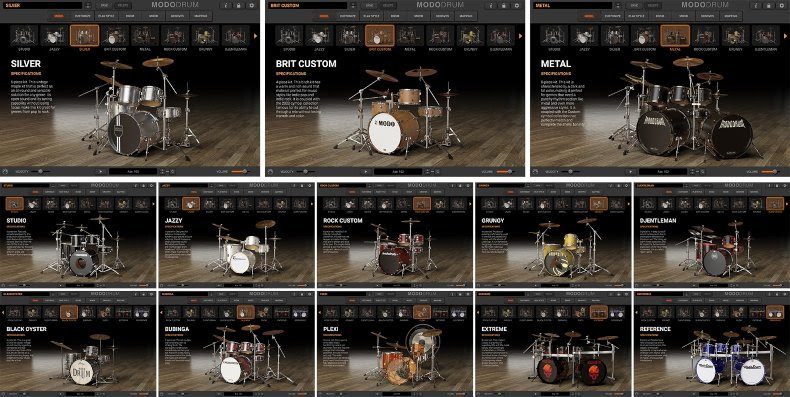
Entering the MODO DRUM 1.5 “Showroom,” users will be astonished by the wealth of kits at their fingertips. Now there are 13 distinct drum sets in total for every style and genre including 3 exciting new kits: Silver, Brit Custom, and Metal, which IK researched and developed to make MODO DRUM 1.5 truly a 1-stop drum shop for all music makers.
Silver is a 6-piece vintage maple kit, perfect as an all-around and versatile solution for any genre. Its open sound and its tuning capability make it great for pop to rock. It’s also perfect for metal and heavier genres using the onboard processing inside MODO DRUM.
Brit Custom is a 4-piece birch kit with a warm and rich sound, ideal for styles like indie-pop and indie-rock. It’s coupled with the 2022 cymbal collection that includes: a 20″ ride, 18″ crash, 16″ crash, and the new hi-hat 2022. These cymbals are made to cut through a mix without losing warmth and color.
Metal is an 8-piece set that’s characterized by a fat sound with a dark color, perfect for genres that need a punchy rhythm section like metal and even more aggressive styles. It’s coupled with a new Custom cymbal collection that features 6 custom-made cymbals designed to perfectly match and complete the shell pack’s tonality.
Try It for Free
MODO DRUM Custom Shop is available free and includes one of IK’s most popular drum kits and the full power of the MODO DRUM engine. At any time within the program, users can choose new kits à la carte, make their purchase and expand their drum room in minutes. All new kits and cymbals instantly become available for making music and creating custom hybrids with the other kits they already own.
There’s One for Everyone
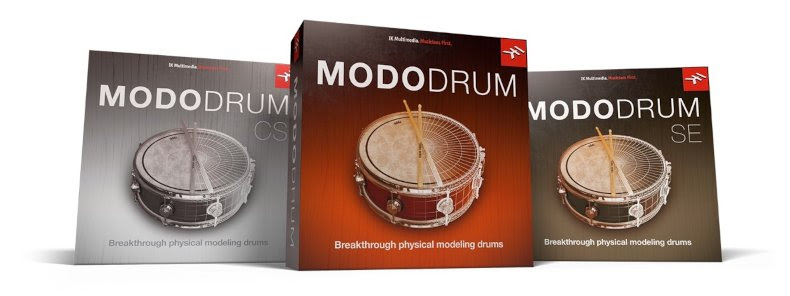
MODO DRUM 1.5 CS is fully featured with all of the same controls and customization capabilities of MODO DRUM SE and Full. It includes the versatile Studio drum kit with 12 more kits available à la carte within the program.
MODO DRUM 1.5 SE comes with 5 kits, including the 3 new ones, with the remaining kits available via the Custom Shop in the exact same manner as MODO DRUM CS.
MODO DRUM 1.5 includes the complete collection of all 13 drum kits and is the best choice for demanding music producers and composers.
Pricing and Availability
All versions of MODO DRUM 1.5 are available from the IK Multimedia online store and from IK authorized dealers worldwide for the paid versions:
MODO DRUM 1.5 CS Free – 1 kit, the MODO DRUM engine, grooves, and effects
MODO DRUM 1.5 SE $/€149.99* – 5 kits, the MODO DRUM engine, grooves and effects
MODO DRUM 1.5 $/€299.99 – all 13 kits, the MODO DRUM engine, grooves and effects
Individual MODO DRUM kits $/€49.99 – available to CS and SE users via the Custom Shop
Special Pricing
Owners of MODO DRUM 1.0 and other qualifying IK products can log into their IK user account and add MODO DRUM 1.5 to cart to see the special crossgrade and upgrade pricing available to them, starting as low as $/€79.99 for the full version.
*All pricing excluding taxes
For more information about MODO DRUM 1.5, please visit:

 LONDON, UK: Spitfire Audio is proud to announce the availability of ORIGINALS ABE LABORIEL JR. DRUMS — duly adding another dimension to its instant writing tools series as a dynamic drum kit library performed by legendary session drummer Abe Laboriel Jr., best known as Sir Paul McCartney’s touring drummer since 2001, on a bespoke drum kit at the world-renowned Henson Recording Studios in Los Angeles, USA for a tight and vibrant sound resulting in a versatile selection of highly detailed and deeply sampled single hits accompanied by a collection of 10 inspiring loop presets while offering optimal creative options for sound design through three distinctive signals served up in the sound-specializing British music technology company’s award-winning AAX-, AU-, VST2-, and VST3-compatible, NKS (Native Kontrol Standard)-ready plug-in that loads into all major DAWs (Digital Audio Workstations) without the need for any additional software — as of February 24…

“The room is integral, a major part of the sound.” So says session drummer Abe Laboriel Jr. — son of legendary Mexican-American bass guitarist Abraham Laboriel, who, having studied at the Berklee College of Music, has toured with the likes of k.d lang, Seal, Sting, and guitarist Steve Vai before becoming the drummer for Sir Paul McCartney’s touring and recording band since 2001, having also recorded and performed with B.B. King, Eric Clapton, Johnny Hallyday, Kelly Clarkson, Lady Gaga, Les Paul, Shakira, Steve Winwood, Vanessa Carlton, and more — before continuing: “It’s actually become my favorite room… I’ve done lots of records there. A lot of records now, they sound like they could have been done anywhere — missing the fingerprint of a room, a place. It’s the perfect size; the decay is really lovely, and drums have great attack there, but a lovely warmth as well.”

This is exactly why ORIGINALS ABE LABORIEL JR. DRUMS was recorded with Abe Laboriel Jr. playing his bespoke kit in that world-renowned recording location to which the legendary session drummer is referring. After all, the Jim Henson Company-owned Henson Recording Studios, located in the historic heart of Hollywood at the former A&M Studios — itself once the headquarters to A&M Records, the longest-lived independent record label as the brainchild of American music industry magnates Herb Alpert and Jerry Moss, and originally home to comic actor, filmmaker, and composer Charlie Chaplin’s namesake Chaplin Studios — is one of the music industry’s top recording facilities, known for its world-class blend of state-of-the-art and vintage equipment, with highlights from its prolific and classic credits including albums like Tapestry (Carole King), Blue (Joni Mitchell), Rock ’n’ Roll (John Lennon), and A Kind of Hush (The Carpenters), as well as records by Eric Clapton, Fleetwood Mac, Herb Albert, Paul McCartney, and Pink Floyd, to name but a notable few artists.

As might well be expected of a world-renowned facility of Henson Recording Studios’ standing, Abe Laboriel Jr.’s bespoke kit was capably captured there as a vibrant and tight sound for Spitfire Audio’s aptly-named ORIGINALS ABE LABORIEL JR. DRUMS drum kit library with a versatile selection of highly detailed and deeply sampled single hits with up to eight layers and round robins beating at its percussive heart to offer complete control of a groove across a wide dynamic range, thanks to the inclusion of 10 easy-to-use controls — namely, expression, dynamics (controlling the dynamic level to provide the user with complete control of velocity), REVERB (with a large room-/medium hall-sized impulse response), KICK VOL. (controlling the volume level of the kick drum), SNARE VOL. (controlling the volume level of the snare drum), HI-HAT VOL. (controlling the volume level of the hi-hat), and SNARE TYPE (cycling between four different snare types). There are actually 22 different hits of all the drums and cymbals, split and duplicated across the keyboard as a General MIDI-mapped preset designed to be played with two hands.

Helpfully, this is accompanied by a collection of 10 inspiring loop presets — namely, Slow and Steady (60 BPM), Triple Threat (60 BPM), In The Pocket (90 BPM), Classic Breakbeats (90 BPM), Riding Solo (90 BPM), Swing It (94 BPM), Funky Breaks (110 BPM), Play It Again (110 BPM), Tom Kit (120 BPM), and Rock and Roll (120 BPM) — performed on the same kit, each with variations and intricate fills mapped out across the keyboard and suited to a range of styles, including pop, soul, funk, and rock, with controls for expression, dynamics (controlling the cutoff frequency of the low-pass filter), REVERB (with a large room-/medium hall-sized impulse response), EQ (custom preset ranging from vintage and colorful to bright and full), and COMPRESSION (controlling the intensity of a custom parallel compression preset).

Readily representing the fifteenth installment in Spitfire Audio’s ongoing ORIGINALS series of inspiring sample libraries making rare and classic instruments available to all at an affordable price, meticulously sampled in authentic detail with no compromise on recording quality, ORIGINALS ABE LABORIEL JR. DRUMS duly makes its percussive presence felt as an all-round classic and dynamic sound, offering optimal creative options through three distinctive signals: Close — a mix of spot the microphones — and Room — a mix of the room microphones — respectively provide clarity and punch, while the third, Hype, adds weight, depth, and crunch by being fed through Spitfire Audio co-founder and composer Christian Henson’s Overstayer Modular Channel 8755DM, a flexible stereo mic, line, and instrument channel designed to add a subtle enhancement or complete sonic mayhem.
Musically, Abe Laboriel Jr. puts his playing — playable by anyone across the keyboard courtesy of ORIGINALS ABE LABORIEL JR. DRUMS — into its rightful context, stating, “As much as I would love to say I have an original sound, I think the truth is I have an original filter. I’d listen so much and so hard to so many people that what’s original about me is not necessarily what I play but how I play it — how I interpret what’s already been done. It’s more about the energy and intensity; it’s not about the specific fills, it’s more about the intention.”
Intentions, of course, can musically flow freely with any of Spitfire Audio’s ongoing ORIGINALS series of inspiring sample libraries since users are always free to tailor their sounds to suit a range of scoring styles and genres through a range of carefully curated signals, presets, and controls. Thanks, then, to the sought-after percussive potential of Abe Laboriel Jr., a supremely talented musician who has been known to occasionally switch to playing bass, guitar, and keyboards, as well as singing when touring with Sir Paul McCartney — musical talents evidenced further still by impressively playing every instrument on his own solo album, Naked, in 2013, rest assured that anyone playing with ORIGINALS ABE LABORIEL JR. DRUMS is irrefutably in good hands.
ORIGINALS ABE LABORIEL JR. DRUMS is available as an AAX-, AU-, VST2-, and VST3-compatible plug-in supporting Native Instruments’ NKS (NATIVE KONTROL STANDARD®) for Mac (OS X 10.10 or later) and Windows (7, 8, and 10 — latest Service Pack) that loads directly into any compatible DAW (Digital Audio Workstation) for an RRP (Recommended Retail Price) of only £29.00 GBP (inc. VAT)/$29.00 USD/€29.00 EUR (inc. VAT) — from here: https://www.spitfireaudio.com/originals/#abe-laboriel-jr-drums
Spitfire Audio’s namesake Spitfire Audio application allows anyone to buy now and download anytime and is available for free from here: http://www.spitfireaudio.com/info/library-manager/
For more in-depth information, please visit Spitfire Audio’s ORIGINALS Frequently Asked Questions webpage here: https://www.spitfireaudio.com/info/faq/spitfire-originals/
Watch Spitfire Audio’s premiere of ORIGINALS ABE LABORIEL JR. DRUMS — including its wonderful walkthrough video from visually-impaired virtuoso finger drummer Andre Louis that really highlights what the NKS compatibility does for this dynamic drum kit library — here:
About Spitfire Audio (www.spitfireaudio.com)
Spitfire Audio is a British music technology company that specializes in sounds—sample libraries, virtual instruments, and other useful software devices. It collaborates with the best composers, artists, and engineers in the world to build musical tools that sound great and are exciting to use.
© 2022 Spitfire Audio Holdings Limited

 As an advanced six-slot, professional, rack-mountable 500-Series powered enclosure suitable for mobile and project recording, duly delivering up to 400mA per rail per slot or 1.8 Amps total (2.0 Amps non-continuous) — whichever is reached first — with a phantom power supply delivering up to 140mA total, the OST-6 v2.0 is duly designed to offer the widest possible range of compatibility with any 500-Series device ever made since its vertical architecture also accommodates ‘double-width’ modules. Thanks to Heritage Audio’s proprietary On-Slot Technology, each channel is individually regulated, filtered, and protected, providing the highest performance, lowest noise, and best protection.

Put it this way: while it is fair to say that most 500-Series enclosures on the market have a relatively simply designed power supply that feeds every channel in parallel, each channel in the OST-6 v2.0 enclosure has its own power supply, individually isolated to ensure peak performance of each module installed and that no ‘power-hungry’ or even faulty modules will compromise the performance of another. After all, many experienced engineers are aware of certain ‘power-hungry’ Class A or vacuum tube-based modules that can cause banks of 500-Series modules to ‘brown out’ or not function, or would simply not work in some standard enclosures. Far from this being the case with the OST-6 v2.0, instead, it ensures that ‘demanding’ modules receive the power they need while any adjacent modules remain unaffected. As well as reducing interference, many 500-Series devices — especially mic pre-amps — actually exhibit lower self-noise and better performance when racked in the OST-6 v2.0 enclosure.

Duly differentiating Heritage Audio’s OST-6 v2.0 iteration from its now-discontinued OST-6 predecessor is its added LINK feature, advantageously allowing each of its six channels to be linked over to the next at the push of a back panel-positioned button — no patch cabling required! Readily realizing the European pro audio manufacturer’s modus operandi, the OST-6 v2.0 enclosure is built utilizing the most cutting-edge methods in manufacturing and design without ever compromising audio quality or cutting corners. Completing the OST-6 v2.0 package are its included detachable rack ears and an all-metal handle, helpfully combining to create the ultimate portable solution.

Saying that, though many might not consider a 500-Series enclosure to be the most exciting addition to a studio setup, it is obviously a necessity for 500-Series modules owners for whom it clearly makes sense to invest in a sensibly priced example that is both durable and compatible with any owned 500-Series modules. Moreover, it also makes sense to invest in a 500-Series enclosure that will bring out the cleanest and best performance from those owned 500-Series modules. Fortunately for anyone weighing up the options, Heritage Audio has thoughtfully tailored the perfect solution in its advanced OST-6 v2.0 by bringing out the best of any 500-Series modules’ sonic potential in a portable, rugged enclosure that will far from break the bank.
OST-6 v2.0 is shipping and available via Heritage Audio’s growing global network of dealers (https://heritageaudio.net/where-to-buy-international/) with an SSP (Standalone Selling Price) of €549.00 EUR (including VAT) in the EU and a MAP (Minimum Advertised Price) of $599.00 USD, US distribution being handled via RAD Distribution (http://www.raddist.com/heritage-audio.php).
For more in-depth information, please visit the dedicated OST-6 v2.0 webpage here: https://heritageaudio.net/catalogue/ost6v2/
Watch Heritage Audio’s tantalizing trailer video for OST-6 v2.0 here: https://youtu.be/DX1Ia7Ashmw
Watch Heritage Audio’s OST-6 v2.0 unboxing video here:
About Heritage Audio (www.heritageaudio.net)
Heritage Audio is a European pro audio manufacturer based in Madrid, Spain. Founded in 2011 by Peter Rodriguez, a sound engineer, and producer with extensive experience in the music industry, its aim is true: to bring back the philosophy of the golden age of recording and adapt it to the needs of 21st Century studios while contributing to transitioning music into a new era in the process. The company’s canon covers all-analog signal processing bases. All its products are designed and manufactured in Spain and available in over 36 countries worldwide.
© 2022 Heritage Audio

 BRNO, CZECH REPUBLIC: software application, software effect, and hardware processor developer Audified is proud to announce the availability of MixChecker 1.2 and MixChecker Pro 1.2 — advancing its aptly-named unique and useful plug-ins for quickly checking reference mixes (without having to export them for listening on different speaker setups) with welcomed updates initiating improvements — as of February 16…
As a software application, software effect, and hardware processor developer dedicated to improving and streamlining music production workflow, Audified surely struck gold back in May 2016 when originally releasing its aptly-named MixChecker plug-in to widespread critical acclaim as a useful tool to quickly check reference mixes without resorting to established exporting-to-different-speaker-setup scenarios by simulating several consumer devices to save time when finding and fixing mixing mistakes. Far from resting on its laurels, however, the Czech company took the concept to a whole new level in July 2018 with its introduction of MixChecker Pro being billed as MixChecker’s bigger brother by featuring an equally easy-to-use UI (User Interface) but boasting a whole host of new features while simulating more than 60 different devices — the overall gain of which were all normalised to the same objective loudness using an algorithm derived from the LKFS (Loudness, K-weighted, relative to Full Scale) loudness standard designed to enable normalisation of audio levels for delivery of broadcast TV and other video (as standardised in ITU-R BS.1770-3) — and multiple environments, as well as radically rewriting the original signal processing code to achieve phase linearity, lower latency, and better resolution in all parts of the frequency spectrum befitting its implied professional positioning… unlike MixChecker, which only simulated the linear behaviour of the devices concerned as a more cost-effective solution.

Fast-forward to today, then, and Audified is introducing MixChecker 1.2 and MixChecker Pro 1.2 as advanced versions with welcomed updates initiating improvements. Immediately obvious is the fact that MixChecker 1.2’s redesigned and simplified UI speeds up workflow, but below the hood, it drops the original’s simpler, less precise impulse response engine in favor of a more precise, technologically advanced processing engine adapted from MixChecker Pro that takes into account the non-linear behavior of simulated devices using parallel warped filters, extended Weiner’s model calibration, and more extensive measurements. It includes improved simulations while also benefitting from lower latency and CPU (Central Processing Unit) consumption, with better and more stable performance as a result — not forgetting also adding Apple Silicon (M1) and Windows 11 support. Digging deeper, users can choose from 12 different consumer devices, Audified has made sure that the simulations represent the most accurate representation of each device concerned by spending weeks measuring their frequency responses and other behavior in laboratory conditions to create accurate models that can be relied on. Of course, the precise definitions of devices and listening environments always afford users the best simulations with which to test their reference mixes in real-time.

Meanwhile, MixChecker Pro 1.2 also benefits from a redesigned and simplified UI to speed up workflow, with improved simulations of over 60 different devices, device distortion and added background noise as the ultimate tool for checking reference mixes without resorting to extra exports. Indeed, it features the most standard consumer devices in their most popular iterations, so users can quickly find the perfect reference device for almost any scenario. Selectable device distortion, mono compatibility, noise generation, and auto-scroll functions further combine to make MixChecker Pro 1.2 a very versatile proposition. Put it this way: with 14 different noise types and an ability to accordingly adjust their level, as well as monitor device distortion and clipping, MixChecker Pro 1.2 remains well worthy of its implied professional positioning. Possibilities for referencing mixes are almost endless since users can save their favorite sets of simulations with distortion and volume levels, also adjusting stereo base width to create their ultimate reference device. Thanks to the now-available Android and iOS apps, plus a dedicated web browser page, it is perfectly possible to control MixChecker Pro 1.2 remotely — feel free to move away from the mix position to experience another way of realistically checking reference mixes! MixChecker Pro 1.2 likewise benefits from lower latency and CPU consumption with better and more stable performance, as well as Apple Silicon (M1) and Windows 11 support.
Improvements introduced with Audified’s advancement of its aptly-named unique and useful plug-ins to MixChecker 1.2 and MixChecker Pro 1.2 status see the software application, software effect, and hardware processor developer still striking gold in its continued quest to improve and streamline music production workflow, adding a new aesthetic value to customer’s work while helping them to achieve the best possible results.
MixChecker 1.2 is available to purchase at a promo price of $39.00 USD until February 22, 2022 — rising thereafter to its regular price of $79.00 USD — from Audified’s online shop, which also includes further information and sound samples, here: https://shop.audified.com/products/mixchecker (Owners of MixChecker 1.2 can currently upgrade to MixChecker Pro 1.2 for $39.00 USD until February 22, 2022.)
MixChecker Pro 1.2 is available to purchase at a promo price of $69.00 USD until February 22, 2022 — rising thereafter to its regular price of $145.00 USD — from Audified’s online shop, which also includes further information and sound samples, here: https://shop.audified.com/products/mixchecker-pro
MixChecker 1.2 and MixChecker Pro 1.2 can both be directly downloaded as AAX (64-bit), AU (64-bit), VST3 (64-bit), and Apple Silicon Native plug-ins for Mac (OS X 10.11 – macOS 12) and AAX (64-bit) and VST3 (32-bit and 64-bit) plug-ins for Windows (7 – 11) — alongside demo versions — from Audified here: https://services.audified.com/download (Note that MixChecker 1.2 and MixChecker Pro 1.2 are both iLok-protected plug-ins, so require iLok License Manager 5.0 or newer and a software machine license or a USB dongle.)
About Audified (www.audified.com)
With more than 20 years of R&D, education, and collaboration connected with its notable name (https://shop.audified.com/pages/history), Audified actively develops software applications, software effects, and hardware processors for musicians, audio engineers, and installed audio. As such, the company’s collective vision is to improve and streamline music production workflow, adding a new aesthetic value to their customer’s work while helping them to achieve the best possible results.
© 2022 Audified s.r.o.

 LONDON, UK: Spitfire Audio is proud to announce the availability of GAIKA – WAR ISLAND — introducing an astonishing new sample library made in collaboration with multidisciplinary sound artist and composer GAIKA as a collection of expansive industrial soundscapes, making multidimensional, evolving sounds from the beating heart of London’s industrial underground accessible, intuitive, and interactive through the sound-specializing British music technology company’s award-winning AAX-, AU-, VST2-, and VST3-compatible, NKS (Native Kontrol Standard)-ready plug-in that loads into all major DAWs (Digital Audio Workstations) without the need for any additional software — as of February 10…
Inspired by sounds that its instigating namesake heard while growing up in South London, the comprehensive toolkit that is GAIKA – WAR ISLAND captures the intense, industrial quality of GAIKA’s specific sonic world, with its rich cultural backdrop of idiosyncratic musical styles — from gothic hip hop to sound system culture, as well as retro-futuristic influences — to produce a range of intense, abstract atmospheres resonating with earth-shattering depth, developed amidst the dystopian backdrop of London in lockdown and a result of being forced to reflect upon the state of the city in the context of the wider world.

As such, GAIKA – WAR ISLAND offers multidimensional, evolving sounds from the beating heart of London’s industrial underground, available as 42 presets split into six sections: Pads — five moody, metallic, and heavy darkwave synth drones made from a range of contemporary and classic analogue and virtual analogue synths, including a SOMA Laboratory LYRA-8, Oberheim Matrix 6, Oberheim Matrix 12, and Roland JP-8000, plus many more besides; Basses — known for massive, jaw-dropping villainous bass, GAIKA provides seven crunchy low-end examples to compliment the nuance of this idiosyncratic sound domain; Leads — 12 manipulated and processed tones conjuring a dystopian backdrop while providing infinite capabilities for layering a unique user sonic footprint; Atmospheres — capturing a unique air of disquiet and metropolitan malaise, each of these seven blissfully discordant offerings set up an unsettling atmosphere; Drums — six punchy, layered sounds made from old school drum machines with extensive processing to create dance, rap, and techno sensibilities within a classical framework for achieving vast rhythmic possibilities; and Vocals — glitchy and melodic vocal samples inspired by jungle music to capture the dystopian sound of a retro yet modern urban landscape.

All are presented in Spitfire Audio’s award-winning AAX-, AU-, VST2-, and VST3-compatible, NKS-ready plug-in that loads into all major DAWs without the need for any additional software as a sophisticated yet easy-to-use library with wide-ranging musical reach — rich, complex sounds that have been meticulously curated, deconstructed, and developed from a diversity of synths, hardware, and processing techniques by GAIKA and producer Felix Lee, his longterm collaborator. “My aim was to create the same feeling of excitement from a sound library that I get from a physical instrument,” illustrates the multidisciplinary sound artist, adding: “A lot of time has gone into creating and sculpting these really rich sounds; I want people to get truly lost in the worlds I build, and for that journeying to trigger internal investigations beyond the moment of encounter.”
Eight controls — namely, expression, dynamics, REVERB, ATTACK, RELEASE, CHORUS, FLANGER, and PHASER — permit investigating a wide range of detailed sound-sculpting possibilities within a single patch, so users can quickly add their own sonic footprint to the core sound provided. It is worth noting here that the dynamics slider controls an inbuilt processed signal, curated by GAIKA himself, starting with the reverberant quality of the processed signal up to the immediate direct impact of the original recording to offer significant creative control. Creating that processed signal involved every sample being played back through a massive sound system at Somerset House Studios — an experimental workspace in the center of London connecting artists, makers, and thinkers with audiences — and being re-recorded in order to create space and depth around each sound, providing a new expansive and cinematic perspective.

Putting all that into wise words, GAIKA says that he wants “…people to just create new music, whether using the library to score in a more experimental way or trying to push the boundaries of what they know without necessarily investing thousands and thousands into all of this hardware. People describe my records as the sound of the memory of the club, as opposed to being really direct dance floor music, but people tend to come to me because they want all of this cinematic, ambient stuff in their records, and the more that I’ve grown as a composer, I’ve really leaned into that.”
This venture is part of a larger-scale anthology of work by GAIKA also known as War Island — including the GAIKA – WAR ISLAND sample library itself, obviously, as well as an album, an installation, film, writing, and technology — which speaks to the universal experience of modern existence absorbed and inspired by urban sprawl in a sharp assessment of the state of post-pandemic Britain and its place in a changed world. With GAIKA – WAR ISLAND, a fresh creative lens is being offered not only to experimental producers but also to composers looking for cutting-edge sounds with which to enhance their scores.
GAIKA – WAR ISLAND is available as an AAX-, AU-, VST2-, and VST3-compatible plug-in supporting Native Instruments’ NKS (Native Kontrol Standard) for Mac (OS X 10.10 – macOS 11) and Windows (7, 8, and 10 — latest Service Pack) that loads directly into any compatible DAW (Digital Audio Workstation) for an RRP (Recommended Retail Price) of only £29.00 GBP (inc. VAT)/$29.00 USD/€29.00 EUR (inc. VAT) — from here: https://www.spitfireaudio.com/shop/a-z/gaika-war-island (Spitfire Audio and GAIKA are contributing 12.5% of ongoing sample library sales to Hackney Caribbean Elderly Organisation: https://www.hceo.org.uk)
Spitfire Audio’s namesake Spitfire Audio application allows anyone to buy now and download anytime and is available for free from here: http://www.spitfireaudio.com/info/library-manager/
For more in-depth information, including some superb-sounding audio demos, please visit the dedicated GAIKA – WAR ISLAND webpage here: https://www.spitfireaudio.com/shop/a-z/gaika-war-island
Watch Spitfire Audio’s launch premiere of GAIKA – WAR ISLAND — including its intriguing trailer video and Spitfire Audio in-house composer Homay Schmitz’s walkthrough — here:
About Spitfire Audio (www.spitfireaudio.com)
Spitfire Audio is a British music technology company that specializes in sounds—sample libraries, virtual instruments, and other useful software devices. It collaborates with the best composers, artists, and engineers in the world to build musical tools that sound great and are exciting to use.
About GAIKA (www.gaika.co)
As a self-described “…hard-to-place person,” GAIKA is an experimental rapper, producer, writer, and visual and performance artist from South London. Drawing directly from his Caribbean heritage, his Basic Volume debut album — an elegy to his late father as a Windrush-generation immigrant — and his first art installation — a vast experimental audio-visual sculpture called SYSTEM that marked the 70th anniversary of Windrush by exploring the impact of migration on music in the UK, sound system culture, and the history of the Notting Hill Carnival — were simultaneously launched in 2018. GAIKA’s rich sound encapsulates the cultural melting pot that is London, and, more specifically, the bustling creativity of his native Brixton. Being both reflective and introspective, yet abrasive and rhythmic, his music represents an aesthetic uncommon amongst composers in neighboring genres by evoking “…the sound of the memory of the club — what’s going on in your head once you’ve left, as opposed to being direct dance floor music.”
© 2022 Spitfire Audio Holdings Limited