




From now until February 25, all users of AmpliTube 5, including the free AmpliTube 5 CS, can claim the software version of IK’s new AmpliTube X-DRIVE distortion pedal (worth €/$149.99) for absolutely free.
This software-only version gives you all 16 new overdrive and distortion effects found in the X-DRIVE hardware pedal. You’ll be able to record, create and save presets within AmpliTube and use them onstage if you choose to own the hardware pedal as well.
Here’s X-DRIVE in action to hear all the sounds you get with the free plug-in:
https://youtu.be/NHAnovqmNmY
Here are the instructions to redeem and get started with your AmpliTube X-DRIVE virtual distortion pedal:
AmpliTube 5 Custom Shop comes with 42 must-have pedals, amps, cabinets, mics, and rack FX, plus the 16 effects found in AmpliTube X-DRIVE, which are all yours to keep.

 LONDON, UK: building upon ABBEY ROAD ONE: ORCHESTRAL FOUNDATIONS, formed from working with a 90-piece symphonic orchestra as its inaugural partnership with Abbey Road Studios, Spitfire Audio is proud to announce availability of ABBEY ROAD ONE: MYSTERIOUS REEDS — recorded in the unmistakable acoustics of the world-famous Studio One with exceptional players, award-winning sound engineers, and priceless microphones as a departure from standard woodwind orchestration by capturing pairings of two oboes and two clarinets as well as two clarinets and two bassoons in octaves to deliver an intriguing alternative for a dark, more mysterious sound utilised by the crème de la crème of Abbey Road-recording film composers as a standalone library allowing anyone to quickly and easily create film scores, elevate existing symphonic orchestra toolkits or pair with ABBEY ROAD ONE: ORCHESTRAL FOUNDATIONS itself to create cinematic themes from the comfort of the British sound-specialising music technology company’s award-winning AAX-, AU-, VST2-, and VST3-compatible, NKS (Native Kontrol Standard)-ready plug-in that loads into all major DAWs (Digital Audio Workstations) without the need for any additional software — as of February 3…

“As an entry in our ABBEY ROAD ONE: FILM SCORING SELECTIONS, this looks at the darker side of the woodwind, evoking the times in John Williams scores or Jerry Goldsmith scores — even that kind of Howard Shore/Lord of the Rings vibe — where you have a darker, more mysterious tone.” That intriguing introduction to ABBEY ROAD ONE: MYSTERIOUS REEDS comes courtesy of Spitfire Audio co-founder Paul Thomson, himself no stranger to the wonderful world of film scoring as an English composer for film, television, and video games — and also an accomplished music technologist to boot.

By departing from standard woodwind orchestration in favor of capturing pairings of two oboes and two clarinets as well as two clarinets and two bassoons in octaves to deliver that intriguing alternative for a dark, more mysterious sound utilized by the crème de la crème of Abbey Road-recording film composers, the ABBEY ROAD ONE: MYSTERIOUS REEDS selection effortlessly inspires intricate voicings to augment arrangements with enduring, enigmatic emotion — as alluded to by name. Indeed, it is intriguing and mystical to its core — clearly suited to creating textural elements, as well as regal tones. Try putting an arrangement in unison for a more piercing tone, or in octaves for a wider and richer sound.
As ABBEY ROAD ONE: MYSTERIOUS REEDS’ carefully captured content was performed in the unmistakable acoustics of Studio One — one of the finest acoustical spaces in the world, with a history that is indelibly connected with the many film scores that have been recorded there — it further enriches Spitfire Audio’s already available offerings in its ABBEY ROAD ONE… orchestral range by providing a darker, more esoteric tone to contrast with more conventional woodwind timbres. The rich tonality and famed reverb of Studio One make for a sound that is widescreen and epic, providing emotion, mood, and magic for many of the most renowned and successful films ever made, as apparent in such classics as Star Wars, Lord of the Rings, Harry Potter, and Avengers: Endgame. It is truly the iconic sound of cinema, after all.
As is the case with all of Spitfire Audio’s ABBEY ROAD ONE: FILM SCORING SELECTIONS series — smaller and more focused libraries inspired by classic films offering pre-orchestrated instrument pairings and themes, ABBEY ROAD ONE: MYSTERIOUS REEDS puts the same first-call musicians that play on globally successful movies at anyone’s fingertips. All are recorded by multi-GRAMMY® Award-winning engineer Simon Rhodes (Avatar, Harry Potter, Hugo) and feature Abbey Road Studios’ coveted collection of outboard gear and microphones.

Microphone positioning plays an important part in making ABBEY ROAD ONE: MYSTERIOUS REEDS sound like it does, of course, which is why there are several options on offer to the end-user. It is hardly surprising, therefore, that Paul Thomson has high regard for some in particular: “We have the vintage signal [Vint. 1], which has that beautifully rounded off top end; we’ve got the pop close mix [Pop Clo], where it just feels like they’re literally sitting right in front of you — fabulously useful, that one; and then we have our usual Close, trees [Tree 1 and Tree 2], outriggers [Out], and ambient [Amb] mics, with the Spill as well. You can just set up your own kind of blend here. This is really useful, because it’s not just about matching the sound to the orchestral mix, or the blend that you are working with, but actually, the balance of the different microphones has a very significant effect on the kind of emotional result that you feel when you hear the sound. So the use of microphones, in this case, can really help you to either dial into a kind of claustrophobic sound or it can give you that kind of distance that gives you the dark forests, almost regal kind of sound. It’s very flexible — just by changing the different mics that you’re using.”
Easily evoking a warm and mysterious air to compositions comes naturally when working with ABBEY ROAD ONE: MYSTERIOUS REEDS, an alluring accompaniment to Abbey Road Studios’ iconic studio to which it owes its name and sound. Saying that, then, those looking for something to provide a darker, esoteric tone to contrast with more conventional woodwind timbres need not look any further; whether soft and unsettling, challenging and dynamic, or somewhere in between, its carefully captured reeds are as well suited to anyone seeking to incorporate magical and bewildering textures to any genre as they apparently are when it comes to adding a regal tone to orchestral compositions… just ask Paul Thomson!
ABBEY ROAD ONE: MYSTERIOUS REEDS is available as an AAX-, AU-, VST2-, and VST3-compatible, NKS (Native Kontrol Standard)-ready plug-in that loads directly into a DAW (Digital Audio Workstation) at an attractive RRP (Recommended Retail Price) of only £49.00 GBP (inc. VAT)/$49.00 USD/€49.00 EUR (inc. VAT) from here: https://www.spitfireaudio.com/shop/a-z/abbey-road-one-mysterious-reeds/
ABBEY ROAD ONE: THE COLLECTION, comprising all seven ABBEY ROAD ONE: FILM SCORING SELECTIONS series sample libraries to date — namely, the inaugural ABBEY ROAD ONE: ORCHESTRAL FOUNDATIONS, plus the ABBEY ROAD ONE: SPARKLING WOODWINDS, ABBEY ROAD ONE: LEGENDARY LOW STRINGS, ABBEY ROAD ONE: WONDROUS FLUTES, ABBEY ROAD ONE: GRAND BRASS, ABBEY ROAD ONE: VIBRANT REEDS, and ABBEY ROAD ONE: MYSTERIOUS REEDS followup releases, is available as a series of AAX-, AU-, VST2-, and VST3-compatible, NKS-ready plug-ins that load directly into a DAW at an attractive RRP of only £449.00 GBP (inc. VAT)/$485.00 USD/€485.00 EUR (inc. VAT) — representing a substantial saving when priced against purchasing all seven sample libraries individually, and available as such until the next ABBEY ROAD ONE: FILM SCORING SELECTIONS series sample library is launched — from here: https://www.spitfireaudio.com/shop/a-z/abbey-road-one-the-collection/
Spitfire Audio’s namesake Spitfire Audio application allows anyone to buy now and download anytime and is available for free from here:
http://www.spitfireaudio.com/info/library-manager/
For more in-depth info, including some superb-sounding audio demos, please visit the dedicated ABBEY ROAD ONE: MYSTERIOUS REEDS webpage here:
https://www.spitfireaudio.com/shop/a-z/abbey-road-one-mysterious-reeds/
Watch Spitfire Audio’s launch premiere of ABBEY ROAD ONE: MYSTERIOUS REEDS — including its tantalizing trailer video
and Paul Thomson’s ‘traditional’ walkthrough — here:
About Spitfire Audio (www.spitfireaudio.com)
Spitfire Audio is a British music technology company that specializes in sounds—sample libraries, virtual instruments, and other useful software devices. It collaborates with the best composers, artists, and engineers in the world to build musical tools that sound great and are exciting to use.
About Abbey Road Studios (www.abbeyroad.com)
Abbey Road Studios is the most famous recording studio in the world and a global music icon. It was declared an English Heritage Grade II listed site in 2010, but the focus continues to be on the future and helping to spread the expertise and knowledge present within the building to a new generation of musicians, engineers, and producers around the world.
© 2022 Spitfire Audio Holdings Limited

February 2, 2022 – IK Multimedia is proud to announce new value-adding initiatives for all hardware products beginning February 1, 2022. All IK products, be it an interface, a pair of monitors, a microphone, a synth, or guitar pedals, not only always sound great, but they’re also at the top when it comes to value for money as IK customers well know and appreciate.
But IK wanted to go even further. So to honor our motto and continue to put “Musicians First,” IK is significantly enhancing the value of all hardware products by offering the following updates:
1. Extended 2-year manufacturer warranty worldwide
IK will now offer a 2-year manufacturer warranty worldwide for the original owner of hardware products purchased from IK’s online store or any IK authorized dealer worldwide. This simplifies after-sales support for customers who shop in different parts of the globe, assures musicians who choose to invest in IK products of our commitment to quality, and further celebrates IK’s heritage of fine Italian craftsmanship.
2. Enhanced software bundles
Customers of select IK interfaces, controllers, microphones, studio monitors, synths, and guitar pedals, can now enjoy an enhanced software bundle with their choice of software. In addition to a pre-selected software bundle, users can now choose up to 2 additional software titles from IK’s SE/CE editions of AmpliTube, SampleTank, Miroslav Philharmonik, MODO BASS, MODO DRUM, Syntronik 2, and T-RackS 5, for a total value of up to $/€450 in free software titles.
3. More JamPoints with each purchase
IK customers will now earn more JamPoints™ on all hardware purchases as part of IK’s popular rewards program. Customers can redeem their JamPoints at any time while shopping in the IK Store or the Custom Shop and save up to 30% on hardware and software purchases.
4. USB-C cables added to all iRig items
All compatible iRig hardware products now include a USB-C cable, together with the already supplied Lightning and USB cables in all applicable products. Providing users with plug-and-play operation right out of the box with all of today’s latest devices and the widest range of compatibility without the need for adaptors, IK continues to be the industry’s leading MFi (Made for iPhone/iPad) manufacturer and developer.
In addition, IK will be premiering and enhancing many hardware/software bundles to bring users even more value. Interested musicians can view these bundles HERE.
These new updates for the hardware range fulfill IK’s commitment to providing musicians and content creators with innovative products representing outstanding value.

 CHICAGO, ILLINOIS, USA: Black Lion Audio is proud to announce Auteur mkIII — making for the boutique audio company’s own offering of on-the-go Chicago-style sonic bliss, born from years of preamp modification as a transformer-coupled mic preamp proffering two channels of fast response with a fat low-end sound stemming from a flexible, well-rounded design that is both perfectly portable and perfectly proportioned to support smaller set-ups when used in a desktop capacity, complimenting any microphone collection to capably capture every nuance and detail — as of February 2…
As a two-channel transformer-coupled mic preamp par excellence, Black Lion Audio’s Auteur mkIII starts with a modern front end that is best described as fast and transparent, therefore perfect for capturing every nuance and detail, following this up with a vintage-inspired output-stage design coupled with Cinemag transformers that allow for a massive, colorful sound. This two-pronged approach results in a preamp that is a perfect jack-of-all-trades, one which sounds amazing when working with anything anyone can throw at it. Indeed, each of those two channels comes complete with rear panel positioned MIC IN connections on XLR jacks and balanced TRS line OUTPUT connections. Clearly labeled LINE level (TRS ENGAGE) inputs for adding warmth to keyboards, synths, and even full stereo mixes are on the front panel, while an associated HI-Z switch makes for a stellar instrument input for direct capture of guitar and bass. Both channels also feature front-panel positioned GAIN controls (with up to 62dB of gain), plus buttons for engaging PAD (-10dB), 48V (phantom power), and ø (polarity reverse).

Removable rack ears are also included as Auteur mkIII can be conveniently racked in a ½U space. Saying that its road-worthy chassis is as robust as it is portable — perfect for on-the-go usage and also perfectly proportioned to support smaller set-ups when used in a desktop capacity.
Clearly, any awesome microphone merits being paired with an awesome preamp to bring out its best qualities, and Auteur mkIII makes for an outstanding offering to achieve that anywhere as a flexible, well-rounded design that works exceptionally well with any microphone collection. Chicago-style sonic bliss is there for the taking — take it to wherever it is needed as a perfectly portable package putting that sought-after sound into any location… and all without being a back-breaking exercise or breaking the bank beforehand!

Auteur mkIII is available to purchase through Black Lion Audio’s growing global network of dealers/distributors (https://www.blacklionaudio.com/dealers) with a MAP (Minimum Advertised Price) of $419 USD and an SSP (Suggested Selling Price) of €419.00 EUR (excluding VAT).
For further information, please visit the dedicated Auteur mkIII webpage here: https://www.blacklionaudio.com/store/mic-pres/auteur-mkiii/
About Black Lion Audio (www.blacklionaudio.com)
Founded in 2006, Black Lion Audio is a boutique audio company based in Chicago. Collectively it takes pride in providing customers with outstanding quality gear for their recording studios at prices that are ridiculously affordable. As such, the company has built a reputation for supplying superior quality sound in a cost-effective manner within the space of a few short years. Yet, given the current economic climate, it is no wonder that major labels, project studios, software companies, and high-profile tracking and mix engineers make up a significant portion of the company’s client base. Indeed, its work can be heard in award-winning major motion picture scores and soundtracks, major television shows and commercials, as well as being utilized by prestigious organizations and major label acts alike.
© 2022 Black Lion Audio
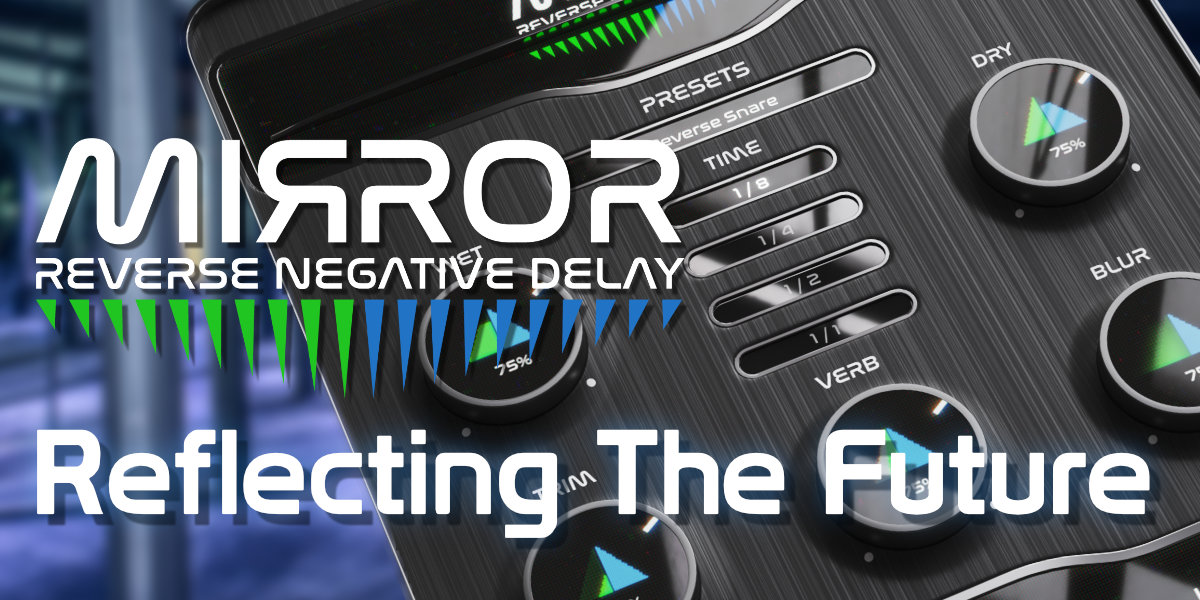
 PRAGUE, CZECH REPUBLIC: independent development teams federation United Plugins is proud to announce the availability of founding partner JMG Sound’s Mirror ahead of its time as the world’s first reverse negative delay plug-in — paradoxically capable of applying effects, reversing audio, and playing it back before the event even begins by reporting a ‘fake’ latency to the host DAW (Digital Audio Workstation), which then compensates, perfectly aligning the end of the effect with the start of the original sound — as of February 1…
Imagine, if possible, owning a plug-in that effectively sees the future, one which is capable of applying effects, reversing audio, and playing it back before the event even begins! Best of all, that imaginary plug-in could create the much-loved reverse reverb effect on snare drums automatically in a matter of seconds, so users could comfortably concentrate on the sound itself, instead of laboriously laboring over the production process. Put it this way: the timely arrival of JMG Sound’s Mirror literally leaves nothing to the imagination, instead making way for reality.
Readily (re)creating that classic reversed snare sound of the past — popularised to the present by purveyors of EDM (Electronic Dance Music) and also evident throughout the likes of ‘Panic Station’ by English alt-rockers Muse (released in 2013 as the fifth single from their sixth studio album The 2nd Law), while Led Zeppelin guitarist and producer Jimmy Page even went as far as claiming that he had invented the reverse reverb effect back in 1967 — contemporarily comes naturally to Mirror. No need to become a prisoner of the past now, though, thanks to Mirror making it perfectly possible to achieve that reversed snare sound instantly — and all without the hassle of having to set it up manually for each hit heard throughout the track being worked on.

On the face of it, then, Mirror is not just for working with snares. Indeed, it can sound amazing on a wide variety of sounds, such as injecting interesting rhythms to tedious drum loops, spicing up arpeggios and leads, or transforming vocals and pads into otherworldly textures. The limit lies only in the imagination of the user. Use it to transition into new elements in a song or add ethereal effects and ambiances to tracks.
Though it is not necessary to know how Mirror works when using it to create classic reversed snare sounds or other reversed reverb effects, it is interesting to read about anyway. As a reverse negative delay plug-in, Mirror records the audio played into a buffer and then plays it back in reverse, yet it plays this reversed audio back before the original audio plays, however. How, exactly, does it do this? Though it is easier said than done, in reality — reporting a ‘fake’ latency to the host DAW, which then compensates, allowing enough time for the buffer to fill and the audio to be reversed, perfectly aligning the end of the effect with the start of the original sound — it surely sounds simple enough when written about.
Simpler still, several straightforward controls are clearly visible via the plug-in’s photorealistic yet flexible GUI (Graphical User Interface), itself imbuing its users with a feeling that they are touching real-world hardware; however, it easily adapts to their needs since they can always drag the arrow at the bottom-right corner to change its size — smaller to save precious ‘screen estate’ or larger to make it easier on the eye and, as a result, even easier to use: WET — controls the level of the added signal; DRY — controls the level of the original signal; TRIM — controls how much of the end of the reversed audio will be trimmed off (in milliseconds); VERB — controls the dry/wet mix of the reversed reverb (applied to the audio before the reversing, so the result is a reversed reverb sound); and BLUR — controls the dry/wet mix of a short reverb (diffusing the audio, so suited to softening any transients that might be too dynamic for the reversed effect). Furthermore, FILTERS are also available in HP and LP flavors — the former controlling the frequency of a high-pass filter applied to the reversed audio (ranging from 20Hz to 2kHz), latter controlling the frequency of a low-pass filter applied to the reversed audio (ranging from 200Hz to 20kHz). All are easy to use and allow Mirror users to soften, trim, filter, extend the reverse effect to seamlessly transition from wet to dry, duly smooth out transients, remove bass punch, reduce harsh attacks, or lower high-end frequencies; all work to make the effect act as a supporting role while the original sound stays center stage, which is the way it should be.
But while it is well worth mentioning here on the home straight that the Mirror plug-in provides maximum audio quality by using internal 64-bit audio processing as well as being able to handle any sampling rate — as, indeed, is the case with all plug-ins released under the United Plugins umbrella, so why not try it at 192 kHz (or even higher) — and also the fact that it intelligently detects whether it makes sense to perform any processing at all — if not, it temporarily turns on sleep mode, meaning it requires virtually no CPU (Central Processing Unit) power at all, thereby saving computing resources for other processes — what it really comes down to is this: musically making the reversed reverb effects of anyone’s imagination quickly and easily come to life in today’s DAW-driven recording world — an already amazing world which would, without doubt, have been unimaginable to the likes of Jimmy Page back in 1967 — without laboriously labouring over the production process is truly a dream come true, thanks to independent development teams federation United Plugins and founding partner JMG Sound working together in perfect harmony to make Mirror a reality well worth working with in today’s DAW-driven recording world.
JMG Sound’s Mirror is available to purchase for a time-limited introductory promo price of only €22.00 EUR until February 28, 2022 — rising thereafter to its regular price of €69.00 EUR — as an AAX-, AU-, VST-, and VST3-compatible plug-in (using internal 64-bit audio processing capable of handling any sample rate) directly from United Plugins here: https://unitedplugins.com/Mirror/ (A 15-day, fully-functional trial version for macOS 10.10 and newer and Windows 8/10 can be downloaded for free from here: https://unitedplugins.com/download/)
Note that no iLok, dongle, or internet access is required for Mirror activation. (All United Plugins software uses license files for activation and owners can freely use purchased software on all their computers as long as they are the user.)
See and hear Mirror in action in United Plugins’ illuminating introductory video here:
About United Plugins (www.unitedplugins.com)
As implied in the carefully chosen wording for an apt appellation that really represents how the Prague-registered Limited Company came about and what it collectively creates, United Plugins is a federation of small, independent development teams comprised of individuals involved in the music industry. Indeed, the founding triad of FireSonic, JMG Sound, and SounDevice Digital can count engineers, producers, and artists amongst their ‘united’ names. Needless to say, all were seeking the freedom to create the tools that they would like to use in their studios and on their projects. And all agreed that this could be better achieved when working together. Though United Plugins’ proliferating product portfolio may not always be for the musical masses, surely someone, somewhere will always find those tools to be a perfect fit for their own music productions… just like those inventive individuals behind United Plugins’ partner brands, the ranks of which have since swelled to include Muramasa Audio and MeldaProduction. Thanks to the latter letting United Plugins utilise its super-easy licensing system, which is why selected MeldaProduction products are also available from the United Plugins website, a thriving future for the federation is assured.
© 2022 United Plugins

 TALLMAN, NY, USA: picking up where it left off with its CLA-200 Studio Reference Amplifier, a 200W RMS per channel Class A/B affair developed in close collaboration with GRAMMY® Award-winning mix engineer Chris Lord-Alge, Avantone Pro is proud to introduce its CLA-400 bigger brother — built the old-school way as a classically-designed Class A/B amplifier to bring about a dynamic, high-output, high-resolution, full-range system designed to be paired with large passive monitors demanding the highest amounts of power — as of February 1…
As alluded to by its ‘numerical’ nomenclature, the CLA-400 can generate over 400W per channel into an 8Ω load, lending its use as a perfect fit for medium to large passive monitors in a studio environment where its standard 3U (483mm W x 133mm H x 487mm D/19” W x 5.25” H x 18” D) rack-mount chassis conveniently comes into its own. Of course, the CLA-400 clearly warrants pairing with large passive monitors that demand the highest amounts of power that it is duly designed to deliver from the ground up.

Ultimately, then, the CLA-400 is a dynamic, high-output, high-resolution, full-range system built the old-school way — as a classically-designed Class A/B amplifier. As such, Avantone Pro paid particular attention to creating an amplifier in the traditional studio style, with ample analog VU (Volume Unit) meters, high-quality Japanese components, and a serious toroidal transformer linear power supply, as well as implementing a classic bipolar transistor design delivering a robust bottom end. Extremely low distortion, steady performance under harsh conditions, and open and transparent sound attributes all combine to make the CLA-400 an obvious choice for discerning studios seeking serious dynamic range.
Notable no-compromise components notwithstanding, it is worth noting that the CLA-400’s convection-cooled design makes for silent operation. So since there is obviously no fan noise involved as a result, it can reside in the same location as the passive monitors to which it is providing power — perfectly suited to installation in studio control rooms, in other words. Indeed, it is designed to be used in a studio environment requiring high power output with no fan noise.

Needless to say, the CLA-400 capably delivered a powerful 400W into 8Ω under test conditions, while it is also worth noting that it can run at one third power without thermal fault — findings borne out by its impressive tech specs: 8Ω stereo power (1kHz): 360W; 4Ω stereo power (1kHz): 540W; 8Ω bridge power (1kHz): 760W; slew rate (at 1kHz): 28V/us; input sensitivity (1kHz): 0.775V (0dBU); Total Harmonic Distortion (1kHz): <0.1%; intermodulation distortion (at 10% rated power 1KHz): <0.1%; crosstalk: -70dB; frequency response: 20Hz-20kHz +/-0.5dB; frequency response: 20Hz-20kHz +/-0.5dB; input impedance: 20KΩ (balanced)/10kΩ (unbalanced); damping factor(100Hz, 8Ω): 250; signal-to-noise ratio (A Weighted): >103dB.
Time to make some room in a suitable studio rack and make an attentive return to passive monitoring, maybe? After all, Avantone Pro puts out 800W of reference-grade power with its all-new CLA-400 studio reference amplifier built the old-school way, weighing in at a reassuringly solid 22.2kg (49lb)!
The CLA-400 is available at Avantone Pro’s US Dealers (http://www.avantonepro.com/us-dealers.php) with a MAP (Minimum Advertised Price) of $1,199.00 USD. (European SSP — Suggested Selling Price — is €1,199.00 EUR, excluding VAT, with worldwide Distributors listed by country here: http://www.avantonepro.com/worldwide.php)
For further information, please visit the dedicated CLA-400 webpage here: http://www.avantonepro.com/cla-400.php
About Avantone Pro (www.avantonepro.com)
As a producer of affordable high-quality studio monitors, reference headphones, microphones, and accessories, Avantone Pro is a different kind of audio company — a creative vehicle, in effect, enabling its core team to bring to market the things viewed as missing in the industry. Indeed, this could be anything as simple as meeting a particular price point to give excellent quality for reasonable pricing to a product that simply does not exist until built by that team. Far from using the shotgun approach to creating a product line, however, each and every product produced has passion and purpose driving it forward. Regardless of whether attracting a two- or four-figure price tag, attention to design is consistent throughout all Avantone Pro products. Performance comes first, of course, but a great deal of design time is spent creating visually attractive products. Put it this way: the company collectively enjoys classic, timeless designs itself; it is convinced, therefore, that others feel the same way! With its microphones and monitors used in studios around the world — whether, within home-based project setups or world-renowned multi-million-dollar facilities, Avantone Pro is sensitive to the real-world operating budgets of bigger and smaller studios alike but also appreciates struggling songwriters/artists who are passionate about creating great music yet must adhere to budget limitations based on common sense spending. Since it strives to offer products that anyone would be proud to own and have long-term use of in the quest for creating great music, even those on a budget can comfortably access Avantone Pro’s world-class sound.
© 2022 Avantone Pro

LONDON, UK: Spitfire Audio is proud to announce the availability of LABS Glass Piano — putting the sound of Philip Glass’ beloved baby grand piano upon which he has written all of his compositions for the past 30 years into anyone’s hands by recording it in the same room it has occupied since acquisition at the celebrated composer’s home in Manhattan, NYC, USA and making it available as the latest addition to the sound-specializing British music technology company’s infinite series of free software instruments in its award-winning, easy-to-use plug-in presented in AAX, AU, VST2, and VST3 formats for use in any compatible DAW (Digital Audio Workstation) without needing Native Instruments’ KONTAKT sample playback engine — as of January 31…

As an acclaimed American composer and pianist, Philip Glass needs no introduction, surely, since he is widely regarded as one of the most influential composers of the late 20th Century, cited as stylistically evolving minimalist musical forms with which he is associated. As such, the celebrated composer’s entire breadth of work over the past 30 years — including The Piano Etudes, all of his Academy Award-nominated film scores (such as Kundun, Notes on a Scandal, and The Hours), 14 symphonies, as well as operas Galileo Galilei and In the Penal Colony, amongst hundreds of other compositions — has been written on his beloved baby grand piano.
Put it this way: with the timely release of LABS Glass Piano, the sound of that piano is effectively now available to the (non-paying) public for the first time as anyone downloading Spitfire Audio’s latest LABS free software instrument will be embarking on a musical voyage of discovery, dazzled by the unique sonic personality of Philip Glass’ beloved baby grand piano via a carefully chosen selection of one-off sounds — ranging from the classic and beautiful Glass Grand preset through to soft and atmospheric warps produced from raw recordings by the talented team at the sound-specializing British music technology company — released to coincide with the celebrated composer’s 85th birthday.

Better still, Philip Glass himself hopes that this close collaboration with Spitfire Audio will open a small viewing window into his world of writing, practicing, and performing. “It’s not just the piano and its sound, it’s the room it’s in — the density of the walls and floorboards and the temperature.” So says the celebrated composer, continuing: “It’s how young or old a piano is; it’s even how the keys are varnished. My piano has a heavy action. Just like people, pianos have personalities. If you look at all 88 keys, the piano is different in different places. The lower octaves of my piano are not meant to be bold and aggressive. They are meant to be beautiful and spiritual, and that’s how they sound.”
Bringing both beauty and spirituality into music surely sounds like an awe-inspiring abstraction, and what better way to do that for free than by utilizing LABS Glass Piano’s six (Glass Grand, Glass Grand Soft, Anthem, Floe, Metamorphosis, and North Star) presets and easy-to-use (expression, dynamics, attack, REVERB, TIGHTNESS, and release) controls. Combining those things to put the sound of Philip Glass’ beloved baby grand piano into anyone’s hands, LABS Glass Piano is suited to both beginners and professionals alike — thanks to the simple UI (user interface) involved. His hope — as stated — has happened already.

All that is left for us to collectively do is wish the celebrated composer to which the latest addition to Spitfire Audio’s infinite series of free software instruments made by musicians in London for anyone anywhere obviously owes both its apt title and creative content the happiest of birthdays — with many more minimalist musical years ahead! After all, as Philip Glass maintains: “My piano has been my piano for 30 years… the way I want it to sound.”
LABS Glass Piano is available as an AAX-, AU-, VST2-, and VST3-compatible plug-in supporting Native Instruments’ NKS (NATIVE KONTROL STANDARD®) for Mac (OS X 10.10 or later) and Windows (7, 8, and 10 — latest Service Pack) that loads directly into any compatible DAW (Digital Audio Workstation) for free from here: https://labs.spitfireaudio.com/glass-piano
Spitfire Audio’s namesake Spitfire Audio application allows anyone to buy now and download anytime and is available for free from here: http://www.spitfireaudio.com/info/library-manager/
For more in-depth information, please visit Spitfire Audio’s LABS Frequently Asked Questions webpage here: https://www.spitfireaudio.com/info/faq/labs/
See and hear LABS Glass Piano in action in Spitfire Audio’s stylishly short and sweet trailer video here:
About Spitfire Audio (www.spitfireaudio.com)
Spitfire Audio is a British music technology company that specializes in sounds—sample libraries, virtual instruments, and other useful software devices. It collaborates with the best composers, artists, and engineers in the world to build musical tools that sound great and are exciting to use.
© 2022 Spitfire Audio Holdings Limited

 PRAGUE, CZECH REPUBLIC: W.A. Production, producers of high-end professional-sounding samples, instrument and effect plug-ins, DAW (Digital Audio Workstation) templates, and more, is proud to announce the availability of CHORDS — conveniently conjuring up chords of all shapes and sizes at a couple of clicks as a must-have MIDI effect plug-in originally designed for EDM (Electronic Dance Music) productions, but beneficial in any musical situation or genre needing an inspirational and creative kick-start — as of January 22…
With writer’s block stubbornly setting up a musical roadblock beyond which it is tough to stop staring at a blank project page idling in a DAW, inspiration, and creativity can sometimes seem to have run dry. It is for this reason that W.A. Production has created CHORDS, conveniently conjuring up chords of all shapes and sizes at a couple of clicks as a must-have MIDI effect plug-in originally designed for EDM productions, but beneficial in any musical situation or genre needing an inspirational and creative kick-start. Thanks to its intuitive interface, it is easy to try out new ideas for tracks as the must-have MIDI effect plug-in in question quickly takes the strain — suggesting single four-note chords to creating complete eight-chords riffs and much more besides — so users will soon be speeding along with a fresh hit of inspiration and creativity, their musical destination in plain sight.

Simply load the CHORDS MIDI effect plug-in in front of any MIDI-triggered audio-generating plug-in in a DAW, hit play, and musically marvel at how the W.A. Production’s state-of-the-art software genius generates looped options for up to eight chords with full control over chord shape, INVERSION, VELOCITY, and more. It is then just a case of dragging the MIDI straight from the plug-in to the DAW project and letting creativity flow freely as CHORDS gently guides its users toward their musical destination with sensible suggestions.
Going global or granular, all is perfectly possible when working with CHORDS — global controls adjust inversions, length, speed, and root key of the entire playback, permitting users to make on-the-fly adjustments to their entire riff as a simple as possible process, while clicking on a colored segment allows for more granular control over chord shapes, including MAJOR and MINOR variations, as well as individual INVERSION and VELOCITY.
Simple segments number up to eight, each containing a different chord type and allowing users to choose to trigger between one and four notes per chord. Choice notwithstanding, playback of all such segments sync to the host BPM of the DAW, duly remaining locked in time at all times. That said, users can easily add and subtract segments at any time, as well as independently change the range of parameters for each segment.
Segments can be programmed with inversions from -6 to +6, transforming chord shapes and placing the root note inside the chord itself. Easily experiment by pushing the lowest notes up an octave or the highest notes down an octave to turn chords inside out!
Once chords are loaded and a segment is chosen, there are 18 small black buttons in the center of the interface with which users can choose S (Subdominant), T (Tonic), or D (Dominant) chord shapes — simple triads right through to more complex shapes, let CHORDS find the right notes for any related chord. Clearly, CHORDS users wishing to make use of an awkward G7sus4 or Bm7b5, say, can do just that — and all without worrying about the complicated chord shapes concerned.
CHORDS also makes it easy to get chord progressions into projects by simply dragging and dropping them from the plug-in itself into the DAW. It is just a case of editing thereafter to anyone’s heart’s content, chopping up the MIDI, and transposing and twisting CHORDS’ suggestions to suit the style of music being worked on.
CHORDS comes complete with a large library of factory preset progressions, helpfully labeled in detail. All act as useful musical motifs to get users up and running in next to no time, and all of which can ultimately form the basis for whole tracks. No need for EDM producers — or anyone else, for that matter — to stay stuck with writer’s block, but rather speed along with constantly fresh hits of inspiration and creativity, their musical destination always in plain sight.
CHORDS is available to purchase for a time-limited introductory promo price of only $34.70 USD (representing a significant 65% saving) — rising thereafter to its regular price of $99.00 USD — as a 64-bit AU-, VST-, and VST3-compatible plug-in for macOS (10.15 or later) and 32- or 64-bit VST-, and VST3-compatible plug-in for Windows (8 or later), as well as an AAX-compatible plug-in for Pro Tools (11 or higher), directly from W.A. Production via its dedicated webpage, which also includes some audio previews, here: https://www.waproduction.com/plugins/view/chords
14-day, fully-functional trial versions of all W.A. Production plug-ins — including CHORDS — are available by signing up for an account for free here: https://www.waproduction.com/users/login
Watch W.A. Production’s informative introductory video for CHORDS here:
About W.A. Production (www.waproduction.com)
W.A. Production was created by producer/DJ and sound designer Redhead Roman in 2014. Helpfully, his deep-rooted passion for EDM (Electronic Dance Music) and time spent in the music industry ignited a desire to put top-tier audio products into the hands of every electronic music producer at prices that they could actually afford. By building its initial reputation on delivering high-end professional-sounding samples, the six-strong team of today has hurriedly matured into boasting a successful brand that offers instrument and effect plug-ins, DAW (Digital Audio Workstation) templates, informative articles, and exclusive interviews with some of the hottest EDM artists around, alongside e-books and tutorials, as well as online video courses. It is also recognized for practicing a ‘hands-on’ style of customer support and service, ensuring that every customer’s experience is a great one. On the face of it, then, that Roman and his talented team remain extremely humble and interactive with their customers, members, and the EDM scene as a whole to this day is an amazing attribute in itself since W.A. Production has experienced substantial growth — growth that is constantly being expanded still further by testing boundaries, pushing creativity and innovation to new heights. Indeed, it is all driven daily by asking themselves the same question: “What about making your sound better?”
© 2022 W.A. Production

LONDON, UK: Spitfire Audio is proud to announce the availability of SPITFIRE APPASSIONATA STRINGS — seriously capable of creating flowing, passionate lines full of movement and dynamism as a next-generation string legato library recorded using a new technique that the sound-specializing British music technology company calls Impulse Legato, something that has its roots in experiments conducted back in 2007 when the then-non-commercial concern created its first bespoke orchestral libraries, albeit all set to infuse music with more passion than ever before with what it collectively considers to be the most alive- and best-sounding string legato sound available today — as of January 20…
SPITFIRE APPASSIONATA STRINGS has been brought to life to create melody lines that definitively deliver passion, emotion, and intensity, thanks to beautiful long and flowing notes captured courtesy of the talent of 30 of London’s finest string players performing in the hallowed (Lyndhurst) Hall at London’s legendary AIR Studios, so it will work seamlessly with Spitfire Audio’s AIR-recorded orchestral libraries like SPITFIRE SYMPHONIC STRINGS — summing up the foundation of the sound-specialising British music technology company’s approach to sampling, recorded with no expense spared via the finest signal path, playing host to the same 60 star string players performing on the same instruments featured on so many memorable scores recorded there for films that have grossed billions between them — and SPITFIRE CHAMBER STRINGS — smaller section with more detail and focus than the SPITFIRE SYMPHONIC… series, while still capturing the beautiful resonance of Lyndhurst Hall — as well as other offerings. On the face of it, then, that should come as little surprise since SPITFIRE APPASSIONATA STRINGS was also recorded in situ using priceless valve and ribbon mics feeding Neve ‘AIR Monserrat’ remote mic pre-amps into a Neve 88R large-format console before being digitally recorded at 96K via two-inch Studer tape. The result is a next-generation string legato library like no other, helpfully housed in Spitfire Audio’s award-winning AAX-, AU-, VST2-, and VST3-compatible, NKS (Native Kontrol Standard)-ready plug-in that loads into all major DAWs (Digital Audio Workstations) without the need for any additional software.

Some might be surprised to learn, though, that the legatos residing at the creative core of SPITFIRE APPASSIONATA STRINGS are actually the result of many years of research and development. Company co-founder and composer Paul Thomson have long been hard at it, innovating and improving the process for recording legatos since Spitfire Audio’s first recording sessions 15 years ago. According to Paul Thomson himself, “It’s something that has its roots in our experiments back in 2007 when we first created the bespoke orchestral libraries.” So it is fair to say that SPITFIRE APPASSIONATA STRINGS is informed by and benefits from those years of learning and expertise, a time in which Spitfire Audio has been busy crafting samples, creating a custom UI (User Interface), and collaborating with AIR Studios — Spitfire Audio’s spiritual home housing the architecturally unique Lyndhurst Hall where many blockbuster scores have been birthed, benefitting from its globally renowned acoustic properties much loved by composers and musicians alike as the gentle room reverberation always adds beauty to anything played within there — to fine-tune the process of capturing the intensity of performance with attention to detail, culminating in a market-leading finished product. Indeed, in the case of SPITFIRE APPASSIONATA STRINGS, inspiration will come in a matter of (musical) moments since those legatos — as alive sounding as they are — offer instant gratification from the keyboard with perfectly balanced vibrato while needing minimal intervention in terms of tweaking to enable composers to write in a beautiful, soaring melodic style in stunning detail.
Time, then, to tunnel down into what inspired Spitfire Audio to make SPITFIRE APPASSIONATA STRINGS as inspirational as it is. Readily referencing the aesthetic of classic melodies from the scores of celebrated composers like John Williams and fellow American Thomas Newman, this medium-sized (8,6,6,6,4) string band duly delivers a much-sought-after performance style that is now anyone’s for the taking — to the point where the sound-specializing British music technology company collectively considers this to be simply the best sounding and most alive, passionate string legato sound captured thus far. For SPITFIRE APPASSIONATA STRINGS allows those who work with it to compose with emotion, intention, inspiration, and, of course, passion.
 Delving deeper still, Spitfire Audio’s so-called Impulse Legato recording technique has resulted in a wide variety of detailed legato types being offered in SPITFIRE APPASSIONATA STRINGS, such that the main ‘combi’ patch features a combination of slurred, bowed, and intense Sul I intervals — albeit available only in Violins 1, Violins 2, and Cellos — with repetition-based alt-attacks. These techniques offer five dynamic layers, delivering incredibly smooth and expressive performances, four round-robin attacks, vibrato, and velocity-switching between legato types. “There’s a huge amount of clever stuff going on under the hood here,” Paul Thomson concedes, continuing: “We’ve captured these five dynamic layers in such a way as to really maximize the potential for this kind of singing, passionate lines, and that extends from the whisper-quiet pp level all the way up to the full-throated, absolute fortissimo, with all the detail in between. You can ride the mod wheel to get through the different dynamic layers, and that works really well just on the basic setting, but we’ve got some new tech in here on the dynamic front, which is called dynamics smoothing [DYN SMOOTHING]; if set to RELAXED, travel through the dynamics is much smoother, and so if you’re playing something where you really want to be able to ride the mod wheel — without worrying too much about those layers — then the dynamics smoothing will help you to not have to worry quite so much about where you’re crossing over the transitions, and it does a really clever job of smoothing all of that stuff out.”
But better still, says Paul Thomson, “This is a library that you genuinely don’t have to move the mod wheel that much to get a very definite change in the dynamic and the kind of musical emotion of what you’re playing; it really is very sensitive and incredibly easy to get a fantastically musical performance from the library — just playing with the SUSTAIN notes makes the hairs on the back of my neck stand up, so you can just do these lovely, beautiful expansive things, playing polyphonically, unlike with the legato articulations, but the legato is obviously the prime reason for the existence of the library, so that’s the main thing that you’re probably going to be using most of the time.”

That the innovative Paul Thomson is so sold on the company he co-founder’s latest market-leading finished product is hardly surprising since Spitfire Audio has surely succeeded in building a library that duly delivers those beautiful, soaring melodies heard in scores from the likes of Thomas Newman and John Williams while working seamlessly with its other orchestral libraries. It is, of course, especially satisfying to pair SPITFIRE APPASSIONATA STRINGS with those libraries likewise recorded in the hallowed (Lyndhurst) Hall at London’s legendary AIR Studios, thanks in no small part to its inclusion of no fewer than 11 professional signals — seven (Close, Tree, Ambient, Outrigger, Close Ribbons, Stereo Room, and Mids) mic positions, plus four expertly engineered mixes — to truly capture the sound produced by the soloists and ensemble, expanding and beautifully blooming inside the performance space concerned. Keyboard-centric composers seeking to literally lay their hands on the best sounding and most alive, passionate string legato sound captured thus far now need to look no further than SPITFIRE APPASSIONATA STRINGS.
SPITFIRE APPASSIONATA STRINGS is available as an AAX-, AU-, VST2-, and VST3-compatible, NKS (Native Kontrol Standard)-ready plug-in that loads directly into a DAW (Digital Audio Workstation) for a time-limited promo price of £149.00 GBP (inc. VAT)/$179.00 USD/€179.00 EUR (inc. VAT) until February 10, 2022 — returning thereafter to its RRP (Recommended Retail Price) of £199.00 GBP (inc. VAT)/$249.00 USD/€249.00 EUR (inc. VAT) — from here: https://www.spitfireaudio.com/shop/a-z/spitfire-appassionata-strings/ (Note that there is a time-limited offer of an attractive 35% saving on its RRP available to owners of SPITFIRE SYMPHONIC STRINGS, SPITFIRE SYMPHONIC MOTIONS, SPITFIRE SYMPHONIC STRINGS EVOLUTIONS, or SPITFIRE CHAMBER STRINGS, who should simply login to their Spitfire Audio account to access their discounted price while it is available to them.)
Spitfire Audio’s namesake Spitfire Audio application allows anyone to buy now and download anytime and is available for free from here: http://www.spitfireaudio.com/info/library-manager/
For more in-depth information, including some superb-sounding audio demos, please visit the dedicated SPITFIRE APPASSIONATA STRINGS webpage here: https://www.spitfireaudio.com/shop/a-z/spitfire-appassionata-strings/
Watch Paul Thomson’s ‘traditional’ walkthrough of SPITFIRE APPASSIONATA STRINGS here:
About Spitfire Audio (www.spitfireaudio.com)
Spitfire Audio is a British music technology company that specializes in sounds—sample libraries, virtual instruments, and other useful software devices. It collaborates with the best composers, artists, and engineers in the world to build musical tools that sound great and are exciting to use.
© 2022 Spitfire Audio Holdings Limited

 KINGSWINFORD, UK: following hot on the heels of its (discontinued) award-winning Fusebox true analogue monophonic synthesizer putting into practice the REAL ANALOGUE VOICE & MODULATION CIRCUITS wording boldly blazoned across its brightly-colored orange panel that surely stood out from (the sound) of the crowd, British boutique electronic instruments innovator Analogue Solutions is proud to announce the availability of its Fusebox X followup — featuring the same general (three-VCO/multimode filter, etc.) specification as the original as a readily released reincarnation bolstered by a three-note polyphonic mode alluded to in its tidied up front panel’s ANALOGUE 3 VOICE POLYSYNTHESISER wording, as well as several new features and many internal performance tweaks — as of January 19…

Putting into practice the REAL ANALOGUE VOICE & MODULATION CIRCUITS wording boldly blazoned across its brightly-colored orange panel fronting a no-compromise steel/aluminum-constructed casing (with no plastic moldings) that surely stood out from (the sound) of the crowd — to partially paraphrase the early-Eighties British breakthrough hit from synth-pop pioneers The Human League (who have a soft spot for Analogue Solutions synthesizers themselves) — patently paid dividends for Analogue Solutions as its Fusebox true analogue monophonic synthesizer scooped several awards after its 2017 launch. Little surprise there, though, since analogue as in really analogue sounds amazing, after all! Aside from the MIDI-to-CV circuit, which, by its very nature, must include a digital element, everything else is absolutely analogue; for the Fusebox concept trades on real transistors and op-amps — no CPU (Central Processing Unit) stabilized and quantized circuits, no DCOs (Digitally-Controlled Oscillators), and no digital EGs (Envelope Generators), as is often the case with many so-called analogue synthesisers. Since the circuitry is based on designs dating back to the mid-Seventies, Fusebox proudly possesses a truly vintage sound that is truly the kind of sound that The Human League — and many others, of course — made their own and continue to trade on to this day during an analogue renaissance that is still showing no signs of abating anytime soon following last month’s (mainly) sold-out (mainly) arena-visiting UK tour.

Some say practice makes perfect. Readily releasing the Fusebox X ANALOGUE 3 VOICE POLYSYNTHESISER as a timely reincarnation of its award-winning Fusebox true analogue monosynth predecessor, but bolstered by a three-note polyphonic mode alluded to in its tidied up front panel’s wording, as well as several new features and many internal performance tweaks, Analogue Solutions’ striving towards analogue perfection is also showing no signs of abating anytime soon. After all, the British boutique electronic instruments innovator has not long launched its Limited Edition BLACK Colossus supersized synth, symbolizing so much more than a powerful analogue ‘workstation’ with no fewer than 12 VCOs (Voltage-Controlled Oscillators) beating at its monumental musical heart — rather representing art, architecture, and superlative studio furniture at its hand-built best, but back this time as a limited-edition run of 20 units with a black-colored panel scheme in complete contrast to the still-available Colossus.
Clearly, Fusebox X likewise wears its colors well with Analogue Solutions’ sought-after synth sound shining through. There are three VCOs beating at its musical heart, here is a precision electronic musical instrument that combines must-have electronic circuitry to create a powerful synthesizer statement seriously housed in an eye-catching, compact box. But this is to be expected given its industry pedigree, perhaps, for Fusebox X is, likewise, designed by Analogue Solutions founder Tom Carpenter. As a fervent fan of electronic music and also an active electronic musician himself, he naturally knows a thing or two about programming synthesizers, so, again, his latest creation is not the result of engineering design decisions alone — nor driven by a steering committee of men (or woman) in suits. So what, exactly, is going on inside this beautifully-built box of subtractive synthesis tricks, then?

Those three VCOs, for starters — sawtooth and square waveforms available to each and all. And all have CV (Control Voltage) inputs for PITCH and PWM (Pulse Width Modulation) alongside manual PW (Pulse Width) controls. Creatively speaking, though, there are some striking variations: VCO 1 has OCT (octave) and XMOD (cross-modulation) FROM VCO2 switches; VCO 2 has a WIDE TUNE (range) switch — allowing a wide tuning range (right down into low-frequency territory) — alongside an oscillator SYNC FROM VCO 1 switch; VCO 3 also has a WIDE TUNE switch, together with a MIDI PITCH switch control — can be disabled to make this a free-running oscillator, ideal for modulation. Meanwhile, VCO 2 and VCO 3 can both be pressed into service as LFOs (Low-Frequency Oscillators) — as announced by their respective VCO / VCLFO wording. All as it was in the original Fusebox, in other words.

This neatly leads to the changes implemented in the Fusebox X’s adjacent MIXING section, where the four rocker switches sited there in the original Fusebox have been replaced with mini-jack sockets for flexible patching purposes. Thereafter, the all-important FILTERS section remains unchanged, centered as it is around a 12dB MULTIMODE VCF (Voltage-Controlled Filter) featuring LP (Low Pass), HP (High Pass), BP (Band Pass), and NOTCH filters and associated patch points, plus CUTOFF MODULATION controls with patch points. Flexibility further abounds at the — renamed — AMPLIFYING section with a VCA (Voltage-Controlled Amplifier) allowing for EG 2 and THRU (bypass) switching; an advanced — also renamed — MODULATING section with a FADE IN (delay)-featured LFO; and an — also renamed — CONTOURING section with two trigger option-friendly envelope generators (EG1 and EG2).
Elsewhere, the INTERVAL GENERATOR — a special type of pitch transposer that allows users to set six different pitches to each of the switches, then transpose the VCOs manually to create performances — and PATTERNATOR pots have been replaced by precision type in Fusebox X, with STEP 1 and NOTE0 trigger outputs in the associated CONTROL section serving up versatile ways to trigger the PATTERNATOR and INTERVAL GENERATOR, while the INTERVAL GENERATOR’s CLOCK IN (input) now allows automatic transposition in a variety of ways. Tweaking the original Fusebox’s design continues with its ARPEGGIATOR being replaced by the SEQUENCING section’s mini-step sequencer in Fusebox X, though there are also a wider range of playable notes available via MIDI, should users wish to play the true analogue monophonic synthesizer from an external keyboard or sequencer. Whichever way they choose to use it, the added 440Hz TUNER certainly helps when working with the British boutique electronic instrument in question.

Questioning the original Fusebox design, Director Tom Carpenter’s creative additions to its Fusebox X successor certainly succeeds in imbuing an already well-received British boutique electronic instrument with further creative scope as a true analogue monosynth, albeit one which is now tri-phonic (three-note polyphonic) to boot, bolstered by more mini-jack input and output sockets, so it can be cross-patched within itself to create an almost infinite range of sounds — themselves bolstered by many internal performance tweaks — or cross-patched with other synthesizers and modular systems for further flexibility. An award-winning combination, if ever there was one!
Limited quantities of Fusebox X are already available to purchase directly from Analogue Solutions for £1,350.00 GBP (excluding VAT) via its dedicated website, where black or orange (optional) rack ears are also available, here: https://www.analoguesolutions.com/fusebox-1 (As Analogue Solutions cannot ship to Austria, Belgium, France, Germany, Holland, Luxembourg, Switzerland, and the US, those territories are serviced by its growing global network of authorized dealers listed — in no particular order — here: https://www.analoguesolutions.com/dealers)
See and hear Fusebox X in action while watching Analogue Solutions’ tempting teaser video here:
About Analogue Solutions (www.analoguesolutions.com)
Analogue Solutions is a UK-based boutique electronic instruments innovator that specializes in true analogue synthesisers, sequencers, and Eurorack modules. More than 25 years of experience in the industry means that it was right there at the start of the Eurorack revolution — the third company to start producing modules, in fact. Furthermore, Analogue Solutions products are all hand built in England — many being tested by founder Tom Carpenter himself, who has hands-on involvement in all aspects of the company. Characterful to boot, Analogue Solutions’ innovative instruments are applauded for proudly possessing a truly vintage sound — synthesisers featuring fully-analogue audio paths with analogue LFOs (Low Frequency Oscillators) and EGs (Envelope Generators) are the order of the day here. Having no memories means that nothing is being made to sound sterile by CPU (Central Processing Unit) control; conversely, turning a knob directly changes the voltage or current in an actual synth circuit to audible affect. As implied by the name, Analogue Solutions consistently constitutes proof of Tom Carpenter’s genuine passion for analogue synths, drawing upon his years of owning and using vintage analogue synths and drum machines that he still uses in his own music productions… alongside Analogue Solutions products, predictably. Put it this way: with its present-day music electronics for electronic musicians mantra ringing true as always, Analogue Solutions has certainly come a long way with its boutique electronic instrument innovations!
© 2022 Analogue Solutions (UK) Ltd