




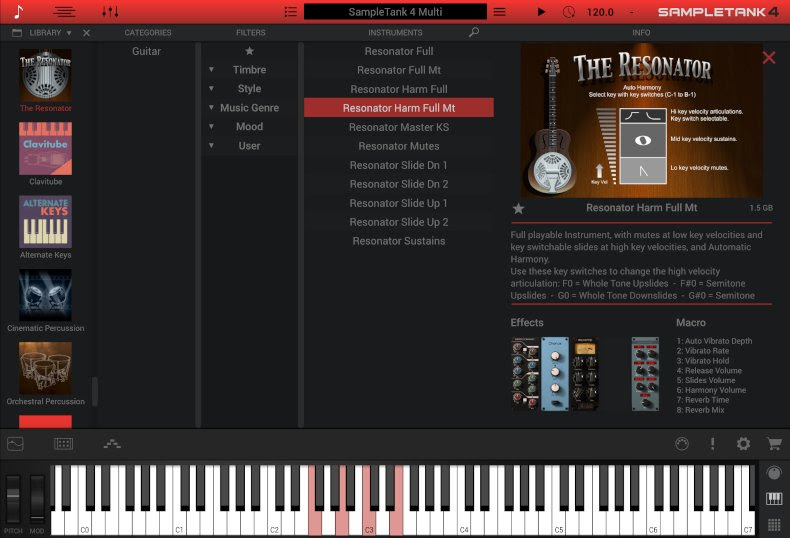
August 3, 2021 – IK Multimedia releases The Resonator, a new SampleTank collection created by sample library specialist Indiginus, which captures the magic of a traditional stringed instrument. Oozing with bluesy, folksy, twangy warmth, The Resonator’s multiple slide articulations offer incredible realism and are easily controllable with velocity switching and/or key switches, while an auto-harmony function creates even more convincing-sounding tracks.
From metal cones to metal slide
Invented in the 1920s, the resonator guitar quickly became a huge favorite for blues and bluegrass musicians due to its characteristically punchy, yet warm sound. Played like a traditional guitar with a bottleneck slide, or with raised strings using a metal slide like a lap steel, The Resonator for SampleTank was sampled using a metal slide for maximum effect, adding unmistakable mojo to any musical production.
Capturing every nuance
For the most authentic sound, a Hound Dog Dobro® resonator guitar was captured using a coincident mic setup. Positioned 8 inches in front of the instrument, a beautiful phase-free stereo image was achieved, with results that also sound great in mono. The overall sonic effect is upfront and present without any room tone that could muddy up mixes.
Intuitive, real-time playing
The emphasis is on playability and the goal was to create an instrument that will inspire musicians and composers to get their ideas down quickly, without getting in the way.
The main instruments allow performers to use key velocity switching to trigger slides (users can select up or down slides with key switches) as they dig in harder. This system allows for complex, but intuitive, real-time playing. Included are normal key switch versions, as well as “breakout” single articulation versions.
Home sweet harmony
For even more convincing real-time playing, automatic harmonies are also available. Select a key, and users can start playing. Also included are instruments that feature picking and strumming patterns and one instrument, “Southern Slide,” is an amped-up take on the resonator.
Options, pricing, and availability
The Resonator is available now from the IK Multimedia online store and from IK authorized dealers worldwide for a special introductory price of $/€49.99* through October 31, 2021
(reg. $/€59.99).
*All pricing excluding taxes

“HAMMERS represents the best possible representation of my personal vision for the way huge cinematic drums and percussion should sound, with enough variety and flexibility of signals for everyone to craft their own personalized interpretation.”
– GRAMMY® Award-nominated composer, keyboardist, record producer, and remixer Charlie Clouser (Saw, Wayward Pines, Nine Inch Nails), 2021

 LONDON, UK: Spitfire Audio is proud to announce the availability of HAMMERS — hitting hard as a comprehensive collection of drums and percussion instruments presented in the sound-specializing British music technology company’s dedicated plug-in with customizations in the mapping of the performances inside the GUI (Graphical User Interface) that are unique to the library itself; it is created in collaboration with GRAMMY® Award-nominated composer, keyboardist, record producer, and remixer Charlie Clouser (Saw, Wayward Pines, Nine Inch Nails) featuring 1,000 sounds across 58 drums, including detailed hits, ensembles, performance loops, and genre-bending warps recorded in a brutalist space comprising concrete, glass, and steel, allowing for a uniquely sharp attack and controlled reverb with which all levels of producers and composers can musically make an impact by creating intricate patterns or finding instant inspiration fit for elevating their craft for 2021 and beyond — as of July 22…

Spitfire Audio co-founder and composer Christian Henson has previously spent time working as an in-demand drum programmer from the unlikely-sounding electronic music world of drum and bass — characterized as it is by fast breakbeats, but clearly knows a good drum sound when it hits him. HAMMERS hits hard, having been developed to quickly provide its users with access to a cutting-edge collection of eclectic drums, percussion, and scrap metals — ultra-hyped, broadcast-ready sounds, tailored to work well when put to good use in various film genres, video games, and trailers. “Transcendent.” That is how Christian Henson himself begins putting the sound-specializing British music technology company’s latest library into words. “This library lifts our craft up an echelon and takes us into a new chapter,” he continues. “Cinematic drums from 2021 and beyond are going to sound like this.”

“Those are pretty glowing terms that I hope I can live up to,” Charlie Clouser counters, before readily recounting HAMMERS’ history: “Like many of us, I’ve been collecting sampled drum and percussion libraries for probably 30-plus years, but I’ve been playing drums for about 45 years, and sampling them for almost that long, and although I have a thousand percussion libraries, out of those thousand, there might be a hundred that are pretty good, ten that are really pretty good, but zero that does what I want, and that sound like my drums sound when I record them in my space with my techniques and my tunings and so on. So this entire effort behind HAMMERS was, I admit, a bit of selfish motivation: to try to capture the sound that I use in my productions and my scores and to put that under my fingertips in a way that is immediately useable and useful — not just to me, but to the wider spectrum of film, television, and media composers, and even people that are making albums that want a slightly left-of-center or bigger-than-life drum sound.”

Since HAMMERS itself is the brainchild of Charlie Clouser — “… renowned composer of the Saw franchise, Wayward Pines, Resident Evil, but also a former member of Nine Inch Nails,” notes Christian Henson, Spitfire Audio’s aim is true as always when choosing collaborators. After all, HAMMERS’ hard-hitting sounds have been recorded, processed, mixed, curated, and produced by the GRAMMY® Award-nominated American composer, collaboratively resulting in an immediately playable and instantly satisfying library featuring 100% all-new recordings, specially crafted for the comprehensive collection concerned.
Collectively, HAMMERS has 58 Drums arranged across eight drum types — Bass Drums, Darbukas, Frame Drums, Roto-Toms, Scrap (metals), Snares, Surdos, and Toms — captured in an acoustic environment to allow for fast-paced, hard-hitting performances, with a wide range of mic, mix, warp signals, and a choice of 12 distinctive reverbs to provide effortless control over extremely powerful drum performances using hard, brash sounds with fast attacks and tight controlled decays allowing for clear and legible patterns when played at speed.

Saying that things do not simply end there since HAMMERS’ hits are presented in a format that allows anyone to easily perform and sculpt their own rhythms — all captured in brilliant detail — featuring a mixture of over 130 performance techniques and beater types, including options for drum head tightness, to provide unparalleled access to a wide variety of unique tonalities, adding a deeply humanistic feel to drum and percussion cues. Composers and producers needing to push things harder can go bigger with 2 PLAYER and 4 PLAYER hits, duly delivering the natural resonance between the drums heard on the performances, to instantly create huge sounds without resorting to duplicating tracks. The default ENSEMBLES patch positions the entire collection of instruments across the keyboard — perfect for trying out the sounds themselves and adding flourishes to the performance loops, of which there are over 400 composed and performed by Charlie Clouser himself (with a little help from first-call percussionists Hal Rosenfeld and Lucas Fehring).
All are carefully composed in eight-bar loop phrases — all appropriate for their respective (70, 90, 110, 130, and 150 BPM) tempos — to provide an ability to build personalized versions of the patterns by not only stacking and rearranging via clear key-mapping but breaking up loops and end hits so users can control and develop the performances. Anyone asking ‘Are we there yet?’ can creatively take solace in the fact that the Warped loops capture the heavily processed sounds that Charlie Clouser is known for obsessing over, personally mixing and treating them using the same time-consuming and intricate techniques that he developed when working with American industrial rock band Nine Inch Nails and refined further for use in his films scores. Synths, step sequencers, a huge modular system, and 40 years of collecting guitar pedals and high-end rack-mounted processors all contributed to the 12 signals each forming uniquely warped processing of the same source material, allowing for a large variety of timbres and tonalities.

“As a drum programmer, having an ability to sculpt sound with rhythm is just absolutely scintillating,” says Christian Henson. However, he — and, indeed, HAMMERS — goes a lot further: “There are a lot of sounds in this library — over 1,000 different individual sounds; over 400 fresh, raw loops; and 400 raw loops with warping and shaping capabilities.” Clearly, that’s the case, but don’t just take Christian Henson’s (wise) word for it… according to Charlie Clouser himself, “HAMMERS represents the best possible representation of my personal vision for the way huge cinematic drums and percussion should sound, with enough variety and flexibility of signals for everyone to craft their own personalized interpretation.” Indeed, HAMMERS ultimately represents the two-and-a-half-years-in-the-making result of a perfect musical marriage between Charlie Clouser’s brutalist, industrial vision and experience in producing and composing — obsessing over every element, from development to recording and processing — combined with Spitfire Audio’s comprehensive approach to sampling, offering music-makers worldwide a wide selection of widescreen drum sounds to fit any production.
HAMMERS is available as an AAX-, AU-, VST2-, and VST3-compatible, NKS (Native Kontrol Standard)-ready plug-in that loads directly into a DAW (Digital Audio Workstation) for a time-limited introductory promo price of £199.00 GBP (inc. VAT)/$229.00 USD/€229.00 EUR (inc. VAT) until August 12, 2021 — rising thereafter to an MSRP (Manufacturer’s Suggested Retail Price) of £249.00 GBP (inc. VAT)/$299.00 USD/€299.00 EUR (inc. VAT) — from here: https://www.spitfireaudio.com/shop/a-z/hammers/ (Also, any ORIGINALS CINEMATIC PERCUSSION library owner ordering HAMMERS saves 30% off its MSRP until August 12, 2021.)
For more in-depth information, including some superb-sounding audio demos, please visit the dedicated HAMMERS webpage here: https://www.spitfireaudio.com/shop/a-z/hammers/
Spitfire Audio co-founder and composer Christian Henson and GRAMMY® Award-nominated composer, keyboardist, record producer, and remixer Charlie Clouser proudly premiere HAMMERS in a scintillating meeting of drum-programming musical minds here:
Watch Christian Henson’s hard-hitting walkthrough of HAMMERS here:
Watch Charlie Clouser’s break down of his score to one of the climactic scenes from this year’s Spiral: From the Book of Saw horror/mystery movie using HAMMERS here:
About Spitfire Audio (www.spitfireaudio.com)
Spitfire Audio is a British music technology company that specializes in sounds—sample libraries, virtual instruments, and other useful software devices. It collaborates with the best composers, artists, and engineers in the world to build musical tools that sound great and are exciting to use.
About Charlie Clouser
Composer Charlie Clouser’s never-ending search for bigger, heavier, and more brutal sounds — starting out as a drummer who became one of the go-to guys in Los Angeles during the early-Nineties for drum programming, remixes, and mad-scientist loop artistry as sampling technology evolved, spending almost a decade as the keyboardist and programmer in Nine Inch Nails, before becoming a composer of violent and intense scores for films like the Saw horror movie franchise — means that he always records and mixes his own drums for his scores. Since creating Hammers in collaboration with Spitfire Audio, his personally crafted sounds are finally escaping into the outside world for the first time.
© 2021 Spitfire Audio Holdings Limited

LONDON, UK: having secured an action-packed, non-scored clip from Season One of American superhero television series Stargirl that premiered on streaming service DC Universe, sound-specializing British music technology company Spitfire Audio is delighted to announce that it has teamed up with DC Entertainment, Mad Ghost Productions, and A-list composer Pinar Toprak — whose credits include Marvel movie Captain Marvel (2019), action-adventure TV series Krypton (2018-2019), and action-fantasy video game Fortnite (2017) — to offer the composing community an amazing opportunity to showcase their skills by reimagining the clip with their own score, working with top-tier visual material (including all dialogue and effects) to win some amazing prizes, as of July 16…
After an incredible 11,000 entries for Spitfire Audio’s Westworld competition last year, this time the composing community can download an exclusive clip from the DC Universe hit TV series Stargirl to work with high-quality visual content while working around dialogue and effects to practice composing to picture or even try it for the first time, thereafter submitting their entry before the competition deadline of 23.59 BST (British Summer Time) on August 12, 2021, to be in with a chance of winning some amazing prizes. Stargirl series composer Pinar Toprak will pick the winner and four runners-up who will be announced on September 23, 2021.

The stakes are high with the competition winner walking away with EVERYTHING (https://www.spitfireaudio.com/everything/) — bundling every Spitfire Audio library on two plug-and-play external SSDs (Solid State Drives) beautifully presented in a hand-crafted display box, signed by Spitfire Audio co-founders and composers Christian Henson and Paul Thomson, worth well over £20,000.00 GBP if purchased separately, and representing over 4 TB of inspiring, world-class sounds and creative tools used by the world’s best composers on everything from blockbuster film scores through to avant-garde records and cutting-edge production; a virtual mentoring session with Pinar Toprak herself; and a manuscript of the Stargirl theme, signed by Pinar Toprak. The four runners up will each receive ALBIONS (https://www.spitfireaudio.com/shop/a-z/albions/) — bundling all six volumes of Spitfire Audio’s bestselling series of modern cinematic scoring tools, taking users from the edge of silence to an epic, blockbuster sound in one collection, worth well over £2,000.00 GBP if purchased separately, and representing over 300 GB of inspiring synths, loops, pads, and textures centered around a beautiful orchestra of varying sizes, performing a huge range of classic and progressive techniques captured in the world-famous acoustics of the legendary Lyndhurst Hall at AIR Studios, London, as well as Scotland’s celebrated Castlesound Studios in Edinburgh; and a manuscript of the Stargirl theme, signed by Pinar Toprak.

The Stargirl series composer will, without doubt, have her work cut out picking that competition winner and those four runners-up, though she surely knows what it takes to successfully score to picture as one of the most refreshing voices in music composition today with a diverse body of work spanning across film, television, and video games, having composed for major superhero sagas like Marvel Studios’ Captain Marvel, DC’s Stargirl, and SY-FY’s Superman prequel series Krypton. Credits continue with the likes of HBO’s six-part docuseries McMillions, as well as Epic Game’s Fortnite. Further back in time, Pinar Toprak began her classical music education at the tender age of five, having been born and raised in Istanbul, Turkey. Conservatory composition and multiple instrument studies served her well as she moved to Chicago, IL, USA to study jazz before continuing on to Boston, MA, USA for a degree in film scoring from Berklee College of Music. Music-making while scoring to picture clearly works well for Pinar Toprak, as audibly evidenced by Stargirl.
Stargirl itself follows high school sophomore Courtney Whitmore — series star Brec Bassinger — as she inspires an unlikely group of young heroes to take up the legacy of a long-lost superhero team — The Justice Society of America — and stop the villains of the past. It is available to view on The CW broadcast network in the USA and Amazon Prime in the UK, with Season Two premiering on August 10, 2021.
So set the Stargirl scoring competition controls to stun… Pinar Toprak! Some stunning-sounding Spitfire Audio prizes are waiting to be won.
Everything needed to enter the Stargirl scoring competition can be found on Spitfire Audio’s dedicated webpage here: https://www.spitfireaudio.com/stargirl
About Spitfire Audio (www.spitfireaudio.com)
Spitfire Audio is a British music technology company that specializes in sound—sample libraries, virtual instruments, and other useful software devices. It collaborates with the best composers, artists, and engineers in the world to build musical tools that sound great and are exciting to use.
© 2021 Spitfire Audio Holdings Limited

And each pedal is accompanied by an exclusive virtual X-GEAR version of the exact same effects for use in AmpliTube 5 (SE version included). This lets users record, tweak settings, and save presets back to the hardware pedal. Now guitarists can switch between stage and studio seamlessly and enjoy world-class tone anywhere.
Four boutique digital effects pedals
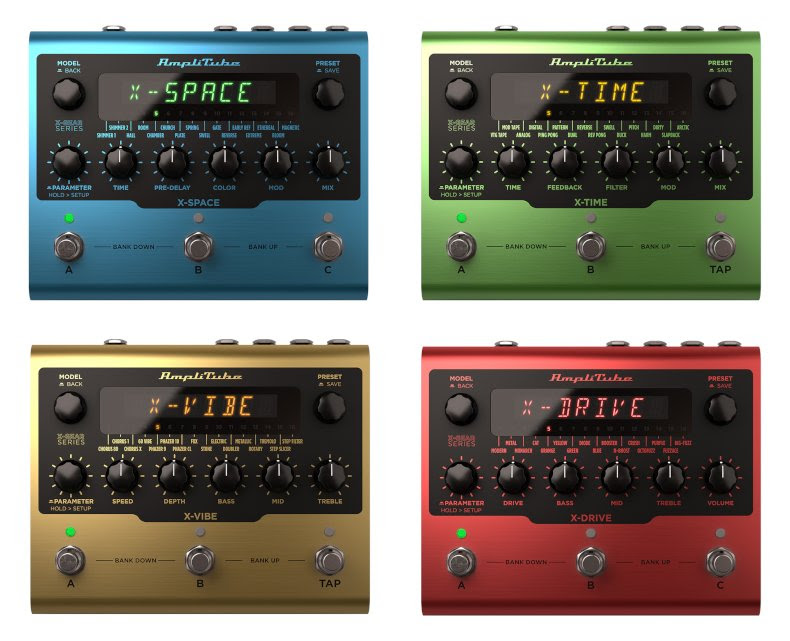
AmpliTube X-GEAR pedals cover the four realms of guitar effects processing. There’s X-DRIVE distortion and X-VIBE modulation, which offer a range of iconic, must-have analog pedal effects – all recreated with IK’s finest algorithms ever.
Custom-created by the IK team just for these pedals, X-TIME delay, and X-SPACE reverb feature cutting-edge, studio-grade effects algorithms. All four X-GEAR pedals share the same high-performance hardware and pioneering DSP for unsurpassed sound quality.
Best-in-show DSP
AmpliTube X-GEAR pedals leverage IK’s latest technologies and over 20 years of experience as the #1 amp and FX modeling company. The state-of-the-art DSP onboard includes 16 custom high-end algorithms per pedal, drawn from the most popular AmpliTube models along with all-new reverb and delay algorithms.
Featuring up to 192kHz internal processing with 4x oversampling, X-GEAR pedals deliver amazing clarity to the stage with the realism and response that users love about AmpliTube 5.
Hardware that stands out
Built to last, X-GEAR pedals feature an aluminum chassis designed and made in Italy with components that guarantee the best possible sound in a stomp pedal. There’s ultra-low noise, 24-bit/192kHz converters for class-leading sound quality, an extended 5Hz-24kHz frequency response to capture the full scope of an instrument’s tone, and up to 123 dB dynamic range for whisper-quiet operation no matter how much gain is applied. With a pure analog dry path and selectable true or soft bypass, the guitar’s tone will ring true no matter how simple or sophisticated the signal chain becomes.
Handy recording
X-GEAR pedals also work as a convenient USB audio interface. The same ultra-low noise converters and frequency response capture bass or guitar in all its range and dynamics. Versatile routing options let users choose between sending the wet or dry signals to their DAW. There’s stereo out for monitoring and thanks to full MIDI implementation users can map the dials and stomps of X-GEAR to control AmpliTube and/or any compatible program.
From soundcheck to final encore
When it’s time to play out, AmpliTube X-GEAR pedals offer everything players need to perform at their best. The intuitive interface and control knobs are easy to tweak on the fly. Indoors or out, a high-contrast LED display keeps users informed on their settings and preset banks. An expression pedal input adds additional control over any parameter, while full MIDI implementation is built-in for even the most complex setups. We’ve also included 5 cabinet impulse responses in each pedal to connect directly to the PA.
Signal chain to the stars
Combining AmpliTube X-GEAR pedals creates a formidable team, seamlessly sending and receiving MIDI commands for dramatic effects changes. With the included Preset Manager, users can easily set up one X-GEAR pedal as the master to send program changes to the other pedals, and then just drop the presets they want to be activated into the appropriate slots. Daisy-chain the pedals together via MIDI and let the show begin.
With open architecture for future updates, AmpliTube X-GEAR pedals will empower players for years to come. Now everyone can bring perfect studio guitar sound onstage or anywhere.
Options, pricing, and availability
AmpliTube X-GEAR pedals will be arriving in August and are currently available for pre-order from the IK Multimedia online store and from IK authorized dealers worldwide for $/€299.99.*
*All pricing excluding taxes

 CHICAGO, ILLINOIS, USA: boutique audio company Black Lion Audio is proud to announce the availability of its PG-P Portable Power Conditioner — a studio-class power conditioner complete with proprietary PG-P PORTABLE FILTERING TECHNOLOGY to provide the same noise filtering found in the majority of rack-mount power conditioners, despite looking like a run-of-the-mill surge protector — as of July 15…
Poor-quality power is the bane of many musician’s lives. Let’s face it, poor-quality power knows no bounds — in homes, on stages, and especially rehearsal rooms. Whether working with modern modeling amplifiers or vintage synthesizers, poor-quality power has a nasty habit of adversely affecting signal paths, which is never a good thing. Thankfully, Black Lion Audio has been trusted by musicians for years to modify the best gear and make it even better, which is exactly what it took to create the PG-P Portable Power Conditioner — taking industry-standard designs, and improving them to the point of peak performance.

Power conditioning, of course, comes naturally to Black Lion Audio. After creating an acclaimed line of confidence-inspiring, rack-mountable power conditioners, including the recently released PG-2 (https://www.blacklionaudio.com/store/products/pg-2/) — a full-featured peak performance power conditioner with a 120V Power Grid of 14 outlets providing an average of 99.7% of noise filtering, thanks to proprietary PG-99 Filtering Technology, the Chicago-based boutique audio company collectively felt that the time had come to provide the world with proper portable power.
Put it this way: while the resulting PG-P (Power Grid Portable) might well look like a run-of-the-mill surge protector, in reality, it is a studio-class power conditioner that not only provides more noise filtering than other portable power conditioners but the same noise filtering found in the majority of rack-mount power conditioners! Cue proprietary PG-P PORTABLE FILTERING TECHNOLOGY as boldly blazoned in writing across its top panel. Pictures paint a thousand words, according to the saying, so picture this: the PG-P itself is built using premium Panasonic capacitors, selected due to their superior execution in eliminating high-frequency noise that robs equipment of its peak performance. Interestingly, in testing, this provided an average of three times the noise filtering capability of other portable power conditioners at the same price point.
Perfect for any musician’s rig, the PG-P provides studio-grade power on the go via six wall-wart-spaced outlets, backed by confidence-inspiring Ground OK, Protection On, and Clean Power On LEDs. Let the music play… in homes, on stages, and even rehearsal rooms!
PG-P is available to purchase through Black Lion Audio’s growing global network of dealers/distributors (https://www.blacklionaudio.com/dealers) with a MAP (Minimum Advertised Price) of $69.00 USD and an SSP (Suggested Selling Price) of €69.00 EUR (excluding VAT).
For more in-depth information, please visit the dedicated PG-P webpage here: https://www.blacklionaudio.com/store/products/pgp/
About Black Lion Audio (www.blacklionaudio.com)
Founded in 2006, Black Lion Audio is a boutique audio company based in Chicago. Collectively it takes pride in providing customers with outstanding quality gear for their recording studios at prices that are ridiculously affordable. As such, the company has built a reputation for supplying superior quality sound in a cost-effective manner within the space of a few short years. Yet, given the current economic climate, it is no wonder that major labels, project studios, software companies, and high-profile tracking and mix engineers make up a significant portion of the company’s client base. Indeed, its work can be heard in award-winning major motion picture scores and soundtracks, major television shows and commercials, as well as being utilized by prestigious organizations and major label acts alike.
© 2021 Black Lion Audio

 LONDON, UK: Spitfire Audio is proud to partner with world-famous Abbey Road Studios to present ORIGINALS JANGLE BOX PIANO — the second Abbey Road Studios-residing piano to be released in the sound-specialising British music technology company’s ORIGINALS series of inspiring sample libraries making rare and classic instruments available to all, this time creatively capturing a Challen ‘studio’ piano featuring brass-tipped felt strips that can be dropped between the hammers and strings to emulate the sound of a ‘tack’ piano, itself made famous during the Sixties pop era at the most famous recording space in the world following its use on recordings by British film composer and conductor John Barry (of James Bond film-scoring fame), Brit-rockers The Zombies, and The Beatles, who prominently featured it on The Beatles (a.k.a. The White Album) and Magical Mystery Tour EP as the most influential (British) band of all time, meticulously sampled at Studio Two, mixed by GRAMMY® Award-winning engineer Sam Okell, and presented in Spitfire Audio’s award-winning, easy-to-use, and affordable plug-in, duly delivering the two distinctive characteristics of the truly iconic instrument in question, both beautiful, mellow, and dark in its original form, plus percussive, bright, and jangly in tack mode — as of July 8…

Following hot on the heels of ORIGINALS MRS MILLS PIANO, released earlier this year to widespread critical acclaim and approved by none other than Sir Paul McCartney — musically acquainted with the distinctive (slightly chorused, lacquered hammer-owing bright, metallic) sound of its iconic 1905-vintage Steinway Vertegrand upright namesake, affectionately known throughout the decades by Abbey Road Studios engineers as the ‘Mrs Mills Piano’ (paying homage to British pianist Gladys Mills, whose popular music hall, singalong-style records were mostly recorded on this piano) — who kindly remarked, “Really exciting for me to hear Spitfire’s sampling of what we used to call ‘Mrs Mills Piano’ from Abbey Road; it’s great to have it on my computer,” sound-specialising British music technology company Spitfire Audio quite literally changed tack to creatively capture another iconic instrument at Abbey Road Studios with which Sir Paul McCartney made musical history — namely, a Challen ‘studio’ piano featuring brass-tipped felt strips that can be dropped between the hammers and strings to emulate the sound of a ‘tack’ piano. History has it that the iconic instrument in question was built back in the Thirties at Piano Works, London, formed from beautifully handcrafted hard maple, making for a ‘studio’ piano slightly smaller than an upright. Ultimately, it became one of The Beatles’ most important instruments. Indeed, it is known as a piano of two distinct sounds — its original warm and mellow tone contrasting with its bright tack sound to which Spitfire Audio’s latest library owes its notable name, owing to the fact that Abbey Road Studios engineers and visiting artists alike took to calling it the ‘Jangle’ or ‘Jangle Box’ piano.

Put it this way: while ‘Mrs. Mills Piano’ was deliberately kept out of tune, the ‘Jangle Box’ piano was properly tuned to provide a beautifully mellow, dark midrange tone (while also yielding an incredibly long sustain in its normal setting) as an alternative to the heavier sound of any Abbey Road Studios-residing grand pianos, also finding favor with Paul McCartney during his Beatles tenure — think ‘The Fool on the Hill’ from the 1967-released Magical Mystery Tour EP. Elsewhere, it is also featured (in tack mode) on the track ‘Bike’ from experimental Brit-rockers Pink Floyd’s The Pipers at the Gates of Dawn debut album that same year and The Zombies’ ‘Care of Cell 44’ single in 1968. Needless to say, the now-famous ‘Jangle Box’ piano is still making its musical mark at Abbey Road Studios to this day, recently appearing on American-British singer/songwriter Celeste’s ‘Hear My Voice’ as part of the film score to 2020’s Oscar-nominated The Trial of the Chicago 7, while past players read like a casting call of musical greats, including John Barry (R.I.P), British bandleader and entertainer Billy Cotton (R.I.P.), British big band leader Joe Loss (R.I.P.), British singer Matt Monroe (R.I.P.), and British bandleader Sid Phillips (R.I.P.), to name a much-missed notable few from an always-lengthening list.
Having hosted countless landmark recordings, Abbey Road Studios is indisputably the most famous recording venue in the world and a global music icon in its own right — right at the heart of British music for nigh on 90 years, in fact. Innovation in equipment, technology, and recording techniques following (then-owner) EMI’s research and development division’s custom-built mixing consoles, outboard gear, and microphones built to meet the needs of studio engineers and artists alike — equipment which was never sold commercially — combined with the expertise of its engineers and unique acoustic properties facilitated what has come to be known as the ‘Abbey Road sound’. Completely contrasting with the film scoring legacy of Studio One, Studio Two is known for producing some of the most popular pop and rock recordings of all time. As a very versatile room that has changed very little since the Sixties, it has a warm acoustic which was originally designed to suit smaller string sections and big bands. It is hardly surprising, then, that Spitfire Audio arrived back at Studio Two to meticulously sample the distinctive characteristics of the ‘Jangle Box’ piano.

Presented in Spitfire Audio’s award-winning, easy-to-use, and affordable plug-in, appropriately mixed by Abbey Road Studios Senior Engineer Sam Okell — an award-winning individual involved in mixing and remastering projects for The Beatles, amongst many other artists, as well as mixing and recording for huge Hollywood blockbusters and primetime TV shows, ORIGINALS JANGLE BOX PIANO flexibly features four signals: Close (tack mode) — a pair of Neumann U67 microphones for a crisp, defined sound; Ribbons (non-tack mode) — a pair of Coles 4038 ribbon microphones placed in front of the piano for an up close, slightly darker sound; Room — a pair of omni condenser microphones, giving a spacious image of the piano and the room; and Vintage — the classic Sixties-vintage Abbey Road Studios recording chain, including an extremely rare AKG D19 microphone placed above the strings in the middle of the piano and recorded using an all-valve Studer J37 tape machine (made famous by breakthrough multitrack recording of The Beatles’ Sgt Pepper’s Lonely Hearts Club Band album at Abbey Road in its one-inch four-track format configuration) via an EMI REDD.47 mic preamp. All authentically combine to form four Tack Piano presets Close Tacks — close microphones with the tacks (as a direct and bright sound); Clean Tacks — close and room microphones with the tacks (blended for an upfront and modern sound); Balanced Tacks — all signals together with the tacks (producing a balanced and characterful sound); and Vintage Tacks — the vintage sound that made the piano famous. Furthermore, two Piano presets showcase the ‘Jangle Box’ piano’s warm, non-tack sound: Mellow Without Tacks — all signals together, capturing the mellow character of the piano without tacks; and Vintage Without Tacks — the tack-free vintage sound that made the piano famous.
Following in the famous-sounding footsteps of ORIGINALS MRS MILLS PIANO, ORIGINALS JANGLE BOX PIANO comes complete with six effects with REVERB — representing one of Studio Two’s Fifties-vintage EMT 140 stereo plates with the decay set to 2.5 seconds; TIGHTNESS — cuts further into the note to make it tighter; HAMMERS — controls the volume of the piano’s hammers, and PEDAL — controls the volume of the sustain pedal noise; plus proprietary expression and dynamics controls for extra realism and detail. Duly delivering the distinctive characteristics of the ‘Jangle Box’ piano to musicians of all levels anywhere as an affordable AAX-, AU-, VST2-, and VST3-compatible plug-in supporting Native Instruments’ NKS (NATIVE KONTROL STANDARD®) for Mac (OS X 10.10 or later) and Windows (7, 8, and 10 — latest Service Pack) that loads directly into any compatible DAW (Digital Audio Workstation), downloadable as a lightweight (~8GB-sized) library with no compromise on recording quality, ORIGINALS JANGLE BOX PIANO puts another unique piece of Abbey Road Studios music history on computers… owned by Sirs or otherwise!
ORIGINALS JANGLE BOX PIANO is available as an AAX-, AU-, VST2-, and VST3-compatible plug-in supporting Native Instruments’ NKS (NATIVE KONTROL STANDARD®) for Mac (OS X 10.10 or later) and Windows (7, 8, and 10 — latest Service Pack) that loads directly into any compatible DAW (Digital Audio Workstation) for an RRP (Recommended Retail Price) of only £29.00 GBP (inc. VAT)/$29.00 USD/€29.00 EUR (inc. VAT) — from here: https://www.spitfireaudio.com/originals/#jangle-box-piano
Spitfire Audio’s namesake Spitfire Audio application allows anyone to buy now and download anytime and is available for free from here: http://www.spitfireaudio.com/info/library-manager/
For more in-depth information, please visit Spitfire Audio’s ORIGINALS Frequently Asked Questions webpage here: https://www.spitfireaudio.com/info/faq/spitfire-originals/
Take a trip to the most famous recording venue in the world through the musical lens of ORIGINALS JANGLE BOX PIANO while watching Spitfire Audio’s premiere — including its tantalizing trailer video and an informative walkthrough with in-house composer Dan Keen — here:
About Spitfire Audio (www.spitfireaudio.com)
Spitfire Audio is a British music technology company that specializes in sounds—sample libraries, virtual instruments, and other useful software devices. It collaborates with the best composers, artists, and engineers in the world to build musical tools that sound great and are exciting to use.
© 2021 Spitfire Audio Holdings Limited

July 1, 2021 – IK Multimedia releases Electromagnetik, which brings together four new SampleTank sound libraries, each focusing on a very specific and rare electric piano. Though available separately, together these instruments offer significant savings and will provide the composer and musician with an inspiring collection of distinctive keyboard sounds from over 4.5 GB of sample content and 80 SampleTank 4 instrument presets.
The jewels of a private collection
Electromagnetik features four meticulously maintained instruments specifically chosen for their individuality and contrast from the personal collection of IK keyboard guru, Erik Norlander. Spanning four decades of electric stage piano history, the keys in this collection each offer their own distinct sound and vibe, which you won’t find in any other SampleTank collection. What they share is the beauty of their design, one that uses electromagnetic pickups and the vibrations of hammers hitting metal strings, tines, or reeds to deliver pleasing tones to the listener.
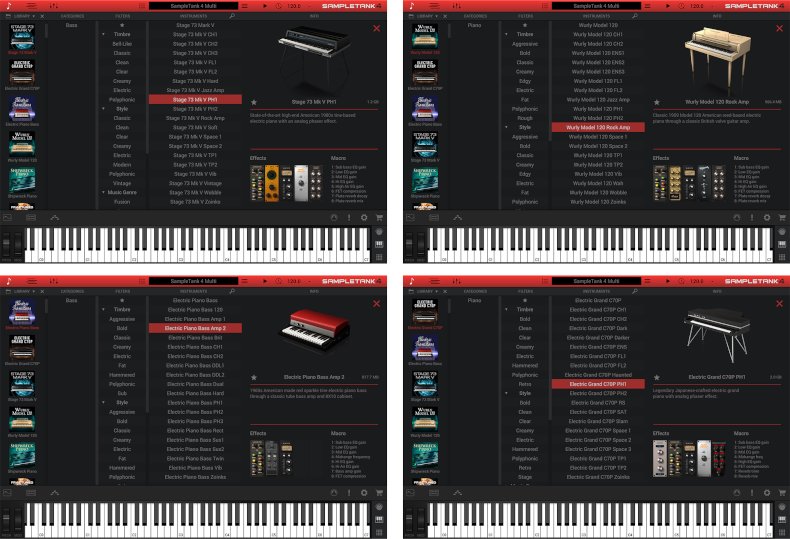
Electric Grand C70P is based on a Yamaha CP70B electric grand, which was developed in the ’70s for stage pianists desiring the depth of expression of hammers hitting strings but at volumes that could compete with the rest of any band. For Electromagnetik, IK sampled an immaculate example of a ’70s Yamaha CP70B electric grand with eight real velocities across the keyboard. There are no loops, only full-length samples of a revered instrument in prime playing condition.
Stage 73 Mark V is a deep sampling of the Rhodes Mark V electric piano, the last “real Rhodes” model that was produced by Harold Rhodes in the mid-1980s. It’s known for having the brightest and clearest tone of all the Rhodes models. For Stage 73 Mark V, IK’s super deep multi-velocity sampling techniques were applied to a beautifully maintained original Rhodes Mark V to reproduce this highly regarded electric piano in all its sonic glory.
Electric Piano Bass is based on the Rhodes Piano Bass, which appeared in 1960 as a way for keyboard players to cover the bass part on a dedicated instrument, its 32 keys covering the most widely used range of a bass. The Piano Bass employed the same design as the Rhodes Piano, using hammers to strike metal tines. For Electric Piano Bass, the model is a stunning red sparkle edition, which IK captured to convey all its low-end mojo and responsiveness.
Wurly Model 120 is based on the Wurlitzer Model 120 portable electric piano from the 1950s, one of the earliest electric pianos to find its way into the pop music charts. Wurlitzer electric pianos use hammers striking a metal reed and electromagnetic pickups for their distinctive tone. For Wurly Model 120, IK chose a superbly maintained vintage specimen from 1959, full of mid-century modern style, which was sampled to fully achieve its warm analog tone and soulful dynamics.
Long live hammers on metal
Generations on, these four instruments maintain their thrones as kings of tone for keyboard players. Users will find here the keys to electrifying piano tracks that are as pleasing today as they were decades ago.
Pricing and availability
Electromagnetik is currently available for purchase from the IK Multimedia online store and from IK authorized dealers worldwide for a limited-time introductory price of $/€99.99* (reg. $/€149.99). The four included individual libraries can be purchased separately for $/€49.99 each.
*All pricing excluding taxes. Intro pricing ends July 31, 2021.
For more information about Electromagnetik, please visit: www.ikmultimedia.com/electromagnetik
LONDON, UK: Spitfire Audio is proud to announce availability of ALBION SOLSTICE — starting recorded life in Scotland’s celebrated Castlesound Studios outside of Edinburgh, exploring the visionary artistry from modern, folk, and heritage instruments as a celebration of un-noted traditions, passed down through the generations, and captured through the magic of sampling as a genre-transcending library with everything needed to create modern cinematic scores inspired by the past, presented as organic sounds split into three distinct sections skillfully curated and workshopped over two years by Spitfire Audio co-founder and award-winning composer Christian Henson to form the sound-specialising music technology company’s boldest (and biggest) ALBION series release up to the present time, treated, blended, and unleashed as an incredibly-extensive, endlessly-inspiring composing toolkit to run in Native Instruments’ free KONTAKT PLAYER application and delivered directly to the creative heart of any modern-day DAW (Digital Audio Workstation) as a 73 GB KONTAKT instrument download — as of June 21…

The thinking behind Spitfire Audio’s ALBION in its original form was as simple as it was extraordinary — everything needed to score a film in one complete product. Fast-forward to today, though, and ALBION SOLSTICE admirably applies that tried-and-tested approach to decontextualizing folk and traditional instruments to transcend genre, creating modern film scores where anything is possible. With widespread sounds creatively connecting traditional Celtic band instruments, strings, brass, and wood with electric guitar textures, synthesizers, and loops, this makes for a very varied yet consistent library like no other. Musically making that happen involved instigator and ‘helmsman’ Christian Henson — himself no stranger to the art of recording and the magic of sampling, both as an award-winning composer and co-founder of Spitfire Audio itself — spending some considerable time in Scotland’s celebrated Castlesound Studios, a state-of-the-art digital and analog recording, mixing, and mastering facility famed for its huge, daylit recording areas and control room with a reputation as a centre of folk excellence bolstered by a 40-plus-year history, housed within a Victorian building outside of Edinburgh. Engaging with highly-specialized players and sound smiths from a cross-section of classic, folk, Celtic, Gallic, and other traditions, there the Edinburgh-residing Christian Henson hardily hurled himself into a two-year voyage of musical discovery, duly mixing modern instrumentation such as analog synthesizers, Eurorack modular, electric guitar textures, tuned percussion, and distinctive audio processing to ultimately arrive — with a little help from his Spitfire Audio colleagues — at a destined deep wellspring of endless inspiration, stemming from the organic sounds of modern and heritage instruments from across the United Kingdom, treated, blended, and unleashed to create extraordinary soundworlds fit for modern scoring.

Says Christian Henson himself: “ALBION SOLSTICE is something that’s been deeply personal to me — the most engaged I’ve ever been about a library. I’ve been thinking about little else for the last two years because it goes back to the heart of how cinema first really affected me — the films Wicker Man; Witchfinder General, which my dad was actually in, so we had posters all over our house; Straw Dogs; Picnic at Hanging Rock; Don’t Look Now; Deliverance… a set of secular, but also rural mysteries, and I loved the spirit that they conjured. So I thought, ‘Wouldn’t it be great to take instruments from folk traditions and stuff that sounds like it is of the earth — borne out of ritual, rights, and raves — and create a cinematic library.’ A folk noir library, if you will.” With that thought in mind, the resulting ALBION SOLSTICE sounds so skilfully curated and workshopped with such dedication throughout those two years are grouped into three distinct sections — namely, The Solstice Orchestra, featuring 10 ensembles and a soloist, 235 articulations, 78 of which are found in the two string sections, including legatos; The Cassette Orchestra, with 700-plus tape-warped, effected organic sounds for users to expand upon using its intuitive eDNA GUI (Graphical User Interface); and The Drone Grid, generating an almost infinite pool of stunning and unique textural evolutions to offer composers never-ending inspiration.

Acting as the beating heart of ALBION SOLSTICE, The Solstice Orchestra is a collection of folk and contemporary instrument ensembles presented in an achingly honest and truthful light. Lovingly selected and curated by Christian Henson himself, closely working with a carefully chosen group of players from the traditional music scenes in Scotland and the rest of the United Kingdom, it offers new, intimate, and sometimes provoking sounds imbued with raw emotion, evoking past, present, and future all at the same time. The Solstice Orchestra itself is made up of nine sections — namely, The Elders (traditional strings, classic strings, and solo bass); The Callers (brass and winds); The Mystics (whistles); The Blaggards (band); The Hosts (choir); The Generator Trio (electric guitars); The Gut Circle (acoustic guitars); The Nursery (bells and mallets); and The Marauders (percussion) — that are as inspirational in name as they are in sound. Since some sections of those sections are effectively libraries in themselves, there is clearly a plethora of sounds to keep keen composers inspired for a long time to come, even if Spitfire Audio’s ALBION SOLSTICE ends up being their only purchase. Painting an alluring word picture, Paul Thomson — fellow composer and Spitfire Audio co-founder — feels that The Solstice Orchestra offers, “An enormously wide variety of sound, with everything infused with an incredible character from various folk traditions. The sound you get back has a very different character, transporting you to new places. It doesn’t mean you have to use this to write a folk score, you just keep writing the way you normally write and it will take you in new directions as an amazing refresh for your palette with tons of inspiration.”

As a cornucopia of creative sound, The Cassette Orchestra is an expansive set of 150 inspirational presets made from 750 sound sources culled from The Solstice Orchestra, personally processed, mangled, and degraded by Christian Henson using vintage tape machines, analog tape delays (including the vintage classic Roland RE-301 Chorus Echo and its heir apparent, the Echo Fix EF-X2 tape echo with spring reverb and DSP reverb/chorus), an enormous Eurorack modular system, and an enviable collection of guitar effects pedals (including the Chase Bliss Audio Automatone CXM 1978 studio reverb, OTO Machines BAM space generator, and Strymon NightSky time-warped reverberator)… take a trip through the looking glass into his world, exploring the impossible and creating the unimaginable. Ultimately, it is inspired by an imagined history: how would the instruments in question sound if the folk players of the past were recorded to cassette via stompboxes? “Well, put it this way: it’s me, in my wheelhouse, or, rather, my shed,” says Christian Henson, before further revealing: “I wanted to capture the zeitgeist of the passion growing behind the cassette movement, and it was extraordinary the lengths we had to go to really get it into a ‘cassette-y’ kind of sound since it’s amazing how good cassettes actually are when they’re pristine. So we ‘un-prestine-d’ them.” There are also 100 different synthesizer sounds from his covetable collection of vintage and modern instruments (including a Korg MS-20 semi-modular analog monosynth, Moog Prodigy analog monosynth, Roland Juno-6 analog polysynth, Roland Jupiter-4 and Jupiter-6 programmable analog polysynths, and SOMA Laboratory LYRA-8 orgasmic analog synthesizer), all processed by an array of analog effects.

Ending on a high — literally long — note, Spitfire Audio ‘composer-in-residence Homay Schmitz introduces the third distinct section to make ALBION SOLSTICE what it is and do what it does as an almost infinite source of inspiration and creativity thusly: “The Drone Grid, which comes in our Evo Grid GUI, means that you have evolutions of long notes. These have been carefully curated by Christian Henson, together with the players in the studio, to capture all of these performances. There is a function that allows you to randomize the different sections, so the options are pretty much endless, and you can really make these combinations very unique to you.”

Yet surely it is only fitting for ALBION SOLSTICE’s instigator and ‘helmsman’ Christian Henson to provide an appropriate closing commentary: “There’s magic in this library. It’s inspiring to compose with and instantaneous to produce with. The sounds spring out of the box, with performances that absolutely drip with personality. It’s an environment where you feel that you are collaborating with the performers and not simply playing samples.”
ALBION SOLSTICE can be purchased and digitally downloaded for a time-limited introductory promo price of £299.00 GBP (inc. VAT)/$349.00 USD/€349.00 EUR (inc. VAT) until July 15, 2021 — rising thereafter to an MSRP (Manufacturer’s Suggested Retail Price) of £399.00 GBP (inc. VAT)/$449.00 USD/€449.00 EUR (inc. VAT) — from here: https://www.spitfireaudio.com/shop/a-z/albion-solstice/ (Also, any ALBION library owner ordering ALBION SOLSTICE saves 35% off its MSRP until July 15, 2021.)
ALBION SOLSTICE needs Native Instruments’ KONTAKT PLAYER (5.6.8 or higher) — a free version of the KONTAKT sample playback engine (included in its purchase) — to run as a fully NKS (NATIVE KONTROL STANDARD®) supporting plug-in instrument for Mac (OS X 10.10 or later) or Windows (7, 8, or 10 — latest Service Pack, 32/64-bit), while Spitfire Audio’s free Download Manager application allows anyone to buy now and download anytime.
For more in-depth information, including some superb-sounding audio demos, please visit the dedicated ALBION SOLSTICE webpage here: https://www.spitfireaudio.com/shop/a-z/albion-solstice/
Watch Spitfire Audio co-founder and composer Paul Thomson’s walkthrough of The Solstice Orchestra beating at the heart of ALBION SOLSTICE here:
Watch Spitfire Audio co-founder and composer Christian Henson’s walkthrough of ALBION SOLSTICE’s The Cassette Orchestra here:
Watch Spitfire Audio ‘composer-in-residence Homay Schmitz’s walkthrough of ALBION SOLSTICE’s The Drone Grid here:
Watch Spitfire Audio’s deeply personal premiere of ALBION SOLSTICE and an appropriately mysterious trailer video here:
About Spitfire Audio (www.spitfireaudio.com)
Spitfire Audio is a British music technology company that specializes in sounds—sample libraries, virtual instruments, and other useful software devices. It collaborates with the best composers, artists, and engineers in the world to build musical tools that sound great and are exciting to use.
© 2021 Spitfire Audio Holdings Limited

 PRAGUE, CZECH REPUBLIC: independent development teams federation United Plugins is proud to present Electrum — available as an all-in-one single-screen guitar amp and pedalboard plug-in from development partner Muramasa Audio, itself inspired by bygone masterworks of a famous Japanese swordsmith to which it (partly) owes its notable name by bringing the perfection of old masters into the audio world, with everything needed to achieve a perfect sound for any electric guitar quickly and easily within a single-window — as of June 21…

In today’s teeming marketplace, most — even great-sounding — guitar software suffers from flawed design, doing little to enhance efficiency and comfort when put to work in a musical environment. Ergonomics is, conversely, central to Muramasa Audio executing Electrum as an all-in-one single-screen guitar amp and pedalboard plug-in, providing its intended users with the fastest way to turn ideas into the perfect guitar sound. No need to take a deep dive through muscle memory-taxing menus in search of hidden options since everything is already accessible on one screen — cue color-coded AMP, AUTOWAH, CABINET, COMPRESSOR, DELAY, DISTORTION, DOUBLER, EQ, GATE, MODULATION, and REVERB components, clearly viewable as part of the plug-in’s photorealistic 3D or flat 2D graphics at the convenient click of an appropriate button without affecting the sound or CPU (Central Processing Unit) load. Readily reordering those components is simply a case of dragging and dropping them into the desired position in the effect chain, without worrying about adhering to real-world setups to encourage experimentation. Examples like having a heavily-amped Reverb sent to the Modulation section’s FLANGER or trying the Distortion pedal after the Amp might well be impossible in the real world, yet all are perfectly possible in the wonderful world of Electrum! Duly double-clicking on the components’ color-coded rectangles instantly bypasses them or otherwise for further ease of use.
Ultimately, achieving a perfect sound for any electric guitar is, indeed, quick and easy when working with Electrum, so let us dive deeper into what is on offer — no menu diving required! Featuring five versatile amps — BLUE, YELLOW, ORANGE, RED, and BLACK — arranged from lighter touch to most extreme, Electrum’s Amp section is at the effect chain’s core. Conveniently, all share the same controls, placing familiarity at the heart of a delightful user experience enhanced further with fast workflow.
Elsewhere, Electrum’s unique Cabinet comes complete with 16 SPEAKER sounds based on classic guitar cabinet loudspeaker measurements, customizable to produce over 300 virtual cabinets! Acting as a true virtual simulator with several parameters, including a bank of AMBIENCE responses to simulate the reflections from real cabinet surroundings, it produces a much smoother and natural sound by avoiding any unnatural resonances present in almost all classic IRs (Impulse Responses) — no need to audition any IR files in what can sometimes seem like a never-ending search for the right tone, in other words.
While most guitarists are already familiar with traditional double-tracking techniques, they will also be well aware of just how difficult and time-consuming it is to perform the same part twice with the same feel and timing. The Doubler section in Electrum is a powerful alternative, producing a thick and wide sound without needing to record the same part twice — easily enable Electrum’s Doubler, record once, and move on.
It is fair to say that having access to great-sounding reverb is essential — especially when it comes to creating great-sounding guitar solos, so Electrum encompasses an extremely versatile Reverb featuring 18 powerful algorithms simulating springs to plates and halls to rooms through to shimmer and ethereal reverbs with wide-ranging controls including DAMP LOW — controls the absorption of the low frequencies, DAMP HIGH — controls the absorption of the high frequencies, and DUCKING — controls the amount of ducking applied on the effected signal and following the dry signal, amongst others.
As a flexible double-tap affair with SYNC — synchronizing with the BPM (Beats Per Minute) of the host DAW (Digital Audio Workstation); PING-PONG — whereby the first echo appears, for instance, in the left channel, the next in the right, then back to the left, making for a nice stereo field; MODULATION; SATURATION; and more, Electrum’s Delay duly delivers.
Back, briefly, in the real world, modulation duties are usually handled by several stomp-boxes spread over a pedalboard, but Electrum takes a different approach by blending multiple effects into its Modulation section, serially executed as they appear — as CHORUS, FLANGER, PHASER, TREMOLO, and SWEEPER — on the GUI (Graphical User Interface) to allow users to quickly create unique effects with all algorithms automatically synchronized… ‘Sweerus’ or ‘Trenger’, anyone? Anything is possible!
Anyone aligning themselves with ever-popular rock and metal guitar playing already knows that distortion pedals provide clarity to low-end frequencies with the additional drive when needed. Needless to say, Electrum’s Distortion is the mother of all distortion pedals, providing three different types — BOOST, for adding a little kick for the Amp section; SCREAM, for creating medium-level distortion; and DIST — for maximizing distortion for extreme metal styles. Again, all share common controls to ease operation and speed up workflow.
Without doubt, Electrum’s pedalboard rocks, with yet more perfect sound creation possibilities on offer, thanks to the inclusion of several smaller sections, such as the self-explanatory Autowah — an essential ingredient for funk, for example, as an automatic wah-wah filter following the INPUT level; Comp — compressing or reducing an audio signal’s dynamic range (which when placed before the Amp will stabilize its distorted character or stabilize the OUTPUT level when placed after); Gate — commonly called a noise gate (which is usually positioned first in the processing chain); and last, but far from least, EQ — providing a powerful graphic equalizer for further customizing the tonal response (which when placed before the Amp will also affect its distorted character or only change the tone when placed after). But better still, Electrum’s EQ MATCHING component does just that — automatically transferring the sonic characteristics of an analyzed guitar sound to the user’s own sound with amazing accuracy!

A number of other notable features — including an advanced spectral analysis-based polyphonic TUNER (to ensure that performances are never out of tune) and easy-setup INPUT level analysis — are also available in Muramasa Audio’s amazing all-in-one single-screen guitar amp and pedalboard plug-in. Put it this way: with a ton of professionally programmed presets to help guide guitarists where they wish to go, Electrum effectively provides everything needed to achieve a perfect sound for any electric guitar quickly and easily within a single-window while making use of its internal 64-bit audio processing to handle any sampling rate up to 192 kHz (or even higher) plus smart bypass and intelligent sleep on silence attributes, all aimed at separating it from the sound of the (plug-in) crowd in today’s teeming marketplace.
Muramasa Audio’s Electrum is available to purchase for a time-limited super-introductory promo price of only €15.00 EUR until July 4, 2021, with another attractive time-limited promo price of €39.00 EUR continuing throughout the summer months until September 5, 2021 — rising thereafter to its regular price of €139.00 EUR — as an AAX-, AU-, VST-, and VST3-compatible plug-in (using internal 64-bit audio processing capable of handling any sample rate) directly from United Plugins here: https://unitedplugins.com/Electrum/ (Electrum entails more testing as a larger-scale plug-in project than can comfortably be handled by United Plugins’ production team alone; as such, users are invited to join its beta program here: https://unitedplugins.com/betaprogramme)
A 15-day, fully-functional trial version of Electrum for macOS 10.10 and newer and Windows 8/10 can be downloaded for free from here: https://unitedplugins.com/download/
Note that no iLok, dongle, or internet access is required for Electrum activation. (All United Plugins software uses license files for activation and owners can freely use purchased software on all their computers as long as they are the user.)
About United Plugins (www.unitedplugins.com)
As implied in the carefully chosen wording for an apt appellation that really represents how the Prague-registered Limited Company came about and what it collectively creates, United Plugins is a federation of small, independent development teams comprised of individuals involved in the music industry. Indeed, the founding triad of FireSonic, JMG Sound, and SounDevice Digital can count engineers, producers, and artists amongst their ‘united’ names. Needless to say, all were seeking the freedom to create the tools that they would like to use in their studios and on their projects. And all agreed that this could be better achieved when working together. Though United Plugins’ proliferating product portfolio may not always be for the musical masses, surely someone, somewhere will always find those tools to be a perfect fit for their own music productions… just like those inventive individuals behind United Plugins’ partner brands, the ranks of which have since swelled to include Muramasa Audio and MeldaProduction. Thanks to the latter letting United Plugins utilize its super-easy licensing system, which is why selected MeldaProduction products are also available from the United Plugins website, a thriving future for the federation is assured.
© 2021 United Plugins

 PAVIA, ITALY: analog saturation circuits digital reproduction specialist Nembrini Audio is proud to announce the availability of MRH-159 Brown Sound — a guitar amp plugin par excellence modeled on what is arguably the most famous amp of all time with an option to switch to a modded Marshall* Super Lead 1959 100W guitar amp head to achieve rock guitarist extraordinaire Eddie Van Halen’s so-called ‘brown sound’ signature distortion tone that many musicians have tried to emulate — as of June 14…
It is fair to say that a Marshall* Super Lead 1959 100W guitar amp atop a couple of 4×12 loudspeaker cabinets remains the definitive guitar rig for many players. Thanks to Nembrini Audio’s MRH-159 Brown Sound being modeled on what is arguably the most famous amp of all time, there is no need, necessarily, to go to such — sizeable and expensive — extremes to achieve a perfect tone. The guitar amp plugin itself is designed to do just that with two channels, one voiced for a higher treble response and the other for a normal response; each has its own loudness — VOLUME 1 and VOLUME 2 — option and two (linkable) — I and II — INPUTS with the ‘HIGH’ (top) option offering more gain and output volume while the ‘LOW’ (bottom) one is quieter with more headroom.

However, it is MRH-159 Brown Sound’s standout BROWN SOUND MODS functionality with which Nembrini Audio effectively hits a home run by switching in a modded Marshall* Super Lead 1959 100W guitar amp head to achieve guitarist extraordinaire Eddie Van Halen’s so-called ‘brown sound’ signature distortion tone that many musicians have tried to emulate. Enabling the sought-after sound in question comes courtesy of several changes to the stock amplifier involved in creating MRH-159 Brown Sound, including a VARIAC variable transformer (to reduce the main voltage down to 90V) — remerging as VOLTAGE VARIAC in the resultant BROWN SOUND MODS GUI (Graphical User Interface) panels; EL34 tubes — found mainly in the final output stages of audio amplification — exchanged for the 6CA7 Fat Bottle — a more classic version of the EL34 with a large bottle and big, warm sound; middle tone stack potentiometer changed to 50 kOhms, and adding a 25uF cathode capacitor ‘fat cap’ on the V2 tube.
That said, the ‘brown sound’ to which Nembrini Audio’s MRH-159 Brown Sound (partly) owes its notable name can mainly be attributed to the cabinet concerned being loaded with two 12” 8 Ohms JBL* D120 loudspeakers on the top and two 12” 8 Ohms Celestion* G12M 25W Greenback guitar loudspeakers on the bottom, blended with Shure* SM57 microphones, but MRH-159 Brown Sound fosters further creativity for flexible guitarists by offering a choice of six selected cabinet emulations — namely, MRH 4×12 BROWN (based on a Marshall* 1960A 4×12 with two of those JBL* D120s atop two Celestion* G12 25W Greenbacks); MB RECT 4×12 V30 (based on a Mesa Boogie* Rectifier 4×12 with Celestion* Vintage 30 loudspeakers); ORANGE 4×12 V30 (based on an Orange* 4×12 with Celestion Vintage 30 loudspeakers); SLD 4×12 LEGEND (based on a Soldano* 412B 4×12 with Eminence* Legend V12 loudspeakers); BG 2×12 V30 (based on a Bogner* 2×12 with Celestion Vintage 30 loudspeakers); and TWEED 4×10 P10Q (based on a Fender* Tweed Bassman 4×10 with Jensen P10Q loudspeakers), selectable in CABINET mode.

MRH-159 Brown Sound users can choose two virtual microphone settings (MIC 1 and MIC 2) for their amp recording chain, selecting from four different emulated models — namely, DYNAMIC 57 (based on the popular Shure* SM57 dynamic microphone); RIBBON 121 (based on the modern Royer Labs* R-121 ribbon microphone); CONDENSER 414 (based on the classic AKG* C414 condenser microphone); and DYNAMIC 421 (based on the vintage Sennheiser* MD 421 dynamic microphone) — with ON/OFF AXIS position switch, plus continuous POSITION and DISTANCE knobs. It is worth noting that if the aforesaid MRH 4×12 BROWN cabinet emulation is selected then those MIC 1 and MIC 2 settings are respectively related to the Celestion* G12 25W Greenback and JBL* D120 loudspeaker emulations. An associated MIXER section with PHASE, SOLO, MUTE, and fader controls allow for blending of the two microphones and the STUDIO REV (reverb).
Readily realizing further flexibility, the CABINETS – IMPULSES LOADER panel permits loading of up to three third-party impulse responses that can be blended together using volume, PAN, PHASE, SOLO, and MUTE controls, while an associated browser window allows users to easily search through all their third-party impulse response files — not that MRH-159 Brown Sound users need necessarily concern themselves with seeking out third-party impulse responses since it comes complete with an already selected set of cabinet impulses.

Always active are MRH-159 Brown Sound’s CLEANER and NOISE GATE sections — the former featuring RUMBLING and HARSH controls, respectively reducing low- and high-frequency content, while the latter’s THRESHOLD and RANGE respectively define the level where the gate is activated and amount of noise reduction selected — alongside a levels section with faders for INPUT (adjusting that level from minus infinite to +12dB) and OUTPUT (adjusting that level from minus infinite to +12dB). Activating an associated FIX button ensures that the input level remains the same when changing presets.
Put it this way: when working with MRH-159 Brown Sound, achieving rock guitarist extraordinaire Eddie Van Halen’s so-called ‘brown sound’ signature distortion tone is now within reach of anyone — all without breaking the bank. But achieving that much-missed guitarist’s extraordinary playing technique… that’s a different ball game entirely!
Marshall Super Lead 1959 is a registered trademark of Marshall Amplification Ltd. MRH-159 Brown Sound was developed by Nembrini Audio SRL based on its own modeling techniques. Marshall Amplification Ltd has not endorsed nor sponsored MRH-159 Brown Sound in any manner, nor licensed any intellectual property for use in this product.
* Please note that all marks and models are trademarks of their respective owners, which are in no way associated or affiliated with Nembrini Audio SRL. These product names, descriptions, and images are provided for the sole purpose of identifying the specific products that were studied during Nembrini Audio’s sound design process.
MRH-159 Brown Sound is available for purchase (as an iLok-protected AAX-, AU-, VST2-, and VST3-supporting plug-in for macOS 10.9 or newer and Windows 7 or newer) at an attractive introductory price of only $37.00 USD until July 4, 2021 — rising thereafter to a regular price of $137.00 USD — from its dedicated webpage (https://www.nembriniaudio.com/products/mrh159-brown-sound-guitar-amplifier), which also includes more in-depth information.
Flexibility further abounds as MRH-159 Brown Sound is also available in AuV3 format for iOS at an introductory price of $9.99 USD until July 4, 2021 — rising thereafter to a regular price of $19.99 USD — on the App Store from here: https://apps.apple.com/us/app/mrh159-brown-sound/id1567393984
Hear the legendary ‘brown sound’ tone when watching Nembrini Audio’s alluring MRH-159 Brown Sound trailer video here:
About Nembrini Audio (www.nembriniaudio.com)
Nembrini Audio was borne out of the extensive experience of founding namesake Igor Nembrini, with over 10 years of involvement in creating many of the greatest guitar amp plug-ins on the market to his notable name. Needless to say, the company’s exacting emulations always start by perfecting digital reproduction of analog circuits before being finely tuned by ear to remain true to the original sound. Saying that it is specialized in the digital reproduction of analog saturation circuits, whereby the dynamic behavior of each individual component is carefully modeled and tuned by ear to always achieve the most musical and creamy saturation in the digital world! With that in mind, it does not simply produce musical software but rather musical instruments suitable for every modern musician in search of uncompromising quality — products that work well in any setting and situation to let the creativity of musicians, producers, and mixing engineers flow forth for all to hear!
© 2021 Nembrini Audio SRL