



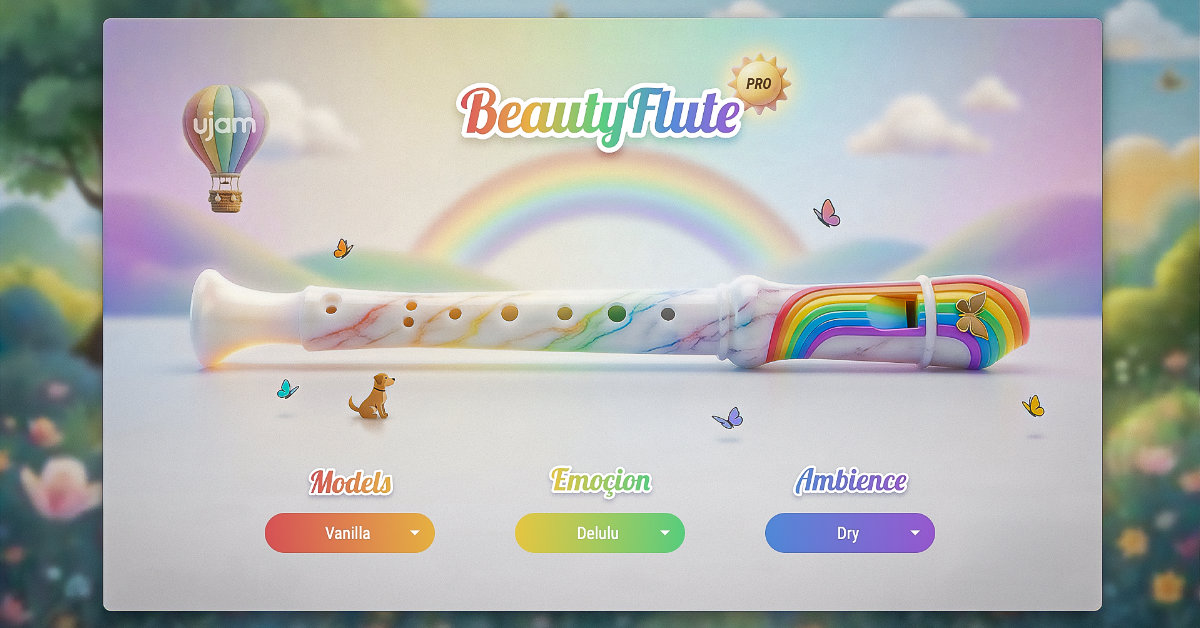

“There are songs that just can’t be left alone the way they were released. I felt they needed a ‘flute with ’tude’ to bring out their true emotional potential,” said Derek von Krogh. “This may be the most important contribution I’ve made to music.”
Key Features
Availability
BEAUTYFLUTE Pro is available as a free download and supports VST2, VST3, AU2, and AAX formats. It is compatible with macOS and Windows operating systems.
For more details, visit www.ujam.com
About UJAM
UJAM was co-founded by Hans Zimmer and Pharrell Williams, both musicians whose careers have been significantly supported by technology. The vision behind UJAM is to make technology even more accessible and encourage even more people to make music.
This vision is being realized by a team of virtual instrument pioneers who had previously developed legendary virtual instruments from Steinberg and Digidesign — from Steinberg Hypersonic to Virtual Guitarist, from Digidesign Xpand to Transfuser — and who finally want to realize their vision of shortening the path from the idea to the perfect track. More fun, better results, less complexity.

Karlsruhe, DE, March 24, 2026 — Klang.io announces the start of its annual Spring Sale. Between now and April 6, 2026, klang.io is offering 40% off of its annual subscription prices for both Transcription Studio and Universe, making the company’s powerful, AI-driven music transcription apps more accessible than ever before.
For more information and to claim the 40% off deal on Transcription Studio and Universe, please click here.

AI-powered notation solutions for musicians of all skill levels
Klang.io’s AI-transcription apps are a fast, straight-forward way to add professional transcription to your musical education, composition, and audio production projects. By utilizing one of the specialist apps within Universe, which includes transcription for Piano, Voice, Guitar, Drums, Violin, and Wind Instruments, or the full, multi-instrument capturing capabilities of Transcription Studios, you can easily transform any audio file or home recording into detailed sheet music, tablature, or MIDI information for whatever musical project you can imagine.
“The ability to transcribe music unlocks communication between musicians in a way that is incredibly important to learning, writing, or performing together,” says klang.io Founder/CEO Sebastian Murgul. “Universe opens this up to an array of standard instrument choices, ideal for learners or songwriters looking to dip their toes into an important skill. Transcription Studio expands that into multi-instrument arrangements ideal for bands, or more serious composition and audio production projects.”
“Whichever you choose, you will now have access to a time-saving, AI transcription assistant that will empower you to focus on fun and creativity in your musical experience.”
About Klangio
Founded in 2018 by Sebastian Murgul and Alexander Lüngen, Klangio GmbH is an innovative, AI-focused music software company that develops tools to empower musicians. The company’s flagship technologies provide quick and precise transcriptions from live and recorded musical sources for a variety of production, performance, and educational purposes. Klangio’s team of passionate experts in music theory, audio processing, AI research, and software development are based in Karlsruhe, Germany.
For more information about Klangio, please visit: https://klang.io/

Percussion instrument with built-in virtual player for Latin and top-mix percussion.
Berlin, Germany, March 25, 2026 — UJAM announces Groovemate LATIGO, a percussion instrument with a built-in performance engine designed to add Latin-inspired rhythms and top-mix percussion to any production. Built on a newly developed engine and interface, LATIGO expands on the concept of the earlier Groovemate ONE plug-in, offering a deeper and more versatile approach to rhythm creation.
A percussion sidekick
Focused on instruments such as congas, shakers, maracas, tambourines, and claves, Groovemate LATIGO provides producers with a cohesive Latin percussion setup that complements drum tracks and electronic beats. The instrument adds rhythmic movement and detail to productions by layering expressive percussion performances on top of existing grooves.
The percussion rig was recorded with a single performer covering a wide range of articulations, ensuring natural interaction between instruments and a consistent mix balance. Overhead and room microphones capture the full sound of the performance space and feed LATIGO’s Depth control, which moves the percussion between the front and back of the virtual stage.
Drawing inspiration from the intuitive workflow of UJAM’s Virtual Drummer series, LATIGO’s phrase-based engine allows users to trigger authentic percussion performances while maintaining control over timing, feel, and arrangement.
“Percussion is the icing on the cake for every drum performance — whether in indie, pop, rock, or electronic styles,” said musician Nate Williams (Jamiroquai, Steve Winwood), who performed the samples and grooves featured in LATIGO. “It can add dynamics and emotion and help set the tone and energy. I’d be hard-pressed to find drum tracks of mine that I can’t make sound more live-like and emotionally engaging with Groovemate LATIGO.”
Key Features
Availability
Groovemate LATIGO supports VST2, VST3, AU2, and AAX formats and is compatible with macOS and Windows operating systems.
Introductory Pricing (March 25 – April 30, 2026)
MSRP
To learn more about Groovemate LATIGO and download a fully functional 7-day trial version, visit www.ujam.com.
About UJAM
UJAM was co-founded by Hans Zimmer and Pharrell Williams, both musicians whose careers have been significantly supported by technology. The vision behind UJAM is to make technology even more accessible and encourage even more people to make music.
This vision is being realized by a team of virtual instrument pioneers who had previously developed legendary virtual instruments from Steinberg and Digidesign — from Steinberg Hypersonic to Virtual Guitarist, from Digidesign Xpand to Transfuser — and who finally want to realize their vision of shortening the path from the idea to the perfect track. More fun, better results, less complexity.

 EDINBURGH, UK: following hot on the heels of its new concepts-embracing GONG PIANO release, The Crow Hill Company is proud to continue its strange pilgrimage of creating piano-like instruments from single resonating sources with CRYSTAL PIANOS — readily realizing the Edinburgh-based enterprise’s ‘samplist-in-residence’ Christian Henson’s long-held dream of having a piano like the one played by an astronaut in the multi-talented John Carpenter’s cult classic sci-fi satire and big screen directorial debut Dark Star (1974), where hammers struck bottles and glasses instead of strings, something the former feels he has finally cracked after 22 years of experimentation, thanks to the GONG PIANO-introduced Shepherd Mapping breakthrough bringing about the creation of entirely chromatic instruments from single objects that resonate at only one pitch, put to the test with 18 different glass objects (spanning wine glasses to beakers and bowls) in the creative case of CRYSTAL PIANOS — as of March 24…
Passion project is, arguably, an oft-overused phrase, but one which is entirely justified in the creative case of CRYSTAL PIANOS, an innovative instrument that has taken The Crow Hill Company co-founder and professional media composer Christian Henson 22 years of experimentation to achieve. As the talented individual in question reflects, the seeds for what would become a passion project in the truest sense of those words were effectively planted even further back in time. “It’s really exciting to finally reach the destination in a journey that I began 22 years ago,” he begins, before revealing: “I guess it was like 1984/1985 when I watched a film on one of the first VHS machines introduced in the UK, and the film was Dark Star, which is a John Carpenter science-fiction film that introduced the concept of space truckers to the sci-fi world — inspired George Lucas, inspired Ridley Scott. There was this one scene — I’d already started learning the piano by this point — where this stinky, truck-y astronaut guy goes into this kind of private space and just starts filling up these vessels with water, so you think, ‘What’s he doing?’ And the scene kind of goes on and on with him filling them up, then tapping them, and this, that, and the other, and then suddenly he starts playing this contraption made of suspended vessels of water. It was just like this space piano thing, but instead of having strings it had glass, and it made this incredible sound — upon reflection, definitely euphoric recall, but I just became obsessed with the idea of being able to create a piano out of milk bottles filled with water — that kind of stuff. So it really, really stuck with me.”
Moving briefly back to the present, all 18 pieces of glassware involved in CRYSTAL PIANOS’ creation were handpicked for their unique sonic characteristics. Christian Henson helpfully adds: “The trick with these things is to get as many samples of them as possible. They just produce one note, so you could change the pitch of the instrument with water, but that changes the mass of what you’re hitting, and you get way more transients. That’s not what I’m after; I’m after the pure, ring-y resonance of the glass. The way around that, as a first step, is to sample it in a really detailed manner, which basically means that you’ve got to hit it a lot of times. In so doing, I want to basically get a bunch of dynamic levels, so I think we went for four on the wine glass, which is quite difficult with a glass like this, because it’s not designed as a musical instrument. Then what I wanted to do was a bunch of round robins; there’s something that the ear is really sensitive to, and that is what I refer to as the ‘Paul Hardcastle’ effect — the same recording being triggered over and over again, and what I was hoping to do with these things was to create these shimmery kind of textures, so I went with a bunch of round robins, but, in order to make those effective so that you don’t have round robins with slightly different dynamic ranges, I came up with this somewhat Heath Robinson idea, and that was to find a bit of sash, a shoelace, or some string and tape it to the beater. But in order to create a dynamic range that’s meaningful and has different timbral elements, what we actually did on the recordings was switch beaters.”
And anyone who thinks getting there sounds straightforward should surely think again; for Christian Henson thinks not when, again, stepping briefly back in time for further recollections: “At 10.29 am on the 27th of September 2004 I decided to try and make that [Dark Star] piano — an homage to it, but, instead of actually constructing it out of stuff, by using sampling technology, because I was scoring a French science-fiction film — you’ll have never seen it because it’s utter dog shite, but I just thought I wanted to recreate what I remembered of that magical sound. So, I just raided my kitchen and started this sampling adventure. This was the moment that I got bit by the bug; I think what I’ve always been interested in doing with sampling is not necessarily recreating reality — not necessarily enabling me to play the guitar, which I can’t play, on the keyboard, or, indeed, an orchestra; whilst I really enjoy using those things, what really interested me is the idea of making something totally unrealistic but that had a firm, organic basis — sounded of this world, but not anything that you would recognize. And I think something that’s really interesting about instruments is that they tend to carry with them a bit of emotional baggage — when you hear a piano, it tends to be kind of a little sad, forlorn, and where something like the celeste is concerned, that, for me, is just owned by John Williams’ scores for Harry Potter. Put it this way: taking just these objects that weren’t musical instruments, you could recognize them as tuned percussion but not work out what they were, and, therefore, they have the same effect, sonically, as, say, the glockenspiel or a celeste, but they don’t have that emotional baggage.”
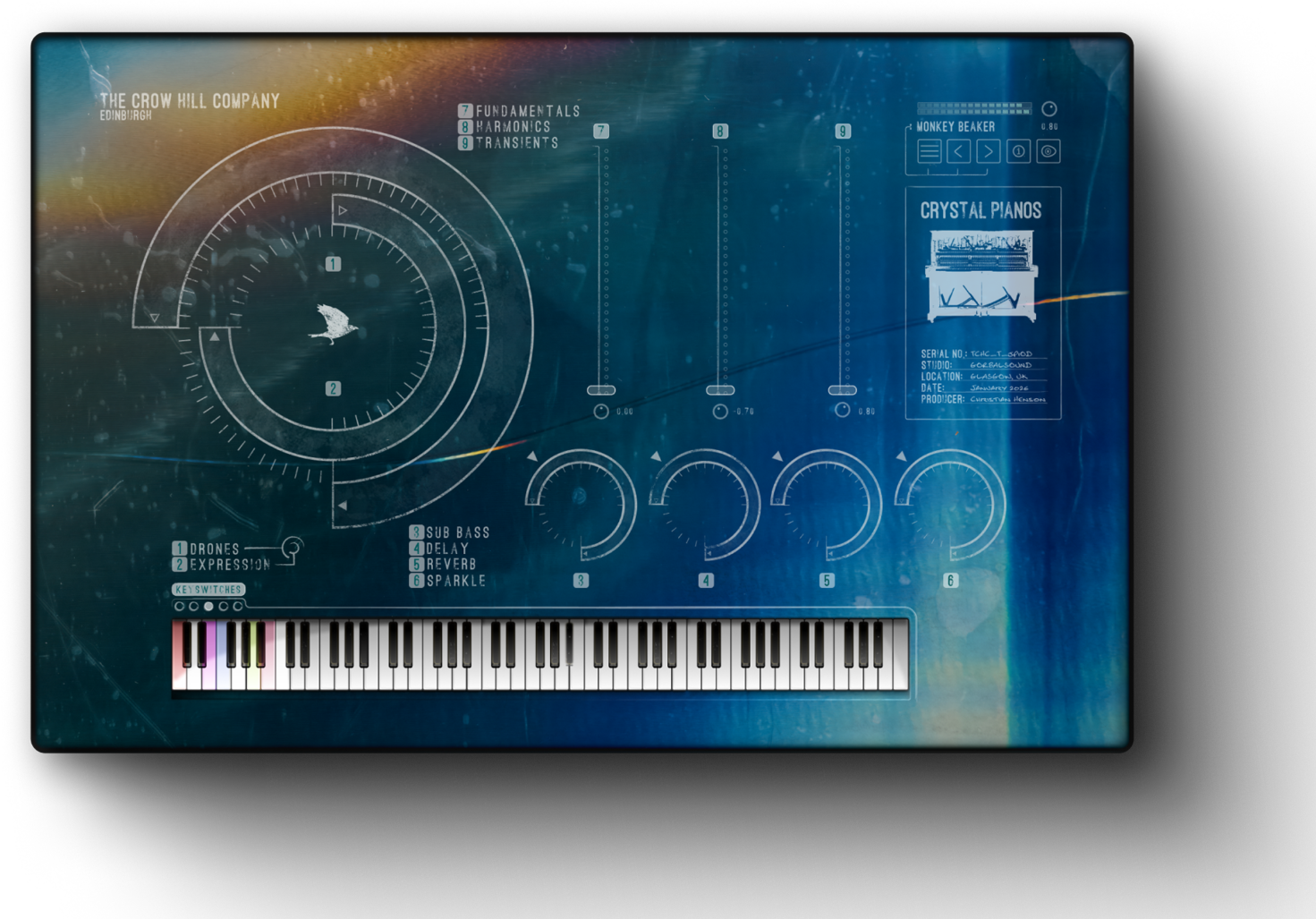
Be that as it may, those events all played a part in making CRYSTAL PIANOS what it is today — an invitation to imagine 18 pianos where the strings have been ripped out and replaced by glass as an innovative instrument. Indeed, each piece of glassware was handpicked for its unique sonic characteristics, ranging from intimate celeste-like tones all the way through to a chorus of shimmering glass; each offering provides users with five different playing styles: Standard Hits, Muted Hits, Tremolo Slow, Tremolo Fast, and Rubs (With Finger on Rim). It is also possible to control the sonic characteristic of each glass via The Crow Hill Company’s unique ‘partial mixer’ that enables users to tweak individual sonic components of the performances — namely, FUNDAMENTALS, the most audible music note or root; HARMONICS, the surrounding frequencies mapped into chromatic shepherd tones; and TRANSIENTS, the strike tone (that asserts the material characteristics of the instrument and therefore does not change, even if the pitch of the other partials does). Ultimately, users are free to create magical melodies that do not exhibit the sentimental ‘Potter-Effect’ of a celeste or glockenspiel, or orchestrate intricate contrapuntal tapestries or, indeed, oceans of rippling glass atmospheres to bring something new and unique to their music.
Clearly, Christian Henson’s road to The Crow Hill Company’s CRYSTAL PIANOS release has been a long and winding one — one that also represents something of a cathartic release for him personally: “I’m just absolutely delighted to have arrived at a point where I finally feel that I’ve created the stinky astronaut space piano thing-y. After 22 years, I can’t begin to tell you what an incredible sense of achievement that is, and that’s thanks to the amazing team that I work with who have persevered with this, because there’s been a lot of experimentation, back and forth — should we pitch the transients slightly, should the shepherd tones be louder or quieter, etc. I’ve taken them on a journey over the last six months, and I think they’re tired of hearing me say, ‘It’s taken me 22 years to get to my stinky astronaut space piano thing-y!’”
Featuring 18 individually selected pieces of glassware recorded at Gorbals Sound Recording Studios in Glasgow, UK with a multiple — Neumann KM 84, KM 184, and U 87 — microphone setup, CRYSTAL PIANOS is available to buy for £75.00 GBP/$99.00 USD/€85.00 EUR as a sample-based virtual instrument comprising over 30 GB of uncompressed audio (compressed loosely to ~13 GB) supporting AAX-, AU-, VST-, and VST3 plug-in formats for macOS 11 through to 15 (Apple Silicon and Intel compatible) and Windows 10 through to 11 with three different and individual controllable Partial Tones, five articulations, and four included — SUB BASS, DELAY, REVERB, and SPARKLE — effects from The Crow Hill Company here: https://thecrowhillcompany.com/tools/crystal-pianos/
For more in-depth information, including some superb-sounding audio demos from The Crow Hill Company co-founder Christian Henson himself, please visit the dedicated CRYSTAL PIANOS webpage here: https://thecrowhillcompany.com/tools/crystal-pianos/
CRYSTAL PIANOS installation and activation requires installation of The Crow Hill App — an easy-to-use app designed by the best in the business to provide seamless download, installation, integration, calibration, and organization of The Crow Hill Company tools — available for free from here: https://thecrowhillcompany.com/crow-hill-app/
About The Crow Hill Company (www.thecrowhillcompany.com)
Achievable as a result of selling some of the best and most interesting sample-based virtual instrument plug-ins available today, The Crow Hill Company represents realization of company co-founder and professional composer Christian Henson’s heartfelt dream of encouraging people to make music and help them on their journey, regardless of whatever point they were at and wherever their journey began by providing access to challenges, content, networking opportunities, and resources. Always abiding by its Make Music, Your Music motto, every month the Edinburgh-based enterprise drops a new VAULTS… release, ready for all to download and make music with for the rest of their lives — free for those who value sound.
© 2026 Crow Hill Productions Ltd
Available now! https://sonoracinematic.com/products/pure-steel-string-soundbox-pack
Edinburgh, Scotland, 4th March 2026. Sonora Cinematic has announced the release of Pure Steel String – the follow up to the recent Pure Nylon and the latest addition to the developer’s series of instruments for Audiomodern’s customizable MPE sampler – Soundbox.
Where Pure Nylon offered warmth and intimacy, Pure Steel String brings vibrancy and definition. Bright, crisp and resonant, it’s the unmistakable sound that has shaped folk, rock, blues, pop and countless contemporary productions.
Pure Steel String focuses on four main articulations – Dynamic Plucked, Dynamic Picked, Harmonics and Mod-Wheel Controlled Tremolo. Every articulation is crafted for dynamic performance, offering a natural and organic playing experience. What’s more, thanks to Soundbox’s MPE-ready workflow, the instrument responds beautifully to MPE controllers for a wonderfully natural vibrato.
Similarly to its counterpart, Pure Steel String goes beyond acoustic sampling by adding a collection of creative tools for sound design. These include expressive improvisations full of character and musicality, a mod-wheel controlled patch to layer in 5th and octave flowing arpeggios, vector-controlled soundscapes for evolving ethereal textures, creative sequences and more.
Designed For Soundbox
Pure Steel String is designed for Soundbox v1.2 – a customizable MPE sampler which is available to download for free from the Audiomodern website, and works on Mac, Windows and iOS. The release joins Sonora Cinematic’s growing lineup of Soundbox instruments which also includes Post-Rock Guitars Vol 1 & 2, Transfigured Orchestra 1& 2, Aethervox, Pure Nylon, Dark Veil and more.
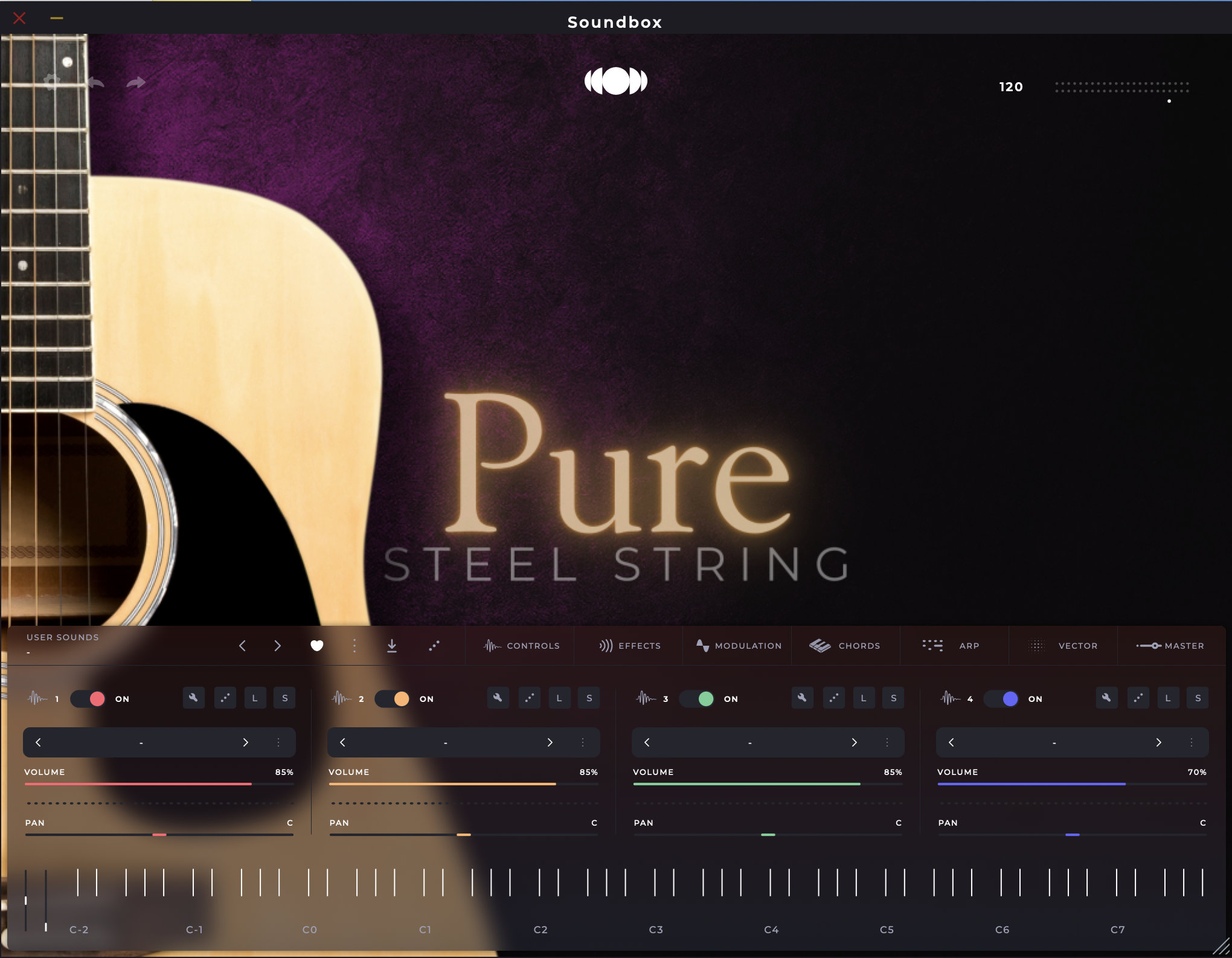
Screenshot
Pricing & Availability
Pure Steel String is available to download now from the Sonora Cinematic website for the introductory price of £10 (normally £15). Prices exclude vat.
Find out more: https://sonoracinematic.com/products/pure-steel-string-soundbox-pack
Walkthrough: https://youtu.be/Z6voWM8hgtg?si=mqiNMSrkavpawbAA
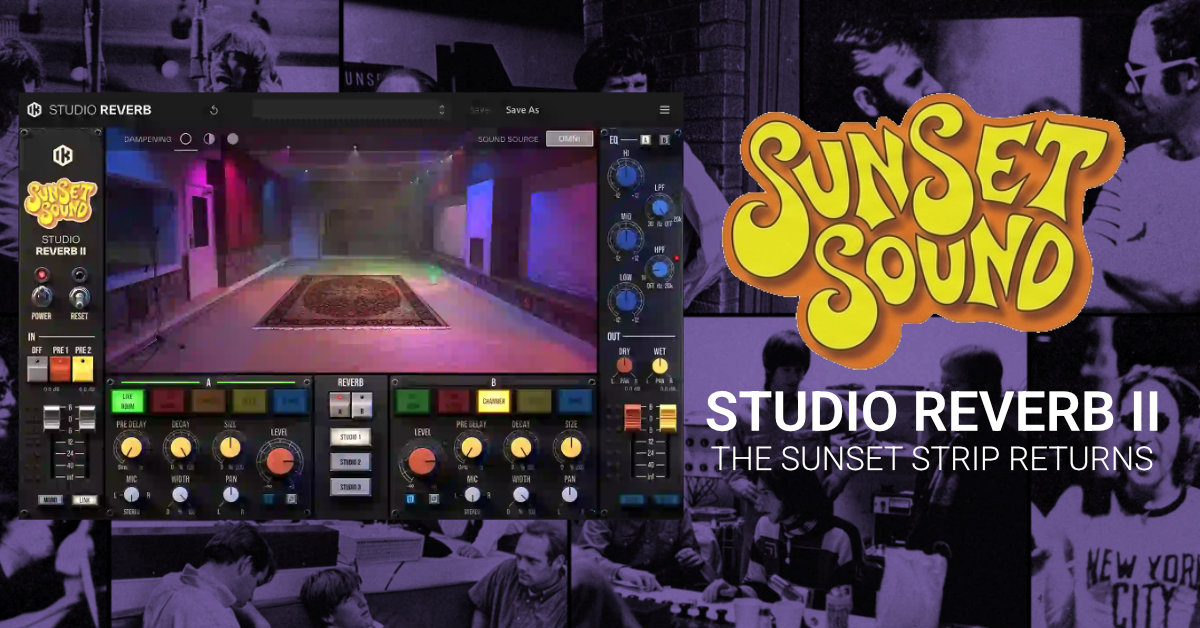
The Sunset Strip returns – the legendary rooms behind timeless recordings,now more immersive, more dimensional, and more powerful than ever
 February 26, 2026 – IK Multimedia launches Sunset Sound Studio Reverb II, a standalone and significantly expanded version of its popular T-RackS plug-in. Using IK’s proprietary Volumetric Response Modeling (VRM™) technology, Version II effectively captures the acoustic details of Sunset Sound’s legendary Studios 1, 2, and 3 with unmatched spatial accuracy, realism, and mix-ready controls.
Moving beyond static convolution, VRM™ maintains how a room reacts to position, direction, and acoustic setup-delivering the tone, depth, and movement that define decades of iconic recordings made at Sunset Sound.
What’s New in Version II
True 3D Source Positioning
Version II features a fully sampled Live Room Positioning System with up to 27 distinct source locations per studio. Each position was captured as a unique acoustic event-not mathematically interpolated-preserving early reflections, boundary reinforcement, and an authentic spatial perspective.
Move the source, and the room reacts naturally, adding depth and realism that traditional impulse-response reverbs can’t match.
Studios 1 and 3 also feature modeled variable dampening settings, mimicking Sunset Sound’s adjustable absorption panels and allowing engineers to reshape decay and tonal balance in a physically accurate manner.

Dual-Engine Architecture
Sunset Sound Studio Reverb II features two fully independent reverb engines working in parallel. Users can combine Live Rooms, Chambers, Iso Booths, EMT plates, and AKG spring reverbs-each with its own EQ, stereo control, and routing. Layer physical spaces with classic hardware reverbs or mix multiple room perspectives with complete flexibility.
This dual-engine design transforms the plug-in from simple room emulation to a versatile spatial production tool.
Advanced Size Control
Size in Version II is not a simple decay parameter. It dynamically scales the impulse response from 0% to 200% while preserving the original capture’s tonal fingerprint and spatial behavior.
Engineers can tighten large rooms without losing early reflection detail, extend smaller spaces into cinematic environments, and adapt decay to tempo and arrangement-all while maintaining spatial coherence. Instead of switching presets to fit a mix, users can reshape the room itself without sacrificing realism.
Directional and Omni Modes
Different sound sources energize a room differently. Sunset Sound Studio Reverb II models this behavior with two source types: Directional Mode for focused dispersion (vocals, guitar cabinets, brass) and Omni Mode for uniform propagation (drums, piano, ensembles). Adjusting source behavior enhances depth perception, improves decay blending, and refines mix translation.
Expanded Capture Library
Version II includes 336 meticulously captured stereo impulse responses from the live rooms alone, dramatically expanding spatial variation over the original version. Every capture preserves the acoustic fingerprint that made Sunset Sound one of the most recorded studios in music history.
True Analog Warmth
In addition to Sunset Sound’s vintage microphone collection, IK modeled the studio’s iconic console signal paths. Version II offers two selectable preamp and signal-path emulations-the API/DeMedio Sunset Sound Custom and the Class-A Discrete NEVE 8880-that add harmonic depth and tonal character.
Built for Modern Workflows
A redesigned 3D interface provides immediate visual feedback while maintaining precise control. Source positioning, dampening states, diffusion selection, and routing adjustments are accessible without interrupting creative flow.
Sunset Sound Studio Reverb II is more than a room emulation. It is a spatial instrument-built from one of the most recorded studios in music history and engineered for realism, flexibility, and modern mix control.
Pricing and Availability
Sunset Sound Studio Reverb II is available now from the IK Multimedia online store and from IK authorized dealers worldwide for $/€149.99*. Existing users of T-RackS Sunset Sound Studio Reverb will receive a $/€50 discount automatically during check-out for a limited time.
*All pricing is excluding taxes.
For more information and to hear demos, visit www.ikmultimedia.com/

EDINBURGH, UK: The Crow Hill Company is proud to introduce its latest innovations in sampling with GONG PIANO — embracing entirely new concepts (including so-called Shepherd Mapping polyphony, as well as recording Partials), engine, GUI (Graphical User Interface), and an environment to work in that is firmly pegged and duly designed to deliver for music-makers wanting cinematic results in an instant as a drone-making, super-chromatic gong machine, to paraphrase the driving force behind its ear-opening creation — as of February 26…
As an undertaking that saw The Crow Hill Company co-founder and professional composer Christian Henson bravely binning his entire sound collection and starting from scratch, the road to GONG PIANO was a long and winding one — hilly, too, with many marches up and down the nearby Crow Hill (from which the Edinburgh-based enterprise takes its name), helping to clear heads and formulate concepts. Christian Henson admits,
“A few months ago, I committed an act; I don’t know if it was in a fit of pique or a legitimate and sound artistic decision. That act was getting rid of all of my sounds — binning my sample libraries, my gun cabinet, my sonic arsenal, my toolkit, constructed, pillaged, rummaged for, and discovered over decades of working as a composer and as a samplist. And when considering starting from scratch, where to begin? Well, I guess at the beginning; the beginning that we’re so used to, whether it be in cinema, or TV, or computer games — that trope of the drone. And the drone I’ve built and am introducing is called GONG PIANO.”
Continues Christian Henson: “I’ve been focusing in on something that I never really have considered as a samplist — not just the room, not just the player and performance, not just the instrument, but also the material. The biggest intrigue for me has always been wanting a full and chromatic piano’s worth of a beguiling tone, but the problem with stretching things up and down is that you change the quality of the material — not just the pitch. So going back to the drawing board entirely meant thinking about sampling in a totally different way — particularly where creating the impossible is concerned: a piano where the strings have been replaced with gongs; the ability to create drones — things that go on forever and ever — out of finite objects like a percussion instrument. And I guess where this whole ORIGINS series is concerned — plumbing the depths of my history with technology to find inspiration that was there all along, I have to go back to my humble [Roland] D-5, a younger, shitter cousin of the D-50, where they used things called Partials — bits of sound. Basically, these things didn’t have the sampling power — didn’t have the technology or hardware — to be able to create something affordable that had fully sampled instruments, so, instead, they just sampled little bits and then added things like wavetables and stuff. And this is, I guess, where the story to this new approach to sampling begins — at this idea of Partials.”
Put it this way: in Roland parlance, Partials refer to the foundational, discrete sound-generating components within many of that Japanese giant’s synths, classic or otherwise, whereby each ‘tone’ (sound) can consist of up to four individual Partials, allowing for complex, layered, and evolving sound design. “When recording these gongs, I always had in mind that we were going to separate them off into Partials,” confesses Christian Henson, adding: “I did the first round of recordings in the house and then tried two different forms of post-production to create the Partials — one was using iZotope, whereby, once you’ve removed the fundamentals, it’s quite easy to see the harmonics and just leave the transients; however, there’s a kind of noise reduction-y, digital squarbly sound that is really apparent that I’m very sensitive to these days, so I decided to do the post-production process again on those same recordings, but this time by using strong or stacked band-passes, high-passes, low-passes, and, again, when putting that together, it just felt like when you freeze some vegetables — they never quite taste like fresh vegetables again. So what I decided to do was to go into a more controlled environment — that being Castlesound Studios, where I’ve got some of the best recordings I’ve ever had the pleasure of being part of making, with the decision to use a selection of beaters but also different positions within the gong and, instead of creating Partials from single recordings, using multiple recordings to basically combine these three Partials — three totally separate recordings — into the sound that we’ve created. Am I trying to make a realistic rendition of this gong? No. I’m just trying to create something that is suitable for us composers as a drone-making, super-chromatic gong machine, but something that still sounds realistic.”
It is worth, perhaps, pausing briefly here to point out that those same gongs have already made an outing — albeit in a somewhat simplified sampled-based virtual instrument plug-in form — on The Crow Hill Company’s free VAULTS – TUNED GONGS, relatively recently released as a downloadable drop with a difference, effectively enabling anyone to play an extraordinary quartet of harmonised gongs designed and used by meditation gurus as part of gong bath setups in a way that was never intended by their Italian creator after being bought and sampled by Christian Henson.
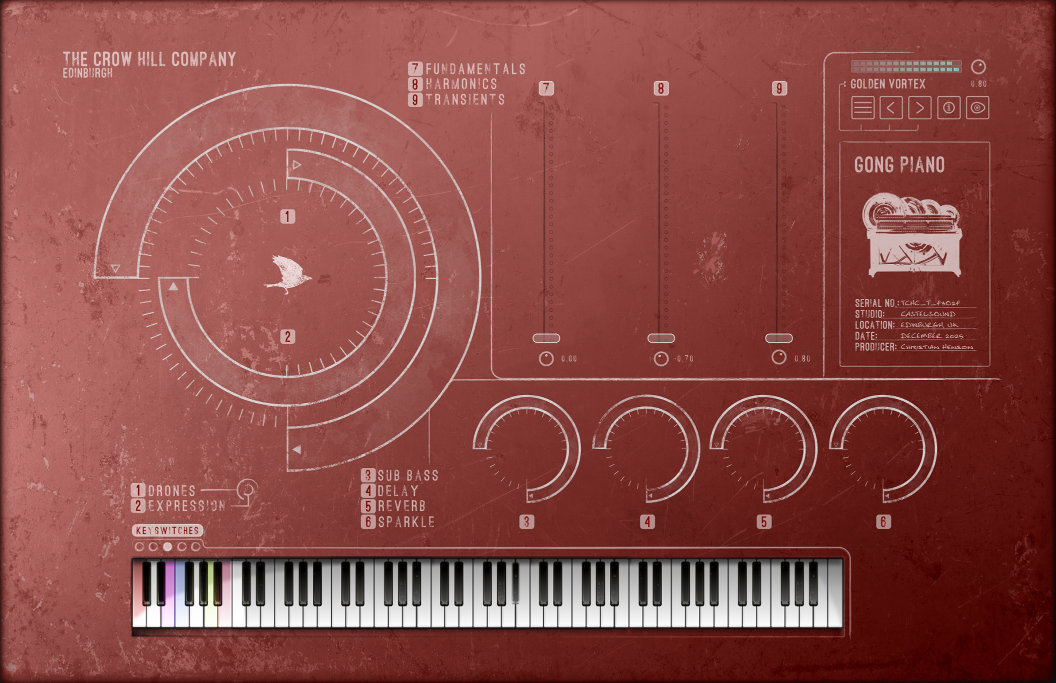
Embracing entirely new concepts warrants an entirely new GUI to operate the new engine driving GONG PIANO: “When you see a bunch of faders on our new GUI, it means something entirely different — three Partials: the FUNDAMENTALS, the HARMONICS, and the TRANSIENTS. The fundamental samples work just like your traditional Akai samplers; there’s a lot to be said for all that magic that happens when you pitch something down loads — and, indeed, pitch it up, but down is better. So there’s a lot of fundamental tone here; we’re hitting the gong in the part of it that produces the greatest, roundest, fattest fundamental. There’s enough interesting harmonic material in there to create real interest across the keyboard, with a very pure, sine wave-type tone down at the bottom, but with all sorts of movement and fluctuation. No surprises here, then; however, if we move to the next Partial, this is the part of the gong that creates the biggest amount of interesting harmonic information — less fundamental and more of the surrounding harmonics. Finally, the TRANSIENTS is the aspect of the gong that creates the least recognisable fundamentals or harmonics. Whilst these gongs resonate at different fundamental frequencies, they’re all made of the same thing — metal, and, no matter what happens to that central resonating frequency, the thing that you can never get away from is material — what they’re actually made of. So what I’ve decided to do with the TRANSIENTS is keep the pitch static — loads of dynamic layers, loads of round robins, so you don’t get a sense of things repeating themselves, but it always stays the same pitch. So what I decided to do was take the harmonic Partial, duplicate it an octave apart, and gradually adjust the mix of that octave unison across an octave so that — whilst it will move pitch with the fundamental across the entire spread of the keyboard — the fundamental harmonic qualities of the instrument won’t change. And what I’ve created is basically a chromatic shepherd tone. The variable Partial, the static Partial, and this kind of hinterland between give the gong its characteristic — the FUNDAMENTALS, the HARMONICS, and the TRANSIENTS. This is just one gong — one pitch centre — that we’ve managed to divide into these Partials, spread across a keyboard, and what I love about it is the tonal change in characteristics depending on the pitch — the change in kind of emotional effect, but, to my ears, it doesn’t just sound like a sample that’s been pitched up and down.”
Provided patches — including Ensembles, as well as Gong Drones designed by Christian Henson himself — to gong glory notwithstanding, GONG PIANO’s gorgeous GUI concept will beautifully translate to future releases, as Christian Henson keenly confirms. “From here on in, whenever you load a preset into a Crow Hill interface, you know that it will always give you five completely different sample sets. Why five? Five fingers. Easy to remember: C is the bottom note, G is the top — all the white notes with different key switches there, which you can either switch on the keyboard or directly on the GUI. That these can be used to create a performance — particularly when creating these undulating, moving, swelling drones — that you can work to picture I think is key to really bringing out the humanity in how you’re helping tell the story. So there’s a ton of interactive improvements that we’ll be bringing to this engine and interface without over complicating it.”
It is fair to say, then, that Christian Henson himself is delighted with both GONG PIANO itself and what it represents in The Crow Hill Company’s creative journey going forward: “The thing that we enjoy most here is dreaming up crazy ideas. What if you were to strip the strings out of a piano and replace them with gongs? And also some kind of EBow mechanism in the piano infrastructure to make those gongs sing forever? And the ability to alter various different harmonic components of that drone while you’re playing it in order to create a single ongoing note and pulse that changes without drawing attention to itself? It’s taken a while to get here, but as the first part of this new beginning for me, which always starts with a drone, I’m absolutely delighted to have not just reinvented the wheel and recreated some samples that I already had from 30 years ago, but, in fact, to take those 30 years of sampling and working as a professional composer to create something new and fresh, which I’m really delighted to be able to share.”
Featuring four handcrafted tuned gongs from Grotta Sonora in Rome, Italy, recorded with five microphones (Super Close Mono: U87, Close Stereo: 2 x U47, Room: DPA ST4006A) at Castlesound Studios in Edinburgh, UK, GONG PIANO is available to buy for £29.00 GBP as an AAX-, AU-, VST-, and VST3-format-compatible sample-based virtual instrument plug-in comprising 10 GB of uncompressed material (compressed losslessly to 5.5 GB) that loads directly into a DAW (Digital Audio Workstation) — with four unique sounds sets with five articulations (Multi-Hit, Muted, Metal, Harmonic Mutes, Scrapes & Swipes) each, plus an additional Drone layer, as well as three individually controllable Partial Tones (FUNDAMENTALS, HARMONICS, TRANSIENTS) and four included effects (SUB BASS, DELAY, REVERB, SPARKLE) — from The Crow Hill Company here: https://thecrowhillcompany.com/tools/gong-piano/
For more in-depth information, including some superb-sounding audio demos, please visit the dedicated GONG PIANO webpage here: https://thecrowhillcompany.com/tools/gong-piano/
GONG PIANO installation and activation require installation of The Crow Hill App — an easy-to-use app designed by the best in the business to provide seamless download, installation, integration, calibration, and organization of The Crow Hill Company tools — available for free from here: https://thecrowhillcompany.com/crow-hill-app/
Become better acquainted with the drone-making, super-chromatic gong machine that is GONG PIANO while watching The Crow Hill Company co-founder Christian Henson’s highly-informative introductory video here: https://youtu.be/zliRp4pws8c
About The Crow Hill Company (www.thecrowhillcompany.com)
Achievable as a result of selling some of the best and most interesting sample-based virtual instrument plug-ins available today, The Crow Hill Company represents realization of company co-founder and professional composer Christian Henson’s heartfelt dream of encouraging people to make music and help them on their journey, regardless of whatever point they were at and wherever their journey began by providing access to challenges, content, networking opportunities, and resources. Always abiding by its Make Music, Your Music motto, every month the Edinburgh-based enterprise drops a new VAULTS… release, ready for all to download and make music with for the rest of their lives — free for those who value sound.
© 2026 Crow Hill Productions Ltd
 HAMBURG, Germany — Steinberg has today announced the immediate availability of
Groove Agent 6, which adds the ability to layer and replace kicks, snares and toms, the
brand-new Punch Kit, many new acoustic kits, a new pattern editor, and much more to
quickly and easily create the best grooves.
Also available as of today is the major update to Absolute 7, which includes the latest
release Groove Agent plus the Etude grand piano, the new Axe Machina guitar, The
Orchestra: Colors, Colors Lofi Tapes, and more.
New kits, new sounds
Groove Agent 6 adds powerful layering and replacement features for kicks, snares, and
toms in Acoustic Agent. With 47 new acoustic kit pieces — 24 snares,15 kicks and eight
toms in various sizes and materials — the ability to give a kick drum more punch, cut through the mix by adding a second snare layer or swapping out toms makes creating a unique, signature sound easier than ever.
Screenshot
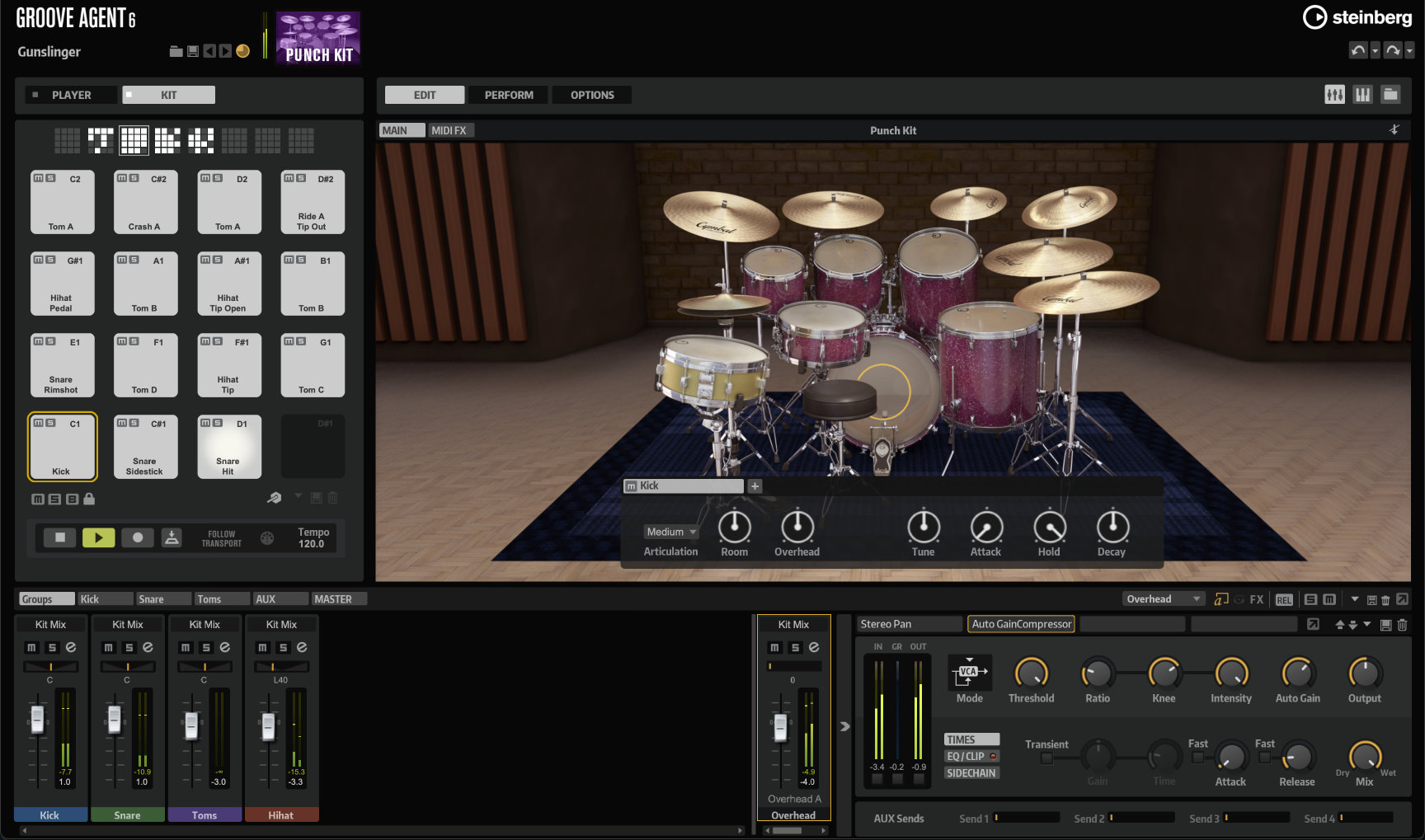
The new Punch Kit delivers the natural, high-impact sound of a deeply sampled Tama Starclassic Bubinga kit. It includes 24 new presets, recorded by a professional session drummer with intros, outros, and multiple groove variations, each with its own mix and MIDI styles.
Even more new drum sounds and patterns come with Color Punch, a selection of kicks,
snares, hi-hats and percussion designed for modern pop production. Especially chosen to
blend seamlessly with synths, basslines, and vocal hooks, Color Punch delivers a dynamic,
rhythmic backbone.
New tools, new interface
Beat makers benefit from the new pattern editor, which has been designed for the straightforward but flexible programming of intricate beats. With each pad assigned to its own dedicated lane, inbuilt random and Euclidean step generators are included to inspire new ideas.
The Mixer panel has been redesigned to integrate into the lower section of the interface.
Alternatively, it can be undocked or opened in its own window. Kits and mixer settings can be edited side by side, while a unified mixer and effects editor is provided across all Agent types for straightforward fine-tuning.
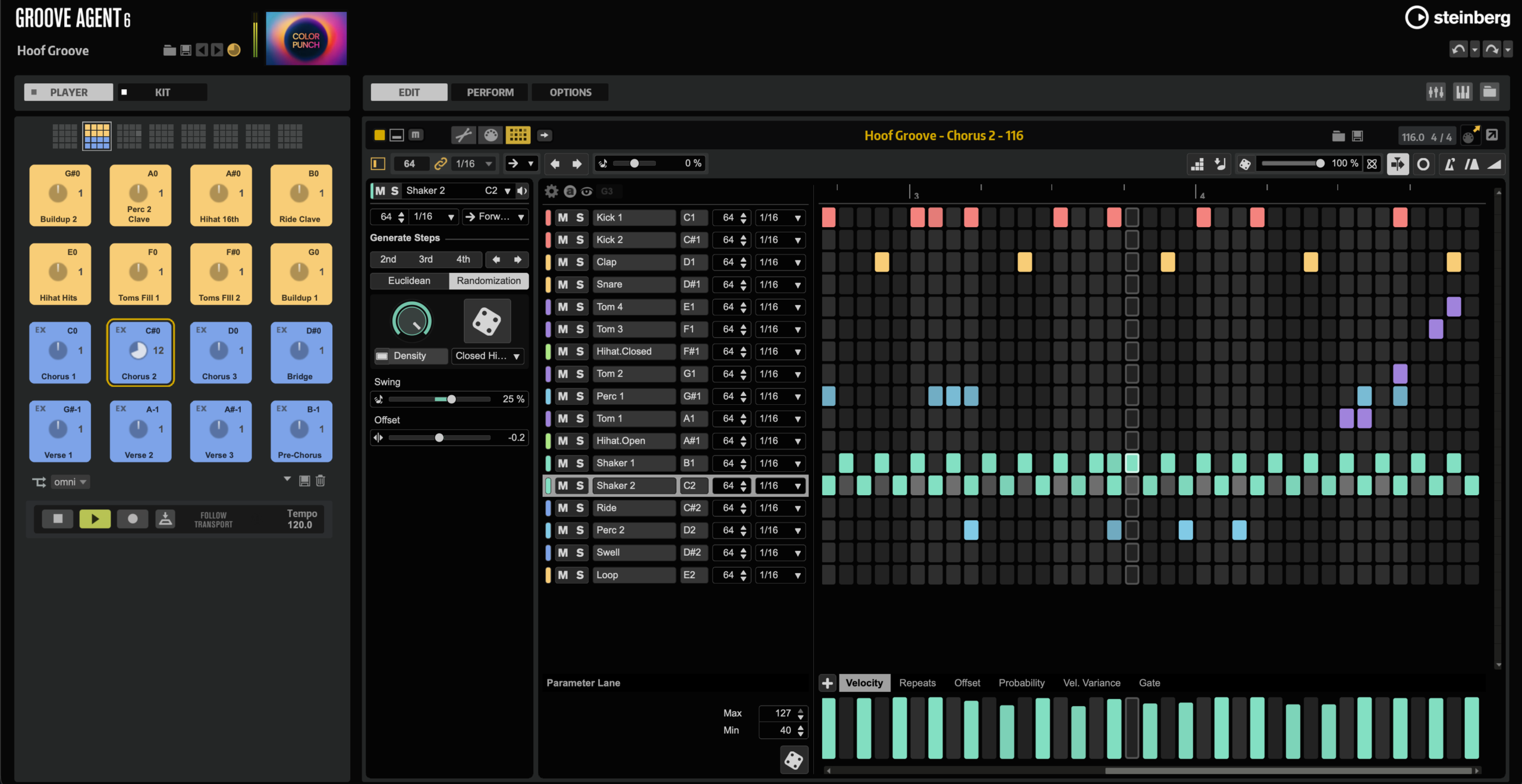
Searching for sounds is easier with the updated, context-sensitive MediaBay: automatically filtering results based on the individual workflow, finding sounds and samples is now faster and more relevant.
All Groove Agent 6 operations are enhanced by the redesigned user interface, which is scalable from -50% to +100% and optimized for single-slot usage. It makes Groove Agent much more adaptable to personal workflows, with larger Acoustic Agent interfaces, an improved edit section, customizable toolbars, and more.
Groove Agent 6 includes more new and enhanced features:
• Shaper Mode with brush, pen, and eraser tools to intuitively draw and refine envelope curves.
• Five new effects: Auto Gain Compressor, Fuzz Distortion, Bit Crusher, Clipper, and Studio EQ 24.
• The pitch of drum samples can be checked with a single click, then tuned to match the key of the song.
• A new spectral algorithm in Warp Mode allows drum or melodic samples to be played in sync with the project tempo or beats.
• Every kit preset now includes a preview, automatically adjusted to the track’s tempo.
• Hardware mapping for e-drum kits, with presets for a range of manufacturers.
“With Groove Agent 6, we focused on simplicity, amazing sounds and flexibility. Users can now customize their acoustic kicks, snares or toms, which gives them so much more options for sound design,” says Senior Marketing Manager Florian Haack. “And for those looking for more, we’ve updated our Absolute instrument collection, which not only includes Groove Agent 6 but many more exciting instruments and libraries.”
And, There’s More!
Groove Agent 6 is also included in the Absolute 7 instrument collection alongside the
additional world-class Etude grand piano, the new Axe Machina guitar, The Orchestra:
Colors, and Colors Lofi Tapes, making Absolute 7 the most comprehensive version yet.
Groove Agent offers a diverse collection of expansion sets that complement the included
libraries, including titles like Rock Essentials, Funk Essentials, Jazz Essentials, Songwriter
Essentials, and the premium Simon Phillips Studio Drums, allowing producers to tailor the
instrument to virtually any musical style.
Availability and pricing
Groove Agent 6 and Absolute 7 are available through the Steinberg Online Shop. The suggested retail price for Groove Agent 6 is 159 euros and 159.99 US dollars. The suggested retail price for Absolute 7 is 499 euros and 499.99 US dollars. Prices may vary according to region.
Updates are exclusively available through the Steinberg Online Shop.
Customers who have activated Groove Agent 5 or Absolute 6 from January 22, 2026, are eligible for a free, downloadable grace period update to the latest version, respectively.
Key features of Groove Agent 6
• Powerful layering and replacement features for kicks, snares, and toms, with 47 new acoustic kit pieces
• Deep-sampled Punch acoustic kit with 24 presets, featuring intros, outros, and multiple groove variations
• Color Punch kicks, snares, hi-hats and percussion for modern pop production
• New Pattern Editor to simplify programming of complex beats
• Updated Mixer panel for enhanced fine-tuning
• Redesigned, scalable user interface
• Context-sensitive MediaBay makes finding sounds and samples faster and more relevant
Links
Product pages: www.steinberg.net/grooveagent and www.steinberg.net/absolute
YouTube channel: www.youtube.com/VSTinstrumentsplugins
About Steinberg Media Technologies GmbH
Steinberg is known the world over for its music and audio software solutions. The company
has been developing, manufacturing and selling innovative products for musicians and
producers in the music, film, post-production and multimedia industries since 1984.
Steinberg products are used by Grammy and Oscar award-winning composers, engineers
and producers.
Visit www.steinberg.net for further details.
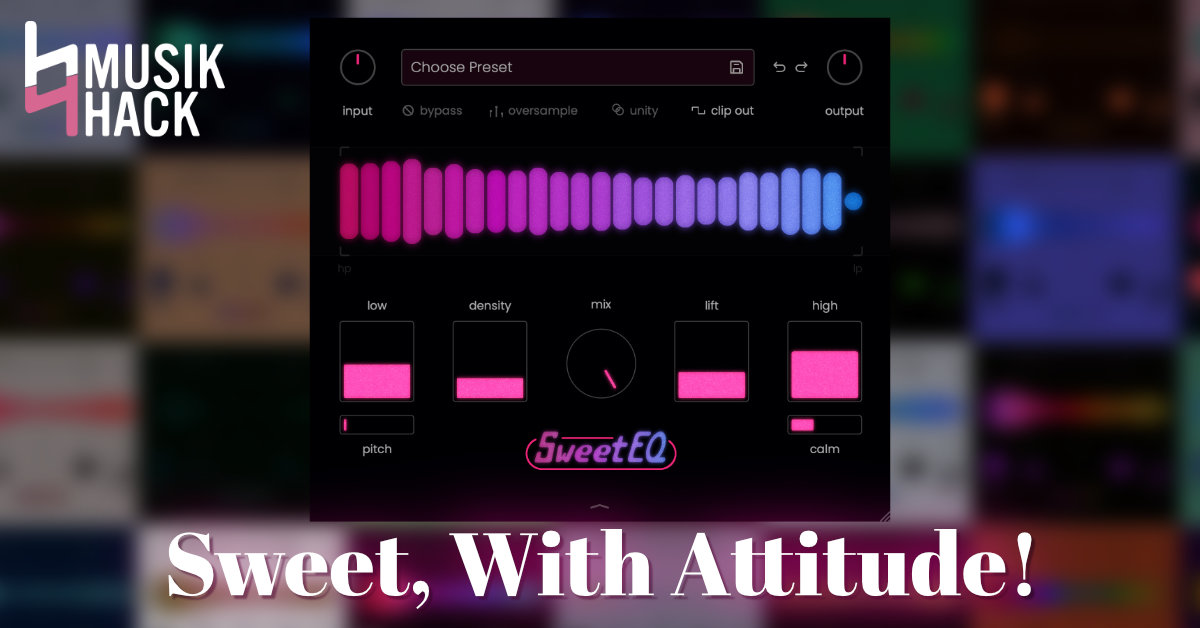
 Los Angeles, CA (February 14, 2026) – Musik Hack proudly releases their newest plugin: SweetEQ is a “saturating EQ”, adding character and energy to any sound, freeing you from the typical set of crossovers, harmonics, filter shapes, resonances, and technical references for targeted saturators.
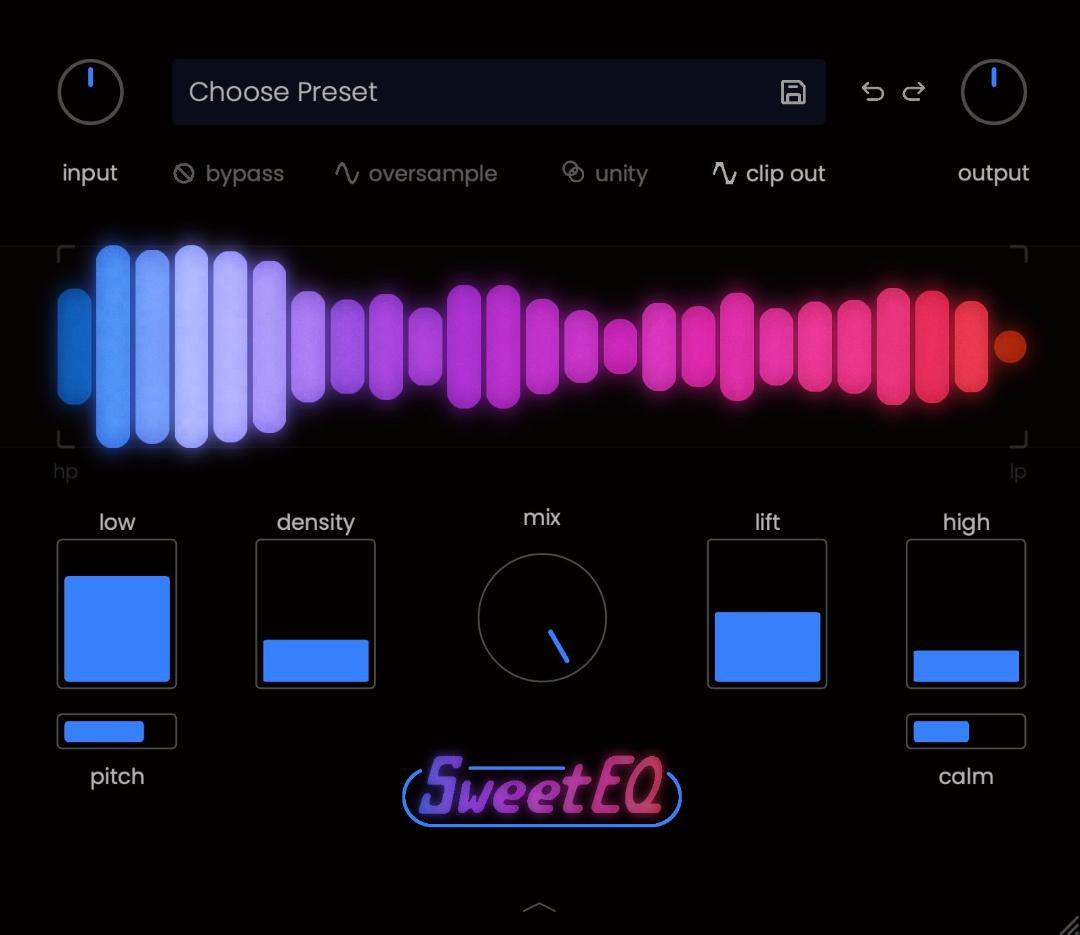
In a marketplace full of complicated saturation plugins, SweetEQ cuts through the noise and delivers it all: sweeter & richer bass, a thicker overall character, high mid articulation and cut through, or high end sizzle and air. Each one of the faders addresses one specific challenge: tuning for bass, mud for overall character, tuning and resonance for mids, and brittle harshness for highs.
Key Features:
Low End Juice – pitched low end saturation to enhance low-end harmonics wherever needed, whether adding heft to a voice or grind to a kick.
High-End Sparkle – excite & control the highs to add maximum air and sizzle to the vocals and dusty samples without harshness ruining the mix.
Midrange Presence – add prominence across the board. SweetEQ’s unique lift circuit helps any sound cut through the mix without overwhelming the low end.
Broadband Punch – create pop and energy with a bespoke density circuit that gives impact to any thin sound.
Intuitive Bandpass – control the outer limits by intuitively dialing in the extreme highs and lows or set up a telephone filter, with immediate feedback.
Endless Vibes – a look for every sound. SweetEQ’s meter dances with every kick, pluck, shift, turn, stab and well in full, living color.
Each of the controls was designed to be awesome, and then meticulously redesigned so that it didn’t interfere with any other control. What good is sweetening the bass if you flatten it again with another knob later? SweetEQ is a truly expressive tool eliminating the worry of finding and losing a great tone.
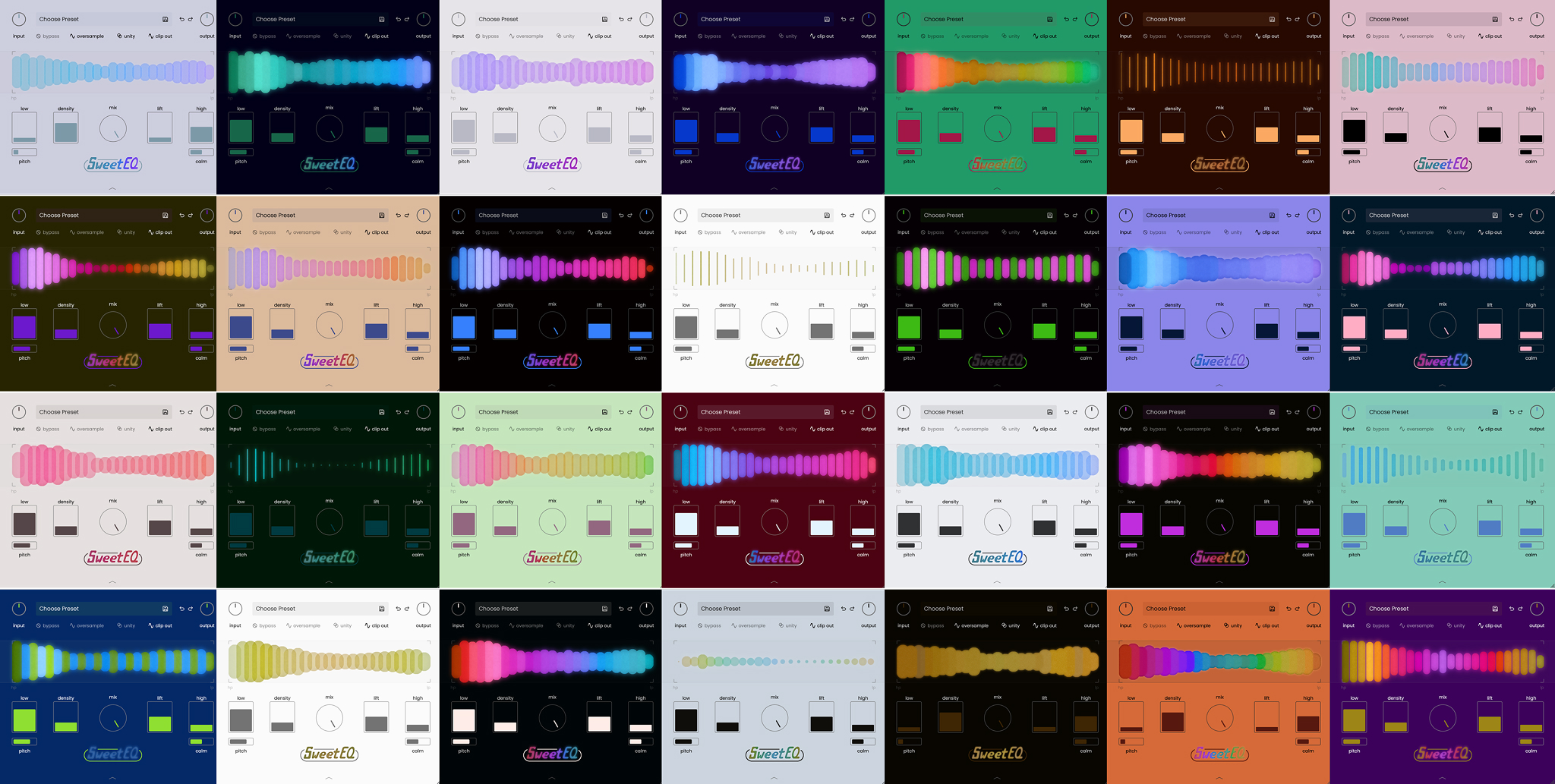
The calm portion of the high circuit required the most research and development: it contains a special de-essing / smoothing circuit and two detection circuits that operate in different ranges to find the worst resonances and attenuate them. The two ranges were picked very carefully so as not to hurt the character of sounds.
The color system for the interface was designed to allow the user to set any vibe for their session and track without sacrificing readability.
Finally, SweetEQ’s sliders are weighted toward the first 0-20% of each effect, keeping in mind that small moves on sound can make big differences. These small moves in combination are similar to what various types of analog gear do to sound by default. Rather than model one piece of gear, Musik Hack looked at all the characteristics over a vast array of gear they liked the sound of, and developed a signal chain that could stand in for any of it.
Price & Availability:
SweetEQ is available at Musikhack.com for the introductory price of $79 (reg. $99)
or
Rent-to-Own $6.50/month introductory rate (reg. $8.25/month) for 12 months.
Free trial available on the website!
About Musik Hack:
Co-founders composer Sam Fischmann and audio engineer Stan Greene set out to design audio tools for people who care about sound. Coming from the real world as engineers and composers, the Musik Hack team builds plugins that solve actual problems they’ve encountered in their professional journey.
Stan is a professional mastering engineer who has mixed on Billboard #1 albums for Rihanna, Big Sean, and Wale, and multi-platinum singles for O.T. Genesis, Jaden Smith, and others He trained under Manny Marroquin and built Musik Hack’s first plugin Master Plan to streamline his own mastering workflow.
Sam is a software developer and composer with a background in audio/DSP, web, and embedded systems. He builds functional, studio-grade tools that don’t look like airplane cockpits.
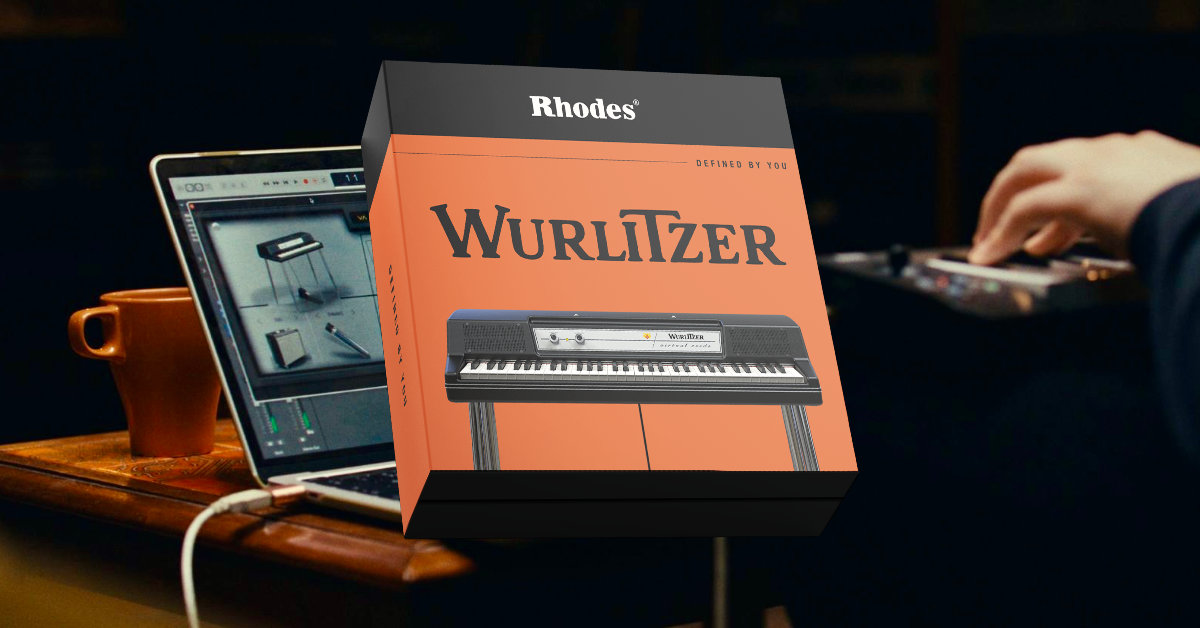
 Leeds, United Kingdom, February 12, 2026 — Rhodes Music and the Wurlitzer brand have announced that the Rhodes Wurli plug-in will be rebranded as Wurlitzer by Rhodes following official endorsement from Wurlitzer. The move marks the first time Wurlitzer has formally supported a digital recreation of its classic reed-based electric piano, recognizing Rhodes’ software as an authentic and faithful representation of the original instrument.
Download the 14-day trial of Wurlitzer by Rhodes, visit www.rhodesmusic.com.
“We are proud to see the Wurlitzer sound brought to life so beautifully by the Rhodes team. It is the most faithful recreation yet. Together, we have created what we believe is the finest Wurlitzer plug-in, one that truly captures the soul of the instrument,” said Luise Wurlitzer, speaking on behalf of the Wurlitzer family.
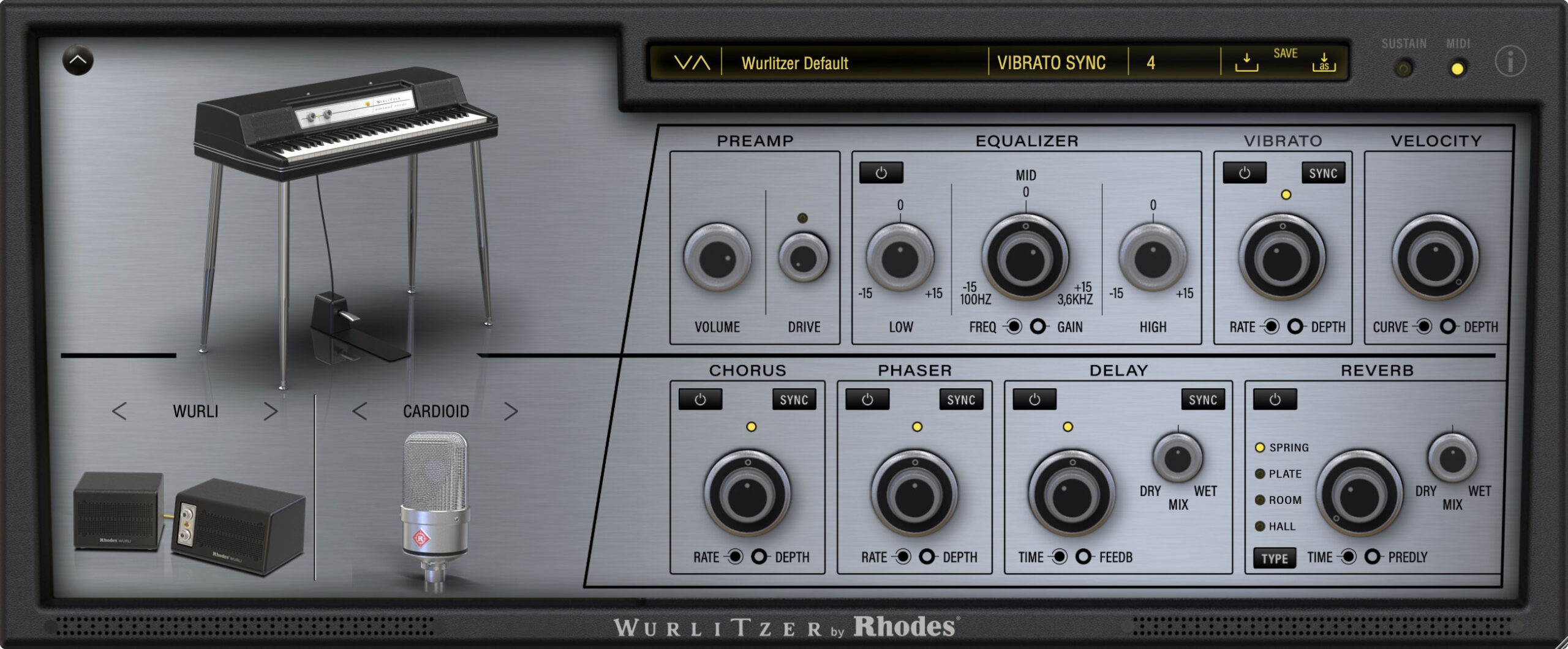
The plug-in, originally released last year as Rhodes Wurli, remains the same deeply musical and faithful recreation of the classic Wurlitzer sound, now carrying an updated name. Rhodes and Wurlitzer have each shaped musical expression for more than fifty years, defining the sound of generations of music makers. That shared legacy makes this endorsement a rare moment in music history, bringing together two of the most influential electric piano brands behind a single virtual instrument.
Availability
Wurlitzer by Rhodes is available now in VST, AU, and AAX formats through the official Rhodes Music store.
To celebrate the announcement, Rhodes is offering a one-week special discount of approximately 50% from February 12, 2026, at 12:00 p.m. GMT through February 19, 2026, at 12:00 p.m. GMT.
Discount Pricing:
Standard Pricing:
To learn more or download the 14-day trial of Wurlitzer by Rhodes, visit www.rhodesmusic.com.
About Wurlitzer by Rhodes
Wurlitzer by Rhodes is the official software recreation of the classic reed-based electric piano, designed to capture the warm, dynamic, and expressive character of the original instrument. Built on the Rhodes Anthology engine, it features detailed sampling, vintage-style controls, 200A-inspired amp and speaker models, and intuitive sound-shaping tools. The result is a versatile and musical virtual instrument suited for both studio production and performance.
About Rhodes
For Rhodes loyalists around the world, this is a new chapter in Rhodes’ history, not a new book. With the Rhodes MK8, we’re returning to the principles, aesthetic, craftsmanship, and pride of Harold Rhodes’ originals. We’re paying homage to the past with our gaze fixed firmly on what lies ahead.