
 SAN CLEMENTE, CA, USA: Q-Bit Electronix is proud to announce availability of Stardust — turning to the stars as inspiration for its introduction as a cosmic tape looper that energizes interaction with recorded audio in the Eurorack format, following on from an impressive legacy of DSP (Digital Signal Processing) audio buffer processors by building upon what made the likes of the self-styled ‘Future Coast’ modular synth-maker’s Daisy platform-based Data Bender, Mojave, Nautilus, and Nebulae modules make musical waves as industry-leading devices — as of November 13…
As a stereo recorder and looper, essentially, Stardust is, at its core, capable of capturing (48kHz, 24-bit hardware/32-bit internal) high-fidelity audio — up to 10 minutes maximum (mono)/five minutes maximum (stereo) — and replaying it. Its rock-solid fundamentals notwithstanding, the conditions in which the looper can find itself showcases the ethereal beauty of the module since Stardust can take any recorded sound and reconstruct a new sonic canvas from those original recordings. After all, this technique — known as musique concrète — dates back to the early 1940s, developed by French composer Pierre Schaeffer and his associates as a type of music composition that utilizes recorded sounds as raw material. Melding both old and new forms of sound processing to re-envision what can be done in the recording medium, Stardust builds upon this tape technique.

The formal introductions can perhaps be best left to Qu-Bit Electronix CEO — and company co-founder — Andrew Ikenberry, who says, “Stardust follows the ethos we’ve had here for the last few years; we want to take complex DSP techniques and make them accessible to everyone — turn a knob, and hear the magic unfold.” It is fair to say that Qu-Bit Electronix’s design philosophy focuses on hands-on, approachable devices that leave room for users to push their own technique and explore sound design in new ways — admirable attributes that have never been more present than with Stardust.
Saying that, Stardust, unsurprisingly, adheres to that ‘New-Bit’ philosophy in all the right ways. Indeed, it behaves like most recorders and loopers in the sense that it can record a sound and play it back, as reflected in its front panel providing all the essential controls for loop manipulation. Ultimately, users can start and stop a loop, reset the loop to the beginning, change the loop playback speed and consequently its pitch (varispeed), and even instantly reverse the loop, each control having a dedicated knob or button and an accompanying jack for signal modulation — all great features to have, but fundamental to the device in question.
Qu-Bit Electronix’s Stardust features various loop modes that alter recording behavior beyond basic recording controls: Sound On Sound Mode bakes each recording into the loop, building an endless cacophony of sound in the process of doing so; Replace Mode cuts out old audio from the loop and replaces it with the new recording; and Frippertronics Mode emulates the trailblazing tape looping technique perfected by British guitarist Robert Fripp to which it — in part — owes its notable name, decaying the recording layer of the loop over time. The final loop mode on offer is Re-Sample Mode, whereby Stardust reads its loop as the audio input and re-samples it as a new buffer! Better still, this is a wonderful way to capture moments of chance transformation within Stardust, thanks to the copious controls available for manipulating recorded sound.
Stardust also allows users to dial in their loop with start and freeze controls in order to set a precise loop within a recording. Thanks to the Eurorack format, the loop size can change at will with CV (Control Voltage) modulation.
Historically, however, not all tape loopers stop instantaneously, so it is just as well, then, that Stardust has a control to emulate that. The inertia knob — positioned just below the front panel-dominating varispeed knob — controls the amount of tape lag when changing the playback speed of the loop, and there is even an ‘Inertial Slope’ control — accessed via the shift button — that lets users set the inertia emphasis depending on playback change direction. As a simpler way of putting it, this only allows the tape-stop effect to occur when stopping or slowing down the loop, with an instant start or speed up, and vice-versa.
Above and beyond that, the two controls that bookend the beautiful galaxy art adorning Stardust’s front panel hark back to the tape technique of splicing and editing, but with a Qu-Bit Electronix twist. The slice control splits the loop into evenly spaced divisions that can reach into thousands of splice points, depending on the loop size, but when paired with skip, the celestial canvas reveals itself in an ever evolving soundscape. Stardust will begin to pick out splices in its night sky, then rearrange them according to how it sees fit. For example, this can include re-pitching the splice, reversing it, repeating it, swapping it with a different splice, changing its stereo positioning, and more!
It is tempting to play with that pairing until the sun burns out, admittedly, but Stardust does not stop there. To add an additional layer of sound design capabilities, the flutter and hiss knobs control a multitude of stackable effects that are, as always, DSP driven — dial in a nostalgic, warm tape feel with wow, flutter, and tape hiss, or digitise a loop with fidelity artefact effects. Elsewhere, Stardust also hosts a lush reverb algorithm, allowing users to transform their loops in a vibrant, nebulous array. And users even have access to high- and low-pass filters for further timbral fine tuning. It is safe to say that Stardust provides the means to completely flip recordings upside down, yet have the end result still make sense in a musical way — not to mention that all of its parameters can be synced to an external clock!
Clearly, Stardust offers more than just its front panel controls. After all, that aforesaid shift button opens up its secondary functions — for instance, jump octaves with the varispeed knob or turn up the pre-gain to use Stardust with line — or even instrument — level devices; press the Effect Mode button to have the DSP effects apply to the dry signal; and even save and export loops as a .wav file to Stardust’s USB drive! Fittingly following in the fanciful footsteps of Qu-Bit Electronix’s more recent additions to its popular product line-up, that USB drive provides Stardust users with a list of under-the-hood settings — all configurable via Narwhal (https://narwhal.qubitelectronix.com/), the ‘Future Coast’ modular synth-maker’s settings web app. Admittedly, varispeed sweeps the whole spectrum in its default setting, but what if it only changed to fifths and octaves? Of course, Narwhal can do that — and so much more besides!
Allowing anyone to reach out into the vast unknown, one overdub at a time, “Stardust is where we’ve wanted to go with Qu-Bit — from every aspect of the design.” So says an equally energized Andrew Ikenberry, winding up with: “We’ve been dreaming up this module for six years now — from what it will do to what it will look like, and how it will contribute to our own patching. We think we nailed it and are so excited to have Stardust out in the world.”
Stardust is available worldwide from Qu-Bit Electronix’s growing global network of distributors (https://www.qubitelectronix.com/distributors) with an MSRP (Manufacturer’s Suggested Retail Price) of $499.00 USD or directly via its dedicated webpage (which includes more in-depth information) here: https://www.qubitelectronix.com/shop/p/stardust (Note that with each Stardust purchased, a portion of the proceeds will go towards the advancement of science and technology via The Planetary Society here: https://www.planetary.org/)
About Qu-Bit Electronix (www.qubitelectronix.com)
Qu-Bit Electronix makes modular synths for sonic explorers. Established by Andrew Ikenberry, the company was formed out of a desire to bridge the worlds of computer music and analog modular synths. Subsequently referred to as purveyors of ‘Future Coast’ synthesis, it is always aiming to find new sounds and techniques that have yet to be fully explored. Fast forward 10 years, the company continues to thrive as a frontrunner in the exploratory modular world. While currently based in southern California, it prides itself on its in-house manufacturing; from automated electronics assembly to testing and calibration, the company continues to uphold the standards and specifications that would be expected of a bespoke modular brand.
© 2024 Qu-Bit Electronix

 LONDON, UK: leading sounds and sample libraries creator Spitfire Audio is proud to announce availability of ÓLAFUR ARNALDS CELLS — working with (Broadchurch) BAFTA-winning, Emmy Award-nominated, and twice-GRAMMY-nominated multi-instrumentalist, composer, and record producer Ólafur Arnalds to create a collaborative tool that enables composers and producers to harness the power of a string orchestra with the feeling of players responding as if they are in the same room courtesy of its innovative Scale Mode providing harmonic movement that follows the user’s tonality to create chance encounters and inspiration, effectively allowing them to play more freely while ensuring everything they play remains within their chosen key, creatively complemented by an associated toolkit of vintage analogue synthesizers with a variety of signal paths created and performed by Ólafur Arnalds himself to embrace this collaborative power further still — as of November 12…
As a collaborative tool that enables composers and producers to harness the power of a string orchestra with the feeling of players responding as if they are in the same room, the musical road to ÓLAFUR ARNALDS CELLS’ collaborative objective has been a somewhat long and winding one, so who better to make the formal introductions than the BAFTA-winning multi-instrumentalist, composer, and record producer to which it — in part — obviously owes its notable name.
“After brainstorming this idea in a London pub back in 2018, we created a prototype, which not only got used on most of my recordings since then but also inspired my sound,” says Ólafur Arnalds, adding:
“The music I make today wouldn’t be the same without that little prototype, and I’m so happy to finally see it in its final form — …CELLS constantly surprises me with little melodies that get created with the random intervals, often inspiring new melodies that I then take over to other instruments.”
Watch Spitfire Audio’s premiere of ÓLAFUR ARNALDS CELLS — including its informative trailer and a welcomed walkthrough with company co-founder Paul Thomson — here:
Its innovative Scale Mode musically beats at the heart of ÓLAFUR ARNALDS CELLS, cementing its collaborative cornerstone in the process of doing so by providing harmonic movement that follows the user’s tonality to create chance encounters and inspiration. Indeed, this process seeks to build a connection whereby the user’s ideas and expertise of the players can come together to create something truly special. After all, Ólafur Arnalds himself workshopped and created the mini performances that comprise the building blocks of ÓLAFUR ARNALDS CELLS. Combined with that powerful Scale Mode technology, they create a playground for creativity, allowing for a level of control and inspiration that has hitherto been impossible to achieve.

Additionally, Scale Mode’s functionality has been extended by Spitfire Audio’s software engineers to add a new PLAYED mode, enabling ÓLAFUR ARNALDS CELLS’ Merlin engine to detect what key or tonality the user is playing, allowing for real-time control of the selected intervals that the engine will provide as options. On the face of it, ÓLAFUR ARNALDS CELLS creates a space where unpredictability, decision making, and harmony converge.
It is well worth exploring, briefly, here how, exactly, that Scale Mode — making ÓLAFUR ARNALDS CELLS so much more than a sample library, but rather a collaborative experience with players — actually works. When playing a key, the feedback received is not a direct replica of the note played, but instead it always fits within the chosen harmonic structure. Importantly, it is still musically coherent and works seamlessly within the user’s composition; for instance, if a C note is played, the software will not only play it back but also introduces another note from within the C major scale that the user did not explicitly ask for, but which fits harmonically. However, though this playback is pseudo-random in its nature, offering dynamic harmonic results while staying within the rules of the chosen key, it can be saved when the user is happy with the take, thereby played back consistently, allowing for repeatability when necessary. Needless to say, this is obviously Ólafur Arnalds’ palette, but the way it interacts with the user is what makes it truly special.
Saying that, then, the key concept here is collaboration. Clearly, the Scale Mode is designed to make ÓLAFUR ARNALDS CELLS users feel as though the players are sitting right there in the room with them, collaborating as they create. It is, therefore, a feeling that ÓLAFUR ARNALDS CELLS replicates. Indeed, it essentially recreates the magic of a live studio session where users are working alongside talented musicians, allowing them to relinquish a bit of control, creatively. After all, this process helps to overcome the intimidating blank canvas that every composer faces at the beginning of a project.
Put it this way: “With …CELLS, I wanted to push the boundaries of how sound can inspire music; by adding random intervals that stay within the musical context of what I am playing, I constantly get surprised and inspired by the beautiful string orchestra while still having the control I need.” So says Ólafur Arnalds — and he should surely know, choosing to end on another high note, itself representing something of a musical bonus, one which can be tweaked further still when working in eDNA Mode via an alternative UI (User Interface) based around Spitfire Audio’s established eDNA (Electronic DNA) engine, accessing a series of extraordinary analogue and digital signal-warping chains: “The …CELLS chamber strings are accompanied by a toolkit of many of my favourite and most used sounds, making it a one-stop arsenal to combine textural strings with electronic sounds.”
Spitfire Audio co-founder Paul Thomson — perfectly positioned to pass positive judgement as an accomplished composer himself — echoes those sentiments, stating, “Obviously, the core of the product is the Scale Mode; that’s the amazing, incredible thing that will appeal to anybody who loves Ólafur Arnalds’ sound and compositional style. It’s absolutely steeped in Ólafur’s musicianship — all recorded in Iceland by Icelandic musicians in Akureyri’s beautiful HOF studio, specializing in orchestral recordings for films, TV, and the music industry. And then you have these beautiful vintage synths from Ólafur’s studio, also with Scale Mode, performed by Ólafur himself. I can’t stop playing with it. It’s just crazy good!”

It is fair to say, therefore, that ÓLAFUR ARNALDS CELLS — with no fewer than 115 articulations and 10 signal paths to its notable name — is ideal for adding an organic texture to film scores, TV soundtracks, or electronic music. Indeed, it fits perfectly within textural, ambient, and emotionally-driven music… little wonder that the BAFTA-winning, Emmy Award-nominated, and twice-GRAMMY-nominated multi-instrumentalist, composer, and record producer to which it — in part — obviously owes that notable name is so happy to see it in its final form, while the equally enthusiastic Paul Thomson thinks it is so good.
The 20.7 GB download-sized ÓLAFUR ARNALDS CELLS is available as a dedicated — AAX-, AU-, VST2- and VST3-compatible — plug-in for Mac OS X 11 to MacOS 14 (Apple Silicon computers supported, 64-bit DAW required) and Windows 10 or 11 (latest Service Pack, 64-bit DAW required) for a time-limited promo price of £159.00 GBP (inc. VAT)/$199.00 USD/€199.00 EUR (inc. VAT) until December 3, 2024 — rising thereafter to its full price of £199.00 GBP (inc. VAT)/$249.00 USD/€249.00 EUR (inc. VAT) — from here: https://www.spitfireaudio.com/olafur-arnalds-cells (Owners of other ÓLAFUR ARNALDS… titles — https://www.spitfireaudio.com/olafur-arnalds — qualify for crossgrade pricing offers.)
Spitfire Audio’s namesake Spitfire Audio app allows anyone to buy now and download anytime, and is available for free from here: http://www.spitfireaudio.com/info/library-manager/
For more in-depth information, including some superb-sounding audio demos, please visit the dedicated ÓLAFUR ARNALDS CELLS webpage here: https://www.spitfireaudio.com/olafur-arnalds-cells
About Spitfire Audio (www.spitfireaudio.com)
Founded in 2007 by composers, Spitfire Audio is the leading creator of sounds and sample libraries uniting pioneering artists with pioneering sounds and music technology. Its products are used by composers and music makers around the globe in their compositions and productions, with a major percentage of composers — including Oscar, Emmy, BAFTA, GRAMMY®, and César Awards nominees and winners — utilizing them in their journey to scoring films and other projects.
© 2024 Spitfire Audio Holdings Limited

 MADRID, SPAIN: vintage-sounding recording equipment developer Heritage Audio is proud to announce availability of updated firmware alongside a new version of the integrated i73 Mixer for its i73® PRO family — effectively expanding core features and tracking possibilities to deliver major improvements to them all, amazingly achieved within months of announcing availability of those first-ever USB-C audio interfaces with built-in Class A 73-style preamps to widespread critical acclaim — as of November 11…
Having proudly presented i73® PRO ONE as a 2-in/4-out USB-C-based desktop design with an integrated 73-style preamp, i73® PRO 2 as a 2-in/4-out USB-C-based desktop design with dual integrated 73-style preamps, and i73® PRO EDGE as a 12-in/16-out USB-C-based desktop design (digitally expandable by up to eight channels over ADAT) with dual integrated 73-style preamps to make the full-analogue experience of the ‘Golden Era’ of recording available to everyone, everywhere, Heritage Audio is clearly not a company content to rest on its laurels — not least by virtue of making available updated firmware alongside a new version of the integrated i73 Mixer so soon after announcing availability of those trailblazing audio interfaces.
Improvements available as of today to i73® PRO ONE, i73® PRO 2, and i73® PRO EDGE owners as a result of that updated firmware alongside a new version of the integrated i73® PRO MIXER are, indeed, major. How so? So how about the fact that a DSP (Digital Signal Processing) version of the recently released SUCCESSOR plug-in — itself successfully recreating all of Heritage Audio’s industry-changing SUCCESSOR outboard predecessor’s features as a DAW (Digital Audio Workstation) workflow-friendly plug-in with welcomed additions — is now included for near-zero latency tracking for starters!
Support for stereo tracks and stereo plug-ins are now available, making it easier and much quicker to deal with stereo sources and their need for processing — perfect when using the aforesaid SUCCESSOR, as well as the HA 1200 TapeSat (tape saturator) and BRITSTRIP (console channel strip) DSP plug-ins, on stereo material.

Thanks to the new HW Mon. (Hardware Monitoring) option available in i73 Mixer by simply selecting it from the Monitoring drop-down menu, latency-free monitoring can now be achieved — no need to even open i73 Mixer (once selected). Selecting this also allows both i73® PRO 2 and i73® PRO EDGE to operate on their own as a dual mic preamp with DSP inserts for each channel, while i73® PRO ONE obviously operates on its own as a single mic preamp with DSP inserts, thereby making it possible for users to simply plug in to their chosen audio interface with its preconfigured setup to take full advantage of all its processing power.
The top-tier i73® PRO EDGE’s ADAT ports, meanwhile, can conveniently now be converted for S/PDIF use when needed by simply selecting S/PDIF from i73 Mixer’s Digital I/O drop-down menu.
Moreover, i73 Mixer now includes a Plugin Delay Compensation option for the audio interface inputs in its drop-down menu, making sure that there is perfect phase alignment between channels when recording multiple tracks or inserting plug-ins only on certain tracks. As a result, everything will now be perfectly lined up to keep things tight and in time.
It is fair to say, then, that Heritage Audio’s already acclaimed audio interfaces are now an even more attractive proposition than ever, thanks to the timely release of updated firmware alongside a new version of the integrated i73 Mixer effectively expanding their core features and tracking possibilities to deliver major improvements to them all so soon after the vintage-sounding recording equipment developer announced their availability as the first-ever USB-C audio interfaces with built-in Class A 73-style preamps.
i73® PRO ONE (https://heritageaudio.com/i73-pro-one), i73® PRO 2 (https://heritageaudio.com/i73-pro-2), and i73® PRO EDGE (https://heritageaudio.com/i73-pro-edge) are available to buy via Heritage Audio’s growing global network of dealers (https://heritageaudio.com/where-to-buy-international/) with an MSRP (Manufacturer’s Suggested Retail Price) in the EU of €649.00 EUR (including VAT), €999.00 EUR (including VAT), and €1,499.00 EUR (including VAT), respectively, and a MAP (Minimum Advertised Price) of $649.00 USD, $999.00 USD, and $1,499.00 USD, respectively, US distribution being handled via RAD Distribution (https://raddist.com/en/brands/heritage-audio).
Heritage Audio’s updated firmware and new version of the integrated i73 Mixer for its i73® PRO family are available from here: https://users.heritageaudio.com
Become better acquainted with Heritage Audio’s updated firmware and new version of the integrated i73 Mixer for its i73® PRO family while watching the vintage-sounding recording equipment developer’s must-see walkthrough video here:
About Heritage Audio (www.heritageaudio.com)
Heritage Audio was founded in 2011 by Peter Rodriguez. As a civil engineer and music producer, he went from building wind turbines to following his true passion — developing recording equipment with the vintage sound that he himself admired so much and so many others yearned for. Fortunately for all, he was able to master the key elements necessary to make high-quality recording gear affordable and reliable by combining his analytical mindset with his experience as a producer within a relatively short space of time. Today, the 15-person team has expanded its production plant located in the heart of Madrid, Spain, where it collectively continues to follow a philosophy of making vintage sound possible for today’s studios, successfully introducing innovative products to rank amongst the most popular brands with top retailers throughout the world.
© 2024 Heritage Audio

 CHICAGO, ILLINOIS, USA: Black Lion Audio is proud to announce that it is accepting pre-orders for its innovative PBR 8-500 — an all-new eight-slot 500-Series rack power supply that builds upon the success of its PBR-8 predecessor by readily redefining flexibility for creatives with a fully-integrated, patented patchbay, duly designed to offer limitless routing options without the need to reconfigure hardware, making it an essential tool for on-the-go and studio setups alike — as of October 31…
As an all-new eight-slot 500-Series rack power supply with a fully-integrated patchbay, PBR 8-500 allows its users to effortlessly manage and reroute signals through their 500-Series modules, bypassing the need for tedious re-racking, thankfully. The front panel-positioned TT/Bantam patchbay features fully-balanced inputs and outputs for each slot alongside the two built-in mults — MULT1 and MULT2 — to deliver a host of easily accessible routing options. On the face of it, users will experience unparalleled creative freedom — whether auditioning a signal chain, splitting outputs for parallel processing, or connecting to external racks. Simple stereo linking of compatible adjacent modules comes courtesy of pressing rear panel-positioned LINK buttons, while internal jumpers offer more advanced linking configurations.

Clearly, Black Lion Audio’s extensive expertise in modding and designing audio equipment have informed PBR 8-500’s power supply design, ensuring that it provides stable, low-noise power across all slots. Saying that, each channel benefits from isolated power regulation, reducing noise and crosstalk between modules. Meanwhile, offering 400 mA per rail per slot and a maximum of 1.6A per rail overall equips PBR 8-500 with what it takes to handle the most power-hungry setups with the greatest of ease.
Ending on a road-ready high note, PBR 8-500 features gold-plated XLR, DB25, and TT connectors for superior signal clarity, all housed in a rugged, black-anodized aluminum chassis design optimized for heat dispersion, delivering both durability and peak performance.

Available for pre-order as of October 31, 2024, PBR 8-500 should start shipping through Black Lion Audio’s growing global network of dealers/distributors (https://www.blacklionaudio.com/dealers) with a MAP (Minimum Advertised Price) of $899.00 USD and an SSP (Suggested Selling Price) of €1,199.00 EUR (including 19% VAT) in mid-November 2024.
For more in-depth information, please visit the dedicated PBR 8-500 webpage here: https://www.blacklionaudio.com/store/patchbays/pbr8-500/
About Black Lion Audio (www.blacklionaudio.com)
Founded in 2006, Black Lion Audio is a boutique audio company based in Chicago. Collectively it takes pride in providing customers with outstanding quality gear for their recording studios at prices that are ridiculously affordable. As such, the company has built a reputation for supplying superior quality sound in a cost-effective manner within the space of a few short years. Yet, given the current economic climate, it is no wonder that major labels, project studios, software companies, and high-profile tracking and mix engineers make up a significant portion of the company’s client base. Indeed, its work can be heard in award-winning major motion picture scores and soundtracks, major television shows and commercials, as well as being utilized by prestigious organizations and major label acts alike.
© 2024 Black Lion Audio

LONDON, UK: following hot on the heels of its AIR STUDIOS REVERB convolution reverb released to widespread critical acclaim earlier this year as the leading sounds and sample libraries creator’s inaugural effect plug-in, Spitfire Audio is proud to present AIR STUDIOS REVERB ESSENTIALS — effectively streamlining its elder software sibling as an easy-to-use follow-up that continues to break new ground in sonic authenticity and making it available to a wider audience, again created in close collaboration with the talented team at London’s legendary AIR Studios to which it partly owes its notable name — as of November 7…
As a streamlined, easy-to-use convolution reverb effect plug-in, AIR STUDIOS REVERB ESSENTIALS is essentially anchored around 64 carefully curated presets based on real-life mixing practices catering to various instruments, moods, and setups, and to create a selection of standard reverb modes and spaces. Spitfire Audio has taken the concept of Impulse Response (IR) — itself a digital reverb effect that simulates the acoustics of a space or hardware device by using recorded impulse responses, themselves a measurement of how a space or system responds to a short sound, the resulting data from which is used to create a convolution reverb effect that can be applied to any sound or instrument — to new heights by capturing an unprecedented 67,000 IRs to recreate any position and configuration in Lyndhurst Hall — one of the world’s largest recording rooms with a live area capable of accommodating a full symphony orchestra and choir simultaneously, its inspiring acoustic adored by musicians since (pre-eminent producer of The Beatles, Oscar-nominated composer, and AIR Studios founder) Sir George Martin opened it in 1992 as a flexible space suited to film scoring, orchestral recordings, and live performances, with music recorded there heard in cinemas and homes throughout the world — within London’s legendary AIR Studios.

Saying that, though, AIR STUDIOS REVERB ESSENTIALS goes beyond traditional IRs, leveraging Spitfire Audio’s proprietary Virtual Positioning Technology (VPT) to effectively allow anyone to drag and drop their — mono or stereo — sounds and musicians anywhere within AIR Studios’ Lyndhurst Hall, capturing the precise ambience of its unique acoustic spaces. It is fair to say that when working in Lyndhurst Hall musicians traditionally face the control room, which creates a distinct reverb character, although a lesser-known, yet equally endearing, sound is achieved with musicians facing the organ — a setup synonymous with the AIR Studios-recorded scores of Hans Zimmer, arguably one of the greatest and certainly one of the most prolific film composers of our time, notable for his innovative integration of electronic sounds with traditional orchestral arrangements. As such, Spitfire Audio’s talented team mirrored microphone placements on the hall floor to recreate both of those signatures sounds within AIR STUDIOS REVERB ESSENTIALS, courtesy of its HALL LAYOUT feature that switches the orientation of the player and microphone positions in the hall, changing the characteristic of captured ambience. And combined with dedicated speaker positioning, this allows users to position their virtual sound source facing in either direction, duly capturing the essence of those renowned recordings.

Realized as a more streamlined, easy-to-use follow-up to its immensely detailed AIR STUDIOS REVERB convolution reverb effect plug-in, Spitfire Audio’s AIR STUDIOS REVERB ESSENTIALS’ UI (User Interface) readily reflects its musical mission, with an information panel positioned towards the top highlighting those hall layouts alongside associated CANOPY HEIGHT, CANOPY MATERIAL, and GALLERY DAMPENING configuration settings — all a visual reflection of whatever preset is selected — to create multiple variations of the reverb response around early reflections and reverb time. The lower panel provides easy access to INPUT — sets the intensity of the input signal and the size of the ensemble, with GAIN control and WIDTH of the source/ensemble; REVERB — augments the sound with artificial PRE-DELAY, plus EARLY STRETCH and TAIL STRETCH settings; and OUTPUT — for final tweaks to the balance between dry and wet signals (MIX) and the OUTPUT gain. It is only fitting, therefore, that the drag-and-drop nature of those amazing VPT controls dominate that UI, ultimately reflecting the years of meticulous research and development that led to AIR STUDIOS REVERB ESSENTIALS continuing to break new ground in sonic authenticity and making it available to a wider audience.
The 9.73 GB download-sized AIR STUDIOS REVERB ESSENTIALS is available as a dedicated — AAX-, AU-, VST2- and VST3-compatible — plug-in for MacOS X 11 to MacOS 14 (Apple Silicon computers supported, 64-bit DAW required) and Windows 10 or 11 (latest Service Pack, 64-bit DAW required) for £99.00 GBP (inc. VAT)/$99.00 USD/€99.00 EUR (inc. VAT) from here: https://www.spitfireaudio.com/air-studios-reverb-essentials
Spitfire Audio’s namesake Spitfire Audio app allows anyone to buy now and download anytime, and is available for free from here: http://www.spitfireaudio.com/info/library-manager/
For more in-depth information, including some superb-sounding audio demos, please visit the dedicated AIR STUDIOS REVERB ESSENTIALS webpage here: https://www.spitfireaudio.com/air-studios-reverb-essentials
Watch Spitfire Audio’s premiere of AIR STUDIOS REVERB ESSENTIALS — including its tempting trailer and
a welcomed walkthrough with company co-founder Paul Thomson — here:
About Spitfire Audio (www.spitfireaudio.com)
Founded in 2007 by composers, Spitfire Audio is the leading creator of sounds and sample libraries uniting pioneering artists with pioneering sounds and music technology. Its products are used by composers and music makers around the globe in their compositions and productions, with a major percentage of composers — including Oscar, Emmy, BAFTA, GRAMMY®, and César Awards nominees and winners — utilizing them in their journey to scoring films and other projects.
About AIR Studios (www.airstudios.com)
Founded in 1970 by pre-eminent producer of The Beatles, Sir George Martin, AIR Studios has delivered award-winning scores for the likes of All Quiet on the Western Front (Volkder Bertelmann, 2022), Atonement (Dario Marianelli, 2007), Interstellar (Hans Zimmer, 2014), Phantom Thread (Jonny Greenwood, 2017), and The Grand Budapest Hotel (Alexandre Desplat, 2014), but beyond its status as a recording Mecca for composers around the world it has hosted mixing and recording sessions for an array of artists and bands, including Adele, Coldplay, Billie Eilish, Dua Lipa, Little Sims, Paul McCartney, Muse, and Radiohead.
© 2024 Spitfire Audio Holdings Limited

Get a Free Pair of High-Quality Tracking Headphones with the Purchase of MiCreator System or the OC16 Microphone
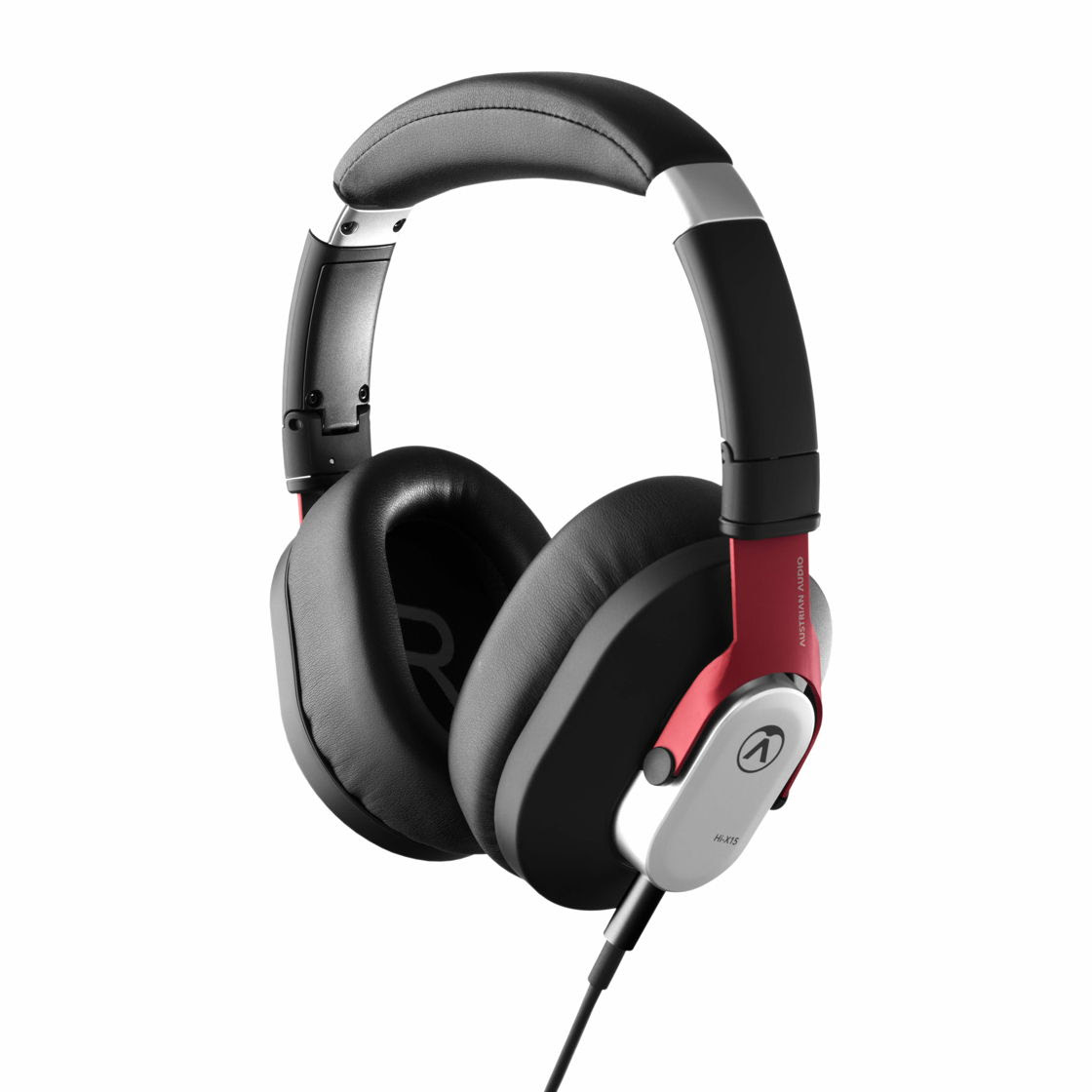
 Vienna, Austria, November 6, 2024 — Austrian Audio announces a pair of limited-time promotional bundles featuring the Hi-X15 closed-back headphones now available from participating dealers. Until November 30, 2024, Hi-X15 is available for free with the purchase of Austrian Audio’s OC16 large-diaphragm cardioid condenser microphone. Until December 31, 2024, Hi-X15 is available for free with the purchase of the Austrian Audio MiCreator System. Both of these packages make it easier and more affordable than ever before to make Austrian Audio’s high-quality headphones and microphones a part of your recording setup. For more information, please contact your nearest Austrian Audio dealer.
|
An ideal pair for the recording studio – Hi-X15 and OC16
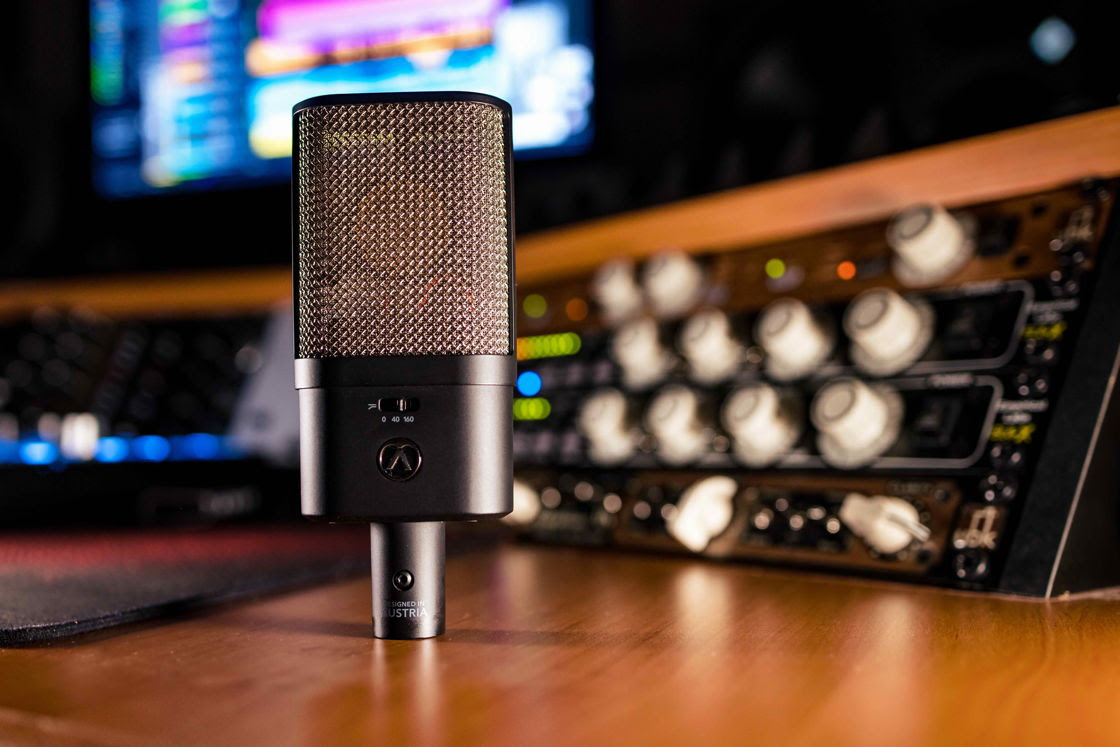
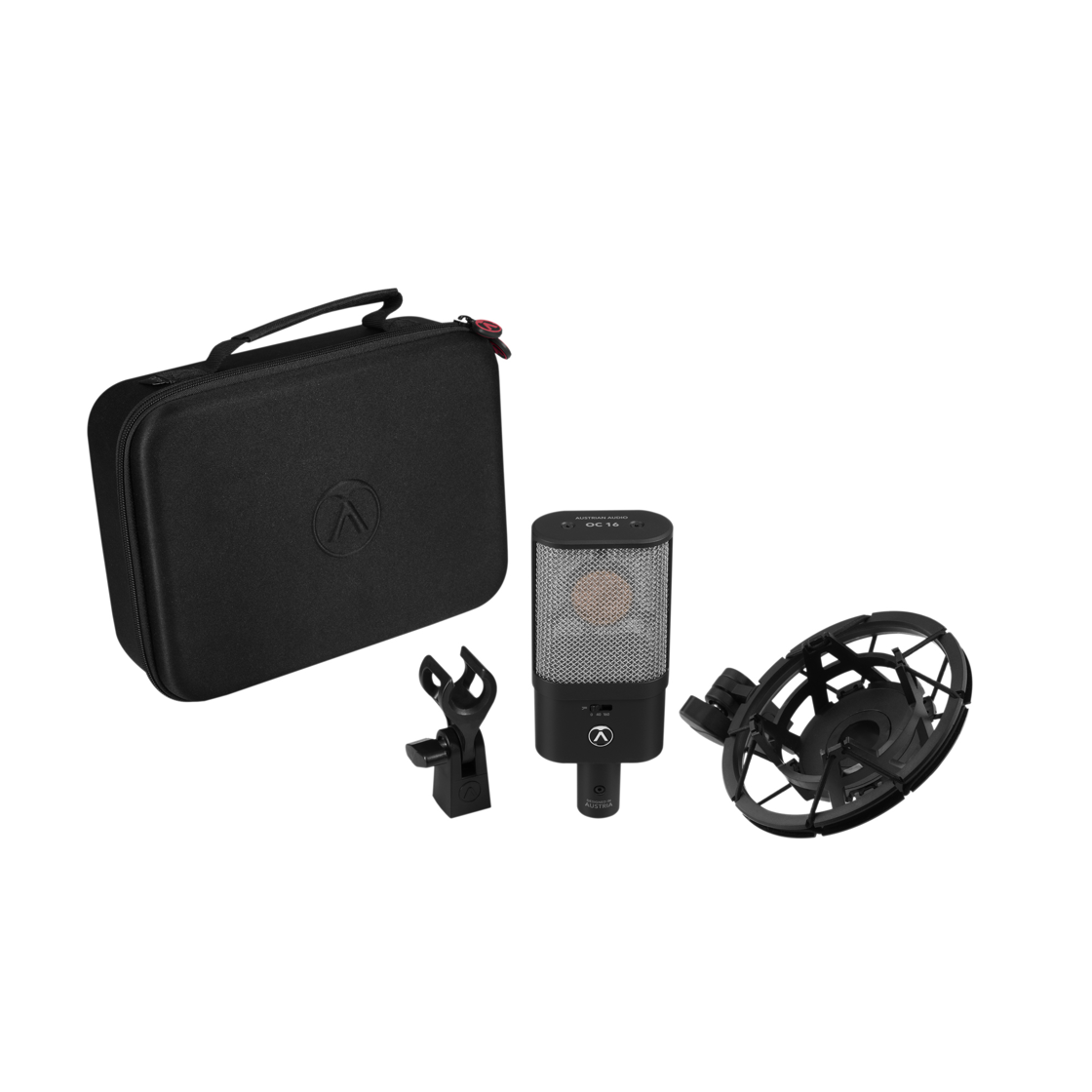
OC16 is Austrian Audio’s best-in-class affordable studio microphone designed for a variety of tracking and recording applications. A robust, powerful mic that utilizes the brand’s patented CKR6 capsule and ‘Open Acoustics’ design approach, it is extremely versatile and faithfully captures the transparent, natural sound of acoustic instruments, electric instruments, and voices. As with all Austrian Audio microphones, OC16 is designed, engineered, and manufactured in Austria out of top-quality components.
|
Working on the go – Hi-X15 and MiCreator
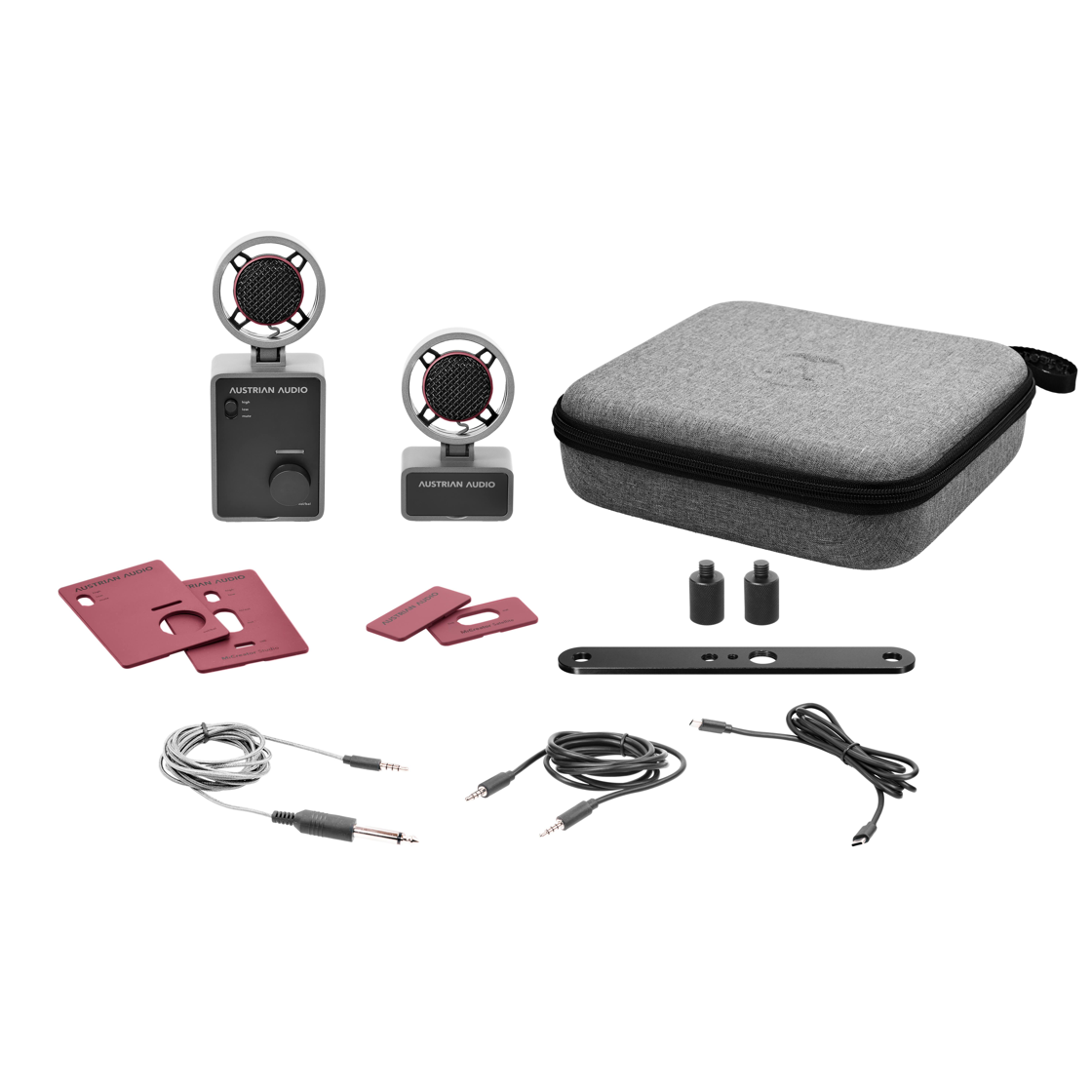
For the mobile music creator looking to record on-the-go, intrepid podcaster, streamer, or found-sound recordist, the MiCreator System is the perfect all-in-one recording solution. Combining a flexible, high-quality condenser microphone with an intuitive audio interface into a single, robust package, the MiCreator System makes it easier than ever to plug in and capture professional-quality audio instantly. The ultra-durable metal housing, adjustable microphone angle, and connectivity with MiCreator Satellite for stereo recording makes the MiCreator System incredibly versatile and usable for a variety of recording applications.
|
Hi-X15 Professional Closed-Back Over-Ear Headphones
|
OC16 Large-diaphragm Condenser Microphone
|
MiCreator Studio
US Dealer Info: Austrian Audio products are available in online and brick-and-mortar stores throughout the US. Current and interested Austrian Audio retailers in the US should contact Michael Huckler at Group One Ltd., the exclusive US distributor of leading professional audio and lighting brands from around the world such as Solid State Logic, Klang, DiGiCo, Calrec and more.
For more information, visit austrian.audio.

Steinberg releases the latest version of Cubase, with innovative new features for music creation, beats and grooves, audio optimization, scoring, and effects that make composing, producing, and mixing more inspirational than ever.
 HAMBURG, Germany — Steinberg has today announced the immediate availability of Cubase 14 with significant new features and enhancements that make the award-winning music production software truly designed to inspire.
Cubase 14 offers three different versions which give users a natural creative pathway — from those taking their first steps with the powerful yet intuitive tools of Cubase Elements through intermediate-level users with Cubase Artist all the way to the comprehensive, industry-standard features of Cubase Pro, which is used on countless well-known recordings by high-profile artists. Cubase provides everything musicians and producers need, for every genre of music, skill level and budget.
The new features in Cubase 14 put creativity first, enabling users to create music which is unique and innovative while making the writing, mixing, and production processes more inspiring and intuitive than ever before.
Cubase 14 introduces six powerful, intuitive Modulators which allow users to modulate any parameter of a track or channel that contains an audio signal. With an LFO and Step Modulator among others, this is a major new feature that will help to push the creative envelope of many music productions.

A new addition to Cubase’s track types, the Drum Track is an all-in-one environment for the creation of complex drum patterns and offers comprehensive features that allow users to build custom drum kits. At its core are the new Drum Machine, a versatile hybrid of drum sampler and percussion synthesizer and the Pattern Editor for programming propulsive, dynamic beats, randomizing grooves, and exploring new rhythmic worlds with just a few clicks.
The full MixConsole can now be opened in the Lower Zone of the Project window, allowing channels to be re-arranged via drag and drop for faster, more intuitive mixing.
The event volume curve editing in Cubase 14 has been enhanced so that users can optimize their audio with draw tools that are familiar from automation editing to edit fades and adjust static event volume offsets.
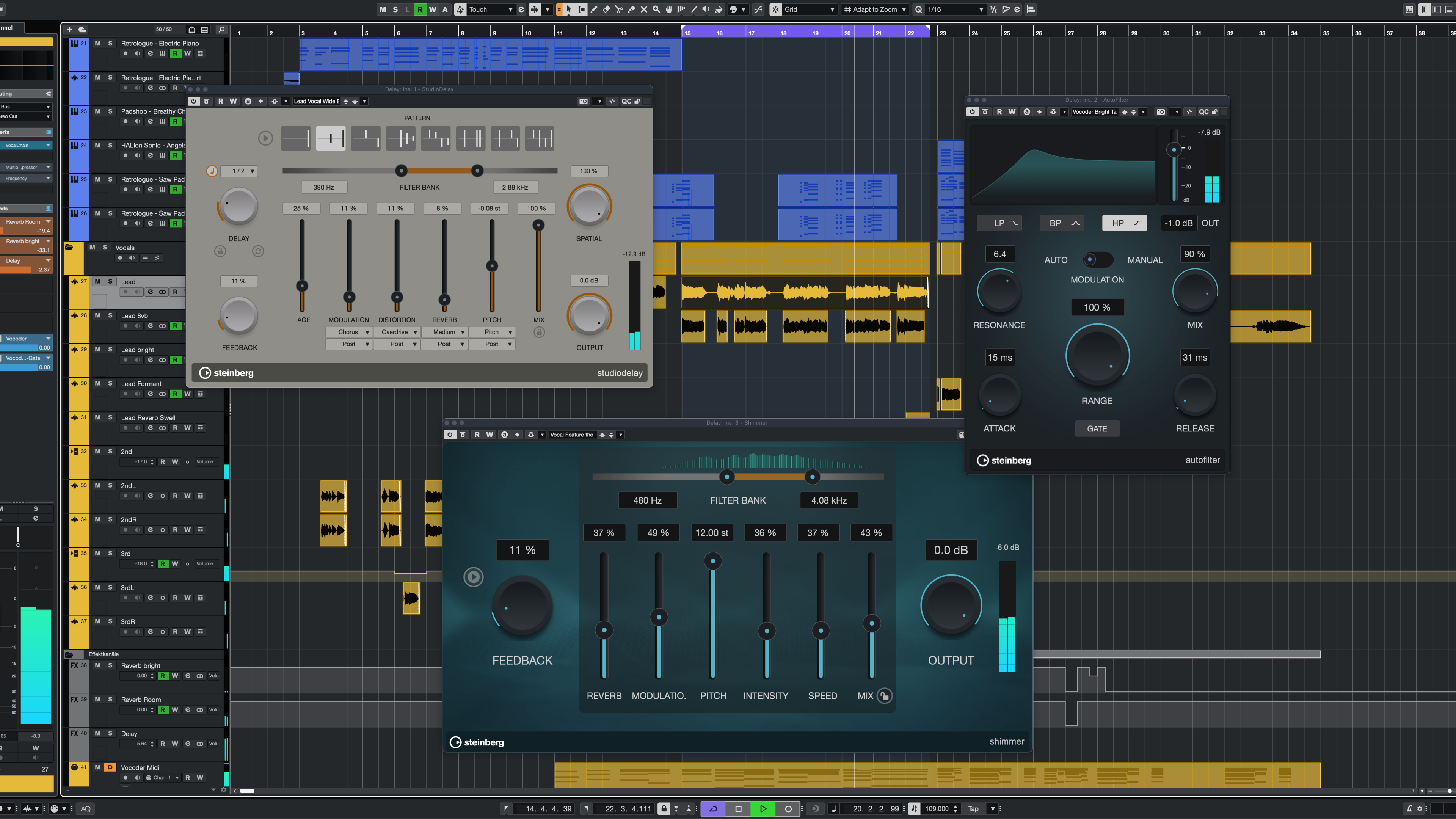
New effects in Cubase 14 include Shimmer, a reverb plug-in that lives up to its name. Then there is StudioDelay, a distinctive, easy-to-use delay with quick access to built-in effects like modulation, distortion, reverb, and pitch. Autofilter is a filter specially designed for modulating its cutoff frequency via the input track or sidechain signal. Cubase 14 introduces Underwater, a brand-new signal processor for building atmosphere and space for vocals or lead instruments with the well-known “party next door” effect. And to round out the new additions, a Volume effect allows control of volume independently of the MixConsole volume fader.
Cubase 14 introduces a revamped Score Editor built on technology from Dorico, the cuttingedge music notation and composition application from Steinberg. The new Score Editor provides a powerful, notation-based MIDI editor which will allow users to quickly and easily examine and edit music as notation while producing great-looking parts for live recording projects.
Customers will appreciate that Cubase 14 is a true evolution, with the many new features and enhancements to the already comprehensive feature set, making it the perfect solution for music-makers of all levels.
“Cubase 14 is designed to inspire creators to explore their creativity without limits,” says
Senior Marketing Manager Matthias Quellmann. “Guided by our Creativity First philosophy, Cubase 14 encourages producers to experiment, innovate, and take their music in exciting new directions.”
Cubase Pro 14, Cubase Artist 14, and Cubase Elements 14 are available from resellers and through the Steinberg Online Shop. The suggested retail price for Cubase Pro 14 is 579 euros or 579.99 US dollars. The suggested retail price for Cubase Artist 14 is 329 euros or
329.99 US dollars. The suggested retail price for Cubase Elements 14 is 99.99 euros or
99.99 US dollars. Prices may vary according to region.
A range of downloadable updates and upgrades, crossgrades, and education versions are exclusively available through the Steinberg Online Shop.
Customers who have activated Cubase Pro 13, Cubase Artist 13, and Cubase Elements 13 or earlier versions from October 9, 2024, are eligible for a free, downloadable grace period update for their particular version of Cubase.
[Pro・Artist・Elements]
Steinberg is known the world over for its music and audio software and hardware solutions. The company has been developing, manufacturing and selling innovative products for musicians and producers in the music, film, post-production and multimedia industries since 1984. Steinberg products are used by Grammy and Oscar award-winning composers, engineers and producers.
Visit www.steinberg.net for further details.

MADRID, SPAIN: vintage-sounding recording equipment developer Heritage Audio is proud to announce availability of SUCCESSOR — successfully recreating all of its industry-changing SUCCESSOR outboard predecessor’s features as a DAW (Digital Audio Workstation) workflow-friendly plug-in with welcomed additions — as of October 31…
As a British Diode-bridge STEREO BUS COMPRESSOR released to widespread critical acclaim back in 2019, Heritage Audio’s SUCCESSOR readily represented a first in its class, finally allowing creative engineers, musicians, and producers alike to apply colorful, fat, and warm compression to their treasured productions. Prior to its release, only clean and transparent VCA-based processors had been available for performing those duties, and — although adequate for mix bus usage, often — they simply do not possess anything like the energy, mojo, and vitality that Heritage Audio’s SUCCESSOR can clearly offer.
Originally conceived for mix bus usage itself, SUCCESSOR subsequently became a popular choice for all aspects of the music and audio production process. Present in thousands of studios worldwide, it has made its way into tracking sessions, on sub-groups and even at the mastering stage, showing that it works well wherever anyone chooses to use it. Top-tier engineers — such as GRAMMY® Award-winning mix engineer Chris Lord-Alge — have happily integrated SUCCESSOR into their setups, drawn to how it lets them feel how their separate tracks interact and blend together in a way that was previously not possible when master bus compression duties are relegated to the mastering stage.

Saying all that, though, having received dozens of offers from plug-in developers eager to try and capture SUCCESSOR’s sought-after energy, mojo, and vitality, Heritage Audio admirably opted to take on the challenge itself. Indeed, SUCCESSOR successfully recreates all of its industry-changing outboard predecessor’s features as a DAW workflow-friendly plug-in with welcomed additions — after all, as a newly-designed plug-in, its creator could not resist bringing a little extra to the production table. The new NUKE function, for example, will actually apply an extra 20dB to the front end before compression, so SUCCESSOR is working much harder and, therefore, producing more and more of the desired artefacts and characteristics for which its hardware namesake is renowned. It is fair to say that this can sound incredible — well worth trying on most material, in fact, as the results can surely surprise. And an OUTPUT TRIM control offers an additional +20 (dB) of GAIN MAKEUP right before the output stage to compensate for the extreme compression. Combined, those welcomed additions essentially take the compressor into new sonic territory that benefits from its exaggerated response.
Helpfully, Heritage Audio’s goal with its SUCCESSOR plug-in is to create a tool to channel creativity and put the focus firmly back on music production, which is exactly why the vintage-sounding recording equipment developer wants to reach as many users as possible by applying a pricing scheme that is both comprehensive and fair. For instance, all SUCCESSOR hardware owners can complete an online form (https://heritageaudio.com/successor-owners-form/) to redeem a native version of the SUCCESSOR plug-in for free, while that native version of the SUCCESSOR plug-in is also available for free to owners of any i73® PRO family products — offering varying I/O and features as the first ever USB-C audio interfaces with built-in Class A 73-style preamps — from here: https://users.heritageaudio.com. Additionally, a DSP (Digital Signal Processing) version of the SUCCESSOR plug-in will soon be available for those i73® PRO family products via a firmware update. Fortunately for everyone else, a no-nonsense price of €99.00 EUR/$99.00 USD is guaranteed.
The native version of SUCCESSOR is available to purchase — as a 64-bit AAX-, AU-, and VST3-format-compatible effect plug-in for MacOS (10.15.7 and higher, with both INTEL and Native Apple Silicon M1/M2/M3 compatibility) and Windows (10 and 11) — directly from Heritage Audio here: https://users.heritageaudio.com/product/successor/
An iLok account is required for SUCCESSOR activation. (If running SUCCESSOR in trial mode, note that the trial will be fully functional for 14 days after activation.)
Watch Heritage Audio’s intriguing introductory video for SUCCESSOR here:
Become better acquainted with SUCCESSOR while watching Heritage Audio’s walkthrough video here:
About Heritage Audio (www.heritageaudio.com)
Heritage Audio was founded in 2011 by Peter Rodriguez. As a civil engineer and music producer, he went from building wind turbines to following his true passion — developing recording equipment with the vintage sound that he himself admired so much and so many others yearned for. Fortunately for all, he was able to master the key elements necessary to make high-quality recording gear affordable and reliable by combining his analytical mindset with his experience as a producer within a relatively short space of time. Today, the 15-person team has expanded its production plant located in the heart of Madrid, Spain, where it collectively continues to follow a philosophy of making vintage sound possible for today’s studios, successfully introducing innovative products to rank amongst the most popular brands with top retailers throughout the world.
© 2024 Heritage Audio

 NASHVILLE, TN, October 31, 2024 – The METalliance (Music Engineering & Technology Alliance) has announced that WSDG (Walters-Storyk Design Group) has become the newest Pro Partner of the organization and the first recording studio designers to be invited as a member. Pro Partner membership is limited to companies that have shown the ability to manufacture and distribute products and services that meet the organization’s professional audio standards.
 The METalliance’s George Massenburg commented, “WSDG’s incredible legacy of innovation and excellence in recording studio design speaks for itself. They embody all of the core traits inherent to the mission of The METalliance and we are thrilled to include them in our organization. All of our Pro Partners must be unanimously agreed upon to be included, and with WSDG that was an incredibly easy decision to reach.”
“All of us here at WSDG greatly respect the members of the METalliance and appreciate all the exemplary work the organization has done to elevate the bar of professional audio standards,” said WSDG Co-Founding Partner John Storyk. “We’re thrilled to be the fist design firm to partner with them as a member.”
“In all our design and integration work we have strived to reflect the highest touchstones, and interaction with the METalliance has been essential in these projects,” added WSDG Partner and Director of Business Development Sergio Molho. “This METalliance Pro Partnership recognition validates the attention to quality that we put into all our work and opens up new possibilities for collaboration in the future.”
WSDG is a global architecture, acoustic, electro-acoustics and advanced audio-visual systems integration consulting and design firm. Pioneering architect/acoustician Storyk (AIA), who began his career in 1969 with the creation of Jimi Hendrix’s Electric Lady Studios in New York, co-founded WSDG with wife and business partner Beth Walters in 1987. The firm has a global team of over 70 partners, associates, and design professionals with four primary offices – New York and Miami in the United States, Basel, Switzerland, and Berlin, Germany – as well as representation in Latin America, the Middle East and Asia.

Left to right: Chuck Ainlay, Grammy Award Winning Engineer & Producer. Niko Bolas, Music Producer. John Storyk, Founding Partner, Director of Design, WSDG. Elliot Scheiner, Grammy Award Winning Engineer & Producer. Jimmy Douglass, Grammy Award Winning Engineer & Producer. George Massenburg, Grammy Award Winning Engineer.
The METalliance Pro Partnership is a group of companies that share the founders’ belief that a call for quality is important. It is limited, by invitation, to those companies that provide products and services deemed worthy of consideration by professionals. WSDG joins other METalliance Pro Partners: AKG, Audio-Technica, Austrian Audio, Avid, Cakewalk, Digital Audio Denmark, DPA Microphones, Eventide, Genelec, Izotope, JBL Pro, Lewitt, Lexicon, Manley Laboratories, GML, Millennia Music & Media Systems, Neumann USA, NTP Technology, Prism Sound, Royer Labs, Sanken Microphones, Sennheiser, Solid State Logic, Sommer Cable, Sonnox, Steinberg, tc electronic, Universal Audio, and Yamaha.
For more information about WSDG, please visit: http://www.wsdg.com/
For more information about METalliance, please visit: http://www.metalliance.com
About the METalliance
Established in 2005, The METalliance (Music Engineering and Technology Alliance) is composed of top award-winning audio engineers/producers Chuck Ainlay, Niko Bolas, Jimmy Douglass, Frank Filipetti, George Massenburg, Sylvia Massy, and Elliot Scheiner. The METalliance works with producers, engineers, educators and manufacturers to further the best practices and technology developed in modern recording and to help ensure the skills and techniques that have developed through the history of recording are carried forward.
The METalliance ProPartner program rewards those manufacturers truly deserving recognition as advocates for better quality in audio recording and reproduction. Through the ProPartner program, the organization works closely with companies to evaluate, recognize, and certify products and services that meet the best standards for quality in the recording arts and science.
ABOUT WSDG, LLC
WSDG (Walters-Storyk Design Group) is a 13-time TEC award-winning global architectural acoustic consulting, design, and A/V integration engineering firm. Founded by interior designer Beth Walters and architect/acoustician John Storyk (AIA), the firm is dedicated to the pursuit of excellence through the intersecting worlds of architecture, acoustics and technology.
Past clients include artists such as Jay-Z, Bruce Springsteen, Alicia Keys, J Cole, and Jack Antonoff, corporate entities such as Spotify, Sony, CBS, Novartis, and IBM, and educational institutions such as Berklee College of Music, UCLA, University of Music Vienna, and NYU.

AI-powered acoustic optimization streamlines creation of the world’s first ‘ski in, ski out’ recording facility
Planning a musical escape on the slopes of an American landmark
The 7,000 square foot facility makes the most of the existing infrastructure of The Destiny Lodge, a comfortable luxury resort filled to the brim with warmth and character. Each of its rooms have been envisioned to complement its new role as a versatile recording space as well as an operational ski lodge. “It’s such a unique place and it’s been very exciting to transform it into a thriving creative space for musicians,” says Hackel. “We both have long standing relationships with PK, and his businesses AVN | SYS and REDIacoustics, so involving him in this project was a natural step.” Pandey adds, “ We have come full circle, Peter and Morgan recorded at my studio over 20 years ago, and now we are teaming up to create one for them”
“We’re honored to be involved in such a special project and can’t wait to showcase this incredible studio when it opens later this year.”