




 DUESSELDORF, GERMANY: DAW (Digital Audio Workstation) plugin and audio DSP (Digital Signal Processing) developer Fuse Audio Labs is proud to announce the availability of its VREV-305 plugin — purposed from an iconic and rare Seventies-vintage spring chamber reverb system, set around a tank comprising no fewer than 12 individual springs with equally tempered timings following a logarithmic progression very similar to the musical scale to produce unique reverberation textures that can be shaped with a compact yet powerful tweaking matrix — as of September 23…
The spring chamber of the VREV-305 plugin produces a harmonic series of reflection patterns that result in lush and dense reverb tails, but without the twangy artifacts typical of springs. Saying that the plate-like ambiance can be adapted to individual signals with a simple yet very musical and interactive EQ section. Also, the plugin permanently removes the fixed decay time limitation imposed by the hardware from which it is purposed.
But better still, VREV-305 also offers separate PREDELAY parameters per channel, as well as switchable stereo summing options — both before and after the spring system. Since it does not need tons of complex controls to do its thing, this reverb plugin lets users create many interesting tails in next to no time — always adjustable in intensity with the onboard MIX controls.

Clearly, its flexibility makes VREV-305 a favorable choice for many sources. Indeed, it is especially well suited to working with drums, guitars, and vocals, and its 12-spring topology produces interesting-sounding alternatives to the default reverbs used on most productions. Put it this way: users who appreciate springs and plates while looking for fresh and easily tunable reverb textures are likely to find a match made in musical heaven with this plugin.
Positioning it this way, Fuse Audio Labs CEO Reimund Dratwa says, “The 305 is a super-inspiring mechanical masterpiece, so it felt only natural to put huge effort into getting its complex and unique signature sound just right for this plugin while offering some really useful DAW add-ons to the original concept.”
VREV-305 is available at an attractive 50%-discounted introductory promo price of only $29.00 USD until October 23, 2022 — rising thereafter to its regular price of $59.00 USD — directly from its dedicated webpage, which includes more in-depth information, here: https://fuseaudiolabs.com/vrev305.html
Note that 14-day trial versions of all Fuse Audio Labs plugins without any restrictions are also available to download for free from here: https://fuseaudiolabs.com/plugins.html
Get a feel for VREV-305 while watching Fuse Audio Labs’ lovingly-produced presentation video here:
About Fuse Audio Labs (www.fuseaudiolabs.com)
Fuse Audio Labs is a number one source for truly analog-sounding plugins designed for the daily demands of real-world musicians and engineers. As an acclaimed company, it was founded in 2017 by Reimund Dratwa, who is deeply knowledgeable as an expert in translating complex analog topologies into top-tier DSP code. Creating a huge portfolio of leading modeling titles over the years for brands like ACME, Black Box, Black Rooster, Elysia, Millennia, Neold, Vertigo, and many others available via Plugin Alliance and the UAD-2 platform, his own designs remain 100% pure Fuse Audio Labs.
© 2022 Fuse Audio Labs

 SAN CLEMENTE, CA, USA: following in the fanciful footsteps of its Aurora spectral reverb released to widespread critical acclaim earlier this year as the then-latest addition to its ever-expanding Eurorack lineup, ‘Future Coast’ modular synth-maker Qu-Bit Electronix is proud to announce that it is taking preorders for Nautilus — newly developed as a stereo delay consisting of eight unique delay lines that can be connected and synchronized in interesting ways to act as a complex delay network inspired by sub-nautical communications and their interaction with the environment while effectively creating a one-stop shop for all things delay and upholding its creator’s cutting-edge sound design standard with a clean, beautiful aesthetic — as of September 27…
Achieving a stereo complex delay network inspired by sub-nautical communications and their interaction with the environment while effectively creating a one-stop shop for all things delay and upholding its creator’s cutting-edge sound design standard with a clean, beautiful aesthetic is no small feat, for what makes Nautilus so special in the densely populated modular landscape is its sheer number of effect possibilities — think present-day pitch-shifted shimmer delays, ever-evolving polyrhythms, as well as distorted echoes of the past — while maintaining a clear, intuitive front panel interface devoid of any second-guess-inducing shift functions. For example, the core of Nautilus’ delay network is built in the standard fashion for delays: a clock signal is generated either internally using the ‘tap tempo’ clock button at the center of the module, or externally via the clock in (gate input) jack just below. But the basic building blocks of the delay system are the controls for resolution, which determines the clock division or multiplication applied to the delay processor, and feedback, which determines the number of repeats on the delay line — from one to infinite. Indeed, even these core functions can yield some incredible results when utilizing their associated CV and gate inputs.
Inspired by the ocean and oceanic exploration, Nautilus’ name is directly derived from the fictional submarine in iconic French writer Jules Verne’s timeless classic science fiction novel Twenty Thousand Leagues Under the Sea, so — much like said novel’s Captain Nemo — Nautilus’ ambitions are found in exploration, finding ways in which sound travels and interacts within the aquatic world. Ambitious as that may well sound, it is made tangible with Nautilus’ delay network design, formed from a multitude of delay lines and means to manipulate them. Thanks to an ability to have up to eight co-dependent delay lines — four per stereo channel — occurring simultaneously (with up to 20 seconds of audio each), as well as tempo-synced control over the spacing between the delays, Nautilus can use its sensors and dispersal functions to take a simple delay line into impossibly complex yet beautifully coherent cacophonies of sound. Saying that each delay line — itself a single delay within the Nautilus network — has an ability to be reversed as well, courtesy of an incremental sensor reversal function.

Furthermore, additional complexity can be introduced using onboard chromatic and depth receptors that apply a host of internal effect processors into the delay lines, letting users further alter their sub-nautical delay network to emulate the varying aquatic materials and terrain that Nautilus’ sonar passes through with digital interference and more. Each effect — including filters, distortion, and coloring — is independently applied to the delay lines, meaning that users can utilize all of the effects using CV and apply them intentionally within the delay network.
Nautilus provides an abundance of stereo feedback behaviors on top of the existing configurability — including ping-pong-style delay, cascading delays, and Adrift, an aptly-named, unique-sounding meandering delay style — and even has a selection of delay modes, allowing access to faded delays (that remove the Doppler effect found on standard delays when changing the delay frequency), Doppler delays (that reintroduce that effect), a pitch-shifted up shimmer delay, and a pitch-shifted down ‘de-shimmer’ delay.
It is easy to assume, then, that when working with Nautilus it could potentially be very easy for things to quickly get out of hand, thanks to the sheer amount of onboard configurability. To the contrary, onboard performative functions, fortunately, aid in the event of a sensor overload. It is possible to freeze the delay lines, locking them in place with the clock rate, or even clear them altogether using the purge button, acting as a unique clear function that makes resetting Nautilus’ delays both simple and pleasing to the ear.
Even though Nautilus needs an audio input to function, it also acts as a modulation source. So users are able to capture its sonar output and use it to self-patch or control other points in their system — drive other parts of a patch with ‘pings’ from the delay network, or use the generated topography as a modulation source. Saying that the output is algorithmically generated from the delay network, creating an evolving, one-of-a-kind output to render patches completely unique.
Ultimately, Nautilus hosts two onboard attenuverters, fixed to its dispersal and feedback inputs… or are they? There is, of course, more to Nautilus than meets the eye. Indeed, it is more than a module with fixed functions, one which is in keeping with Qu-Bit Electronix’s ethos of always designing with customizability in mind — from USB text files to shift functions, right through to the ambitious open-source implementation of Nebulae. Needless to say, Nautilus is no exception to this, coming complete with a free open-source app allowing users to configure a whole host of settings and functions. But back, briefly, to those attenuverters; assignable not only to any input on the module but they themselves can also be assigned various functions, such as splitting the left and right channel resolutions. And as if that was not enough to be getting on with, the sonar output creates a unique CV or gate signal algorithmically generated from its findings, further configurable as envelope followers, triggers, additive modulation, and more. It is perfectly possible, for instance, to change the freeze gate behavior or change the knob range of any parameter. Put it this way: users can choose their settings, then the web app exports a single file that can be saved onto the module’s USB flash drive, which, when reinserted into the module itself, automatically updates its settings — no button commands, no reboots, no fuss!
Furthermore, functionality and more are all wrapped up in an enthralling front panel with a hypnotic kelp LED interface at its center. Clearly following in the fanciful footsteps of its Aurora spectral reverb sibling from a design choice perspective fit for forward-thinking, those LEDs indicate Nautilus’ numerous settings, while also acting as a VU meter for the left and right channels… from the deep ocean trenches to shimmering tropical reefs, Nautilus is the ultimate exploratory delay network.
“Nautilus is the delay processor that the Eurorack world has been waiting for,” asserts Andrew Ikenberry, co-founder, and CEO of Qu-Bit Electronix, ending on a high note: “Thanks to recent advances in embedded processors, we were able to create a sophisticated delay algorithm that has never been done before in hardware; Nautilus is capable of creating entire worlds of sounds and certainly feels like far more than just an effects processor.”
Officially released on October 6, 2022, Nautilus is available to preorder from Qu-Bit Electronix’s growing global network of distributors (https://www.qubitelectronix.com/distributors) with an MSRP (Manufacturer’s Suggested Retail Price) of $399.00 USD or directly via its dedicated webpage (which includes more in-depth information) here: https://www.qubitelectronix.com/shop/nautilus (Note that with each Nautilus purchase, a portion of the proceeds will go towards ocean and coastal conservation through the Surfrider Foundation: https://www.surfrider.org)
About Qu-Bit Electronix (www.qubitelectronix.com)
Qu-Bit Electronix makes modular synths for sonic explorers. Established by Andrew Ikenberry, the company was formed out of a desire to bridge the worlds of computer music and analog modular synths. Subsequently referred to as purveyors of ‘Future Coast’ synthesis, it is always aiming to find new sounds and techniques that have yet to be fully explored. Fast forward 10 years, the company continues to thrive as a frontrunner in the exploratory modular world. While currently based in southern California, Qu-Bit prides itself on its in-house manufacturing; from automated electronics assembly to testing and calibration, the company continues to uphold the standards and specifications that would be expected of a bespoke modular brand.
© 2022 Qu-Bit Electronix

From AIR Studios to the edge of the world. We’ve collaborated with Hans Zimmer’s prestigious scoring collective Bleeding Fingers Music (Frozen Planet II, Planet Earth II, Blue Planet II) and London’s finest string players to create a new kind of small ensemble library — featured in BBC’s Frozen Planet II.
 Fractured Strings introduces an innovative approach to articulations that delivers inspirational surprises through intervallic performances and new modal colors, with unparalleled depth and realism. With these sophisticated and emotive musical gestures and our new Scale Mode technology, this library lends itself perfectly to cellular, ambient, and neoclassical composing — reflecting the intricacies, patterns and contrasts found in natural phenomena.

This library’s journey has only just begun. Featuring an eight-piece string ensemble and two soloists, these sounds have been brought to life in the unparalleled acoustics of AIR Lyndhurst Hall, complete with 15 signal paths. With infinite intervallic possibilities, you can take these strings anywhere — to places of warmth, grit, darkness or light.
“Early on in the process of scoring Frozen Planet II, we looked at the patterns of splintering ice and the individuality of snowflakes. In creating Fractured Strings, we worked closely with the Spitfire team and London’s best players to represent these natural phenomena in musical performances — resulting in a toolkit that became the foundation of our score for the show.”
– James Everingham & Adam Lukas — Composers, Frozen Planet II
REFRACT, BLOOM, SOAR
This is a new kind of chamber string library, designed to infuse warmth, color, and humanity into the gestures, leaps, and cellular motifs that you compose — as well as to inspire you with surprising intervallic and modal possibilities. These strings refract, bloom and soar across 100+ seventh-reaches, two-note statements, swelling rotations, pizzicato strums, and soaring chord extensions.
ELEVATE YOUR SCORES WITH SCALE MODE
Introducing our new Scale Mode technology — select from any of the seven diatonic modes or build your own scale by simply clicking the notes you want to be included. From there, it intelligently selects the right samples our players will follow your lead that conforms to the scale you’ve entered, split by velocity — developing their intervallic string techniques and triggering wider intervals at higher velocities for endless inspiration.

AIR STUDIOS AT ITS MOST SPELLBINDING
“The vast space of the hall really reflected the extremes that we were scoring in the natural world…”
— James Everingham, Bleeding Fingers Music

To capture tiny, intimate moments unfolding across a vast, uncaring landscape, we brought a small section of London’s finest string players to the mammoth AIR Lyndhurst Hall, home of blockbuster scores. Together, these eight players, the Bleeding Fingers Music team, and our own collective of composers, conductors, and engineers collaborated to create a vast suite of short leaps, gestures and swells. The resulting sound makes for a sublime companion to other libraries recorded at AIR Studios, including other small string section libraries such as Albion Neo, Chamber Strings, and Olafur Arnalds Chamber Evolutions.
EXTREME SCORING
For Frozen Planet II, Bleeding Fingers Music and the show’s composers Hans Zimmer, James Everingham and Adam Lukas were looking for a library that could score not only scenes of frozen silence, but also scenes of action, tension, crisis and drama. Rather than imitate the whispering textures of glacial rivers, Fractured Strings offers a spectrum of sounds and textures that reflect the planet’s fuller-voiced, more melodic moments, from microscopic to grand gestures. The result is a library with potential far beyond the world’s end.
BLEEDING FINGERS MUSIC: THE PRESTIGIOUS SCORING COLLECTIVE
“Creating these instruments in partnership with Spitfire Audio is what sets our scores apart on tentpole projects like those for the BBC Natural History Unit.”
– Russell Emanuel, Co-Founder & CEO, Bleeding Fingers Music
Emmy-winning and BAFTA-nominated Bleeding Fingers Music is an exciting, diverse composer collective, hand-selected and mentored by Hans Zimmer. They were awarded an Emmy for Outstanding Music Composition for BBC’s Primates, Emmy nominations for BBC’s Planet Earth II and National Geographic’s Being the Queen, plus two Webby awards for the BBC’s groundbreaking 13 Minutes To The Moon.
Bleeding Fingers has created original music for productions including National Geographic’s Documentary Film Apollo: Missions to the Moon; Around the World in 80 Days (BBC); Blue Planet II (BBC); Planet Earth II (BBC); Seven Worlds; One Planet (BBC); The Simpsons (Fox); Superfly (Sony Pictures); Diana: In Her Own Words (Nat Geo); The Planets (Nat Geo); Savage Kingdom (Nat Geo); Intervention (A&E); Alien Christmas (Netflix)’ Earth At Night In Color (Apple TV); The Real Right Stuff (Nat Geo); Prehistoric Planet (Apple TV+); and more. In recent years they have found innovative ways to bring mainstream musicians into the scoring world, collaborating with artists such as Radiohead, Sia, Muse, Foals, Aurora, and X Ambassadors.
Hailing from eight countries, the Bleeding Fingers composers embrace and nurture their wide-ranging musical identities to deliver a sonic depth that is second to none. Housed in state-of-the-art studios on Hans Zimmer’s world-renowned Santa Monica campus and supported by a best-in-class creative production team, Bleeding Fingers produces music at the very highest standard.
KEY FEATURES
AVAILABILITY & PRICING
Available – September 22nd, 2022 at 5pm BST
Link – http://www.spitfireaudio.com/fractured-strings
RRP Price: £249 / $299 / 299€
Pre-order / Promo Period: £199 / $229 / 229€
Owners of Orchestral Swarm eligible for crossgrade price – will save 30% off RRP (automatically calculated once logged in)
About Bleeding Fingers Music (https://www.bleedingfingersmusic.com/)
Emmy-winning and BAFTA-nominated Bleeding Fingers is an exciting, diverse composer collective, hand-selected and mentored by Hans Zimmer. They were awarded an Emmy for Outstanding Music Composition for BBC’s Primates, Emmy nominations for BBC’s Planet Earth II and National Geographic’s Being the Queen, plus two Webby awards for the BBC’s groundbreaking 13 Minutes To The Moon.
Bleeding Fingers has created original music for productions including National Geographic’s Documentary Film Apollo: Missions to the Moon; Around the World in 80 Days (BBC); Blue Planet II (BBC); Planet Earth II (BBC); Seven Worlds; One Planet (BBC); The Simpsons (Fox); Superfly (Sony Pictures); Diana: In Her Own Words (Nat Geo); The Planets (Nat Geo); Savage Kingdom (Nat Geo); Intervention (A&E); Alien Christmas (Netflix)’ Earth At Night In Color (Apple TV); The Real Right Stuff (Nat Geo); Prehistoric Planet (Apple TV+); and more. In recent years they have found innovative ways to bring mainstream musicians into the scoring world, collaborating with artists such as Radiohead, Sia, Muse, Foals, Aurora, and X Ambassadors.
Hailing from eight countries, the Bleeding Fingers composers embrace and nurture their wide-ranging musical identities to deliver a sonic depth that is second to none. Housed in state-of-the-art studios on Hans Zimmer’s world-renowned Santa Monica campus and supported by a best-in-class creative production team, Bleeding Fingers produces music at the very highest standard.
About Spitfire Audio (www.spitfireaudio.com)
Spitfire Audio is a British music technology company that specializes in sounds — sample libraries, virtual instruments, and other useful software devices. It collaborates with the best composers, artists, and engineers in the world to build musical tools that sound great and are exciting to use.
Spitfire Audio was founded by two award-winning composers: Christian Henson and Paul Thomson. Born out of their shared dissatisfaction with string sample libraries, they pooled their resources and decided to record their own string samples at the legendary Air Studios in London. Initially, they invited a limited number of friends and associates to own copies of their samples, but whispers of this private sample club soon started to echo across the Atlantic Ocean throughout the composer community. Within a year, some of the most renowned composers in film and television signed up, so Paul and Christian decided to take their samples public.
To date, Spitfire Audio has recorded and released over 100 sample libraries, collaborating with some of the biggest names in media composition, including Hans Zimmer, Eric Whitacre, Ólafur Arnalds & the London Contemporary Orchestra. Spitfire Audio’s sounds are heard in everything, from major Hollywood film scores to recordings by Radiohead and U2. Paul and Christian’s initial side project is now a thriving international music technology enterprise, with a uniquely experienced and diverse workforce, all focused on a shared mission: to inspire a generation of composers. The composer team remains at the center of the business, drawing on their own experience as obsessive music makers to explore the needs and wants of their fellow composers.

 LAKE HIAWATHA, NJ, USA: professional audio signal processing equipment designer and manufacturer/plug-ins producer Empirical Labs Inc. (ELI) is proud to announce the availability of BIG FrEQ™ v1.3 — elevating its inaugural EQ plug-in inspired by its much-loved Lil FrEQ hardware parametric’s precision and warmth with a welcomed update bolstered by numerous new additions and improvements, including AAX-DSP and VENUE (S6L) support, the latter in particular playing a part in increasing the plug-in’s user base by bringing it into the live sound arena — as of September 7…
With no fewer than 12 powerful sections of processing to its appropriate appellation, BIG FrEQ™ should single-handedly handle all tonal and spectral-shaping needs for single tracks, as well as busses, including use as a versatile mastering tool. As always, ELI itself strove to bring new functionality and creative twists to plug-in EQs with its first such release, having labored long and hard over making it easy to learn and plain fun to use.
But best of all, BIG FrEQ™ is immensely useful, obviously, offering the ability to create modern ‘flat-top’ EQ curves with an analog workflow and added controls for more tone-shaping possibilities than a typical EQ plug-in. Put it this way: each of the six parametric bands has an additional SLOPE control that allows for flattening out the EQ shape and grabbing more frequencies equally while switching on the focus (F) function lets users fine tune frequency adjustment — centering the selected frequency and reducing the range of the FREQ (frequency) knob — to hear exactly what frequencies are being affected with the simultaneously switchable solo (S) buttons available on each parametric band. Elsewhere, each parametric section’s GAIN knob can be expanded from ±15dB to ±30dB with the range (R) button, while parametric section settings can uniquely be copied and pasted from one to another for quickly moving and duplicating bands, facilitating faster operation. On top of that, the unique FINISHER section adds warmth to any track with organic saturation and provides for up to 8x oversampling (tested up to 768 kHz operation).

Other features are also well worth highlighting: Hi Pass and Lo Pass filters with adjustable Q and selectable filter orders from 6dB to 96dB (per octave); Lo Shelf — smooth bass boost or cut, centered around 120 Hz — and complimentary Hi Shelf controls; WIDTH slider — controls bandwidth or, inversely, Q; and master PHASE switch — inverts the phase of the audio.
Additionally, a modern spectral display shows cumulative EQ shape as well as colored individual bands, while the built-in preset management system (with proprietary preset format for cross-DAW preset access), smooth automation of all parameters, available direct entry for all parameters (by double-clicking on any parameter to type in a value), un-linkable stereo version for dual mono operation, and an ability to bypass any section (to monitor changes and free up processing) rounds out BIG FrEQ™’s fattened features.
Following in the footsteps of Arousor™ — ELI’s first foray into the software arena as the only Distressor-derived compressor plug-in, produced by the creators of the award-winning hardware Distressor itself, BIG FrEQ™ is another fine example of how the professional audio signal processing equipment designer and manufacturer/plug-ins producer brings the quality of its hardware to its software products and continues to offer things that cannot be done in the hardware realm to in-the-box mixing. Making room in any plug-in collection for BIG FrEQ™ is to see and hear what it can do when single-handedly handling all tonal and spectral shaping needs for single tracks, as well as busses, including use as a versatile mastering tool.
That said, updating BIG FrEQ™ to v1.3 status sees ELI elevating its inaugural EQ plug-in inspired by its much-loved Lil FrEQ hardware parametric’s precision and warmth with numerous new additions and improvements, including AAX-DSP and VENUE (S6L) support, the latter in particular playing a part in increasing the plug-in’s user base by bringing it into the live sound arena. Additionally, BIG FrEQ™ v1.3 benefits from improved CPU (Central Processing Unit) usage on both macOS and Windows and across all popular platforms, added A/B comparison functionality, plus refinements to the factory Presets… menu, making for an improved ELI-endowed experience with added Save and Save As options for current presets or settings, while any preset name is italicized if changes have been made to the preset itself. Indeed, some of those additions and improvements can be seen in BIG FrEQ™ v1.3’s updated GUI (Graphical User Interface) that remains as easy on the eye as it is in use.
Being bolstered by numerous new additions and improvements, it is fair to say, then, that the immense usefulness of BIG FrEQ™ has, likewise, been improved, itself a reflection of the professional audio signal processing equipment designer and manufacturer/plug-ins producer putting in the hours to make things even easier to learn — not forgetting fun to use! After all, the word empirical — in its most positive interpretation — means fashioned from experience.
BIG FrEQ™ v1.3 is available for purchase as an AAX-DSP-, AAX Native-, AU-, VST- and VENUE systems-supporting plug-in at a ‘flash sale price of only $99.00 USD from September 7-9, 2022 (inclusive) — returning thereafter to its MSRP (Manufacturer’s Suggested Retail Price) of $149.00 USD — directly from its dedicated webpage here: https://www.empiricallabs.com/product/big-freq/
A fully-functional, 15-day trial of BIG FrEQ™ v1.3 is available to download from here: http://www.empiricallabs.com/downloads/ (It is necessary to activate BIG FrEQ™ v1.3 — demo and full versions alike — via iLok USB-A or USB-C dongles or iLok Cloud.)
About Empirical Labs Inc. (ELI) (www.empiricallabs.com)
Empirical Labs Inc. (ELI) designs and manufactures professional audio signal processing equipment used in recording studios, live sound, broadcast studios, and other audio production facilities all over the world while working hard to live up to its stated simple philosophy: “We want to make products that work a little easier, a little better, and a lot longer — and make sure they’re fun to use.” After all, the word empirical — in its most positive interpretation — means fashioned from experience. ELI also produces plug-ins for DAWs (Digital Audio Workstations) and software for DSPs (Digital Signal Processors).
© 2022 Empirical Labs Inc. (ELI)

 Paris, September 8th, 2022 – UVI releases Fluidity, a new expansion for Falcon 2 by exploring the states of movement, flow, and passage through time, available now for $39/39€. With 111 masterfully-crafted patches by sound design maestro Simon Stockhausen, Fluidity is presented in categories including Electronic, Mallets, Sequencer, Soundscapes, Strings, Water, and Wind. The sounds of Fluidity evoke a sense of natural motion and beauty, dazzling with small lights of technical wizardry, making a perfect companion for anyone looking to expand their library with an exceptional
collection of highly detailed and tweakable patches.

Explore a diverse collection of lush pads, glittering arpeggios, moving leads, incredible soundscapes, washing textural sounds, and more. Every patch is configured with between 7 and 12 macros, allowing for deep customization, performability, and sonic range. Make broad or fine stroke changes, and quickly find the perfect balance for your composition. Presets can be quickly layered, tweaked, and modulated providing endless creative potential.
Fluidity leverages the advanced synthesis capabilities and software architecture of Falcon, with 16 oscillators, over 90 effects, and a fast and intuitive interface that easily handles both basic tasks and deep instrument design. All presets have been programmed with macros which provide the user with easy access to the key parameters of each patch. These may be controlled via MIDI, OSC, host automation, and Lua scripting, allowing for easy customization and expressive performance
capabilities.

Fluidity requires UVI Falcon. Falcon offers native 64-bit operation as a stand-alone application and is available as a plug-in supporting all popular formats on both Mac and Windows. One license allows simultaneous authorization on up to 3 computers or iLok keys.
PRICING AND AVAILABILITY:
Fluidity is available immediately for $39 / 39€ from uvi.net
ADDITIONAL PRODUCT INFORMATION:
Additional information on Fluidity is available at:
https://www.uvi.net/fluidity

 GRENOBLE, FRANCE: Auburn Sounds, setting itself up as a plug-in company committed to originality, reliability, simplicity, and sound, is proud to announce the availability of LENS — let loose as a spectral dynamics processing plug-in par excellence, providing multi-band compression (without crossover phase shifts); constant phase EQ (without ringing); up to 64 crystal-clear companders (compressing source signals to reduce the dynamic range, and independently expanding them to save headroom and remove noise), all working together on a stereo signal; simultaneous control of sidechain and output EQ; nearby component masked information removal; and clean ‘over-the-top’ upwards multi-band compression — to provide profound punch and clarity since it achieves so much in constant phase, as of September 6…
Amazingly, Auburn Sounds set out originally to design a mastering compressor as its latest plug-in prior to the prototype revealing itself as an adept tracking compressor, auto-EQ, noise-remover, upwards compressor, and multi-band expander/gate, providing profound punch and clarity as a spectral dynamics processing plug-in par excellence. Indeed, the ‘spherical’ nature of its sound steered the plug-in’s creator, CEO Guillaume Piolat, towards an appropriate name — namely, LENS.
LENS itself is designed around being spectral — hence the company concerned calling it a spectral dynamic processing plug-in. Put it this way: once a signal is in the spectral domain, compression, expansion, and EQ are all applied by LENS simultaneously with linear phase — property of a filter whereby the phase response of the filter is a linear function of frequency, resulting in all frequency components of the input signal being shifted in time (usually delayed) by the same constant amount (the slope of the linear function). Favoring simplicity in operation, LENS’ Selectivity section shows its available 18 bands (less selective) to 64 bands (more selective) reach, resulting in thinner phase-shift with possible high-end roll-off while offering little in the way of distinguishing between frequencies at lower settings and increasing phase-shift with a fuller, rounder sound while distinguishing between nearby frequencies at higher settings — albeit at considerable cost to the plug-in’s CPU (Central Processing Unit) usage when working at higher Selectivity settings. An adjacent (self-explanatory) Stereo Link control ranges between 0% to 100%.

Far from falling short in compression capability, all 64 of LENS’ compressors can be simultaneously manipulated from its COMPRESSOR panel, providing controls for Attack Hi. (High)— attack time of the compressor for high frequencies (at 20 kHz); Attack Lo. (Low) — attack time of the compressor for low frequencies (at 20 Hz); Release — release time of the compressor for both low and high frequencies; SC Width — adjusts the stereo width of the compressor sidechain signal; and Link Bands — continuously transitions between full-band and multi-band for the gain reduction stage.
Similarly, all 64 of LENS’ expanders can be simultaneously manipulated from its EXPANDER panel, providing controls for Attack — attack time of the expander for both low and high frequencies; Release — release time of the expander for both low and high frequencies; Relative Thr. (Threshold) — a specialized mode whereby the threshold of the expander is the average local energy, allowing for suppression of information masked by high-volume components in the same spectral frame, making the signal sound less ‘complex’; SC Width — adjusts the stereo width of the expander sidechain signal, and Link Bands — continuously transitions between full-band and multi-band for the gain reduction stage.
Sandwiched between those COMPRESSOR and EXPANDER panels to take ‘centre stage in the LENS GUI (Graphical User Interface) is its gain map, viewable in COMPRESSOR or EXPANDER modes; the former lets users adjust the threshold of the compressor (by dragging the middle point), compressor ratio (by dragging the rightmost point), and compressor make-up (by dragging the bottom-left point), while the latter lets users adjust the threshold of the expander (by dragging the middle point) and expander ratio (by dragging the bottom point). It is also possible to simply speed up that already speedy process by right-clicking the threshold point to simultaneously set the threshold and ratio in both viewing modes.
Meanwhile, the COMP. SIDECHAIN EQ panel displays compressor detection, and compressor gain reduction as a graph — albeit without taking into account the Input (output distortion stage), Dry (signal level added to form the LENS output), or Wet (signal — spectral, companded — that forms the LENS output when mixed with Dry) level sliders in the adjacent levels panel; while there is no EQ for the expander sidechain, Listen Mode can be activated to listen to the compressor sidechain.
Creativity continues with the OUTPUT EQ panel, displaying a view of the ‘Wet’ signal — after the compressor and expander is applied. As another graph, it accounts for Input and make-up levels but not Dry or Wet levels since it is not the actual ‘output’ signal but rather before the Dry signal is mixed.
It is worth noting here, however, that LENS offers extensive manipulations for its EQ bands — by double-clicking to add an EQ point, for instance, with many more options also available.
Bringing up the rear, though no less creative, clearly, LENS’ VINTAGE panel puts the following controls into anyone’s hands: Even — an output distortion stage; Stage — an input transformer distortion stage; plus Min Rate and Max Rate — to remove spectral bands, emulating old hardware or simply saving CPU usage.
Ultimately, then, anyone seeking profound punch and clarity from spectral dynamics processing should surely set their sights on Auburn Sounds’ LENS, the latest plug-in par excellence from a company committed to originality, reliability, simplicity, and sound, since it provides multi-band compression (without crossover phase shifts); constant phase EQ (without ringing); up to 64 crystal-clear companders, all working together on a stereo signal; simultaneous control of sidechain and output EQ; nearby component masked information removal; and clean ‘over-the-top’ upwards multi-band compression.
LENS is available to purchase at an attractive (time-limited) introductory promo price of only $49.35 USD (representing a 53% discount) until September 20, 2022 — rising thereafter to its regular price of $105.00 USD — in AAX, AU, LV2, VST2, and VST3 plug-in formats for macOS (10.12 or newer), Ubuntu (18.04 or newer), and Windows (7 or newer) with supported sampling rates ranging from 11,025 Hz to 192 kHz directly from Auburn Sounds, via its dedicated webpage, here: https://www.auburnsounds.com/products/Lens.html (Note that an alternative version of LENS — losing EXPANDER functionality — is also available to those seeking to taste some of its fanciful features for free.)
Watch Auburn Sounds’ eye- and ear-opening LENS introductory video here:
About Auburn Sounds (www.auburnsounds.com)
Auburn Sounds is a plug-in company committed to originality, reliability, simplicity, and sound. Indeed, its mission is to have the largest impact on electronic music production possible by building meaningful products with unprecedented attention to quality and no stone left unturned in pursuit of doing so, each product painfully crafted in utmost detail. Its inaugural product, Panagement, found its way into thousands of studios worldwide as a spatialization laboratory letting raw power reign over stereo tracks, while Graillon not only found itself sitting comfortably alongside the world’s best pitch corrective products, but was also the first plug-in to provide PTM (Pitch Tracking Modulation) for real-time voice transformation. The company is far from afraid of taking the technical lead — the first in the audio market to use real-time PBR (Physically Based Rendering), a computer graphics approach that seeks to render images in a way that models the flow of light in the real world, and working with the ultra-productive D, a multi-paradigm system programming language — while often other developers make use of its Dplug open-source plug-in framework.
© 2022 Auburn Sounds
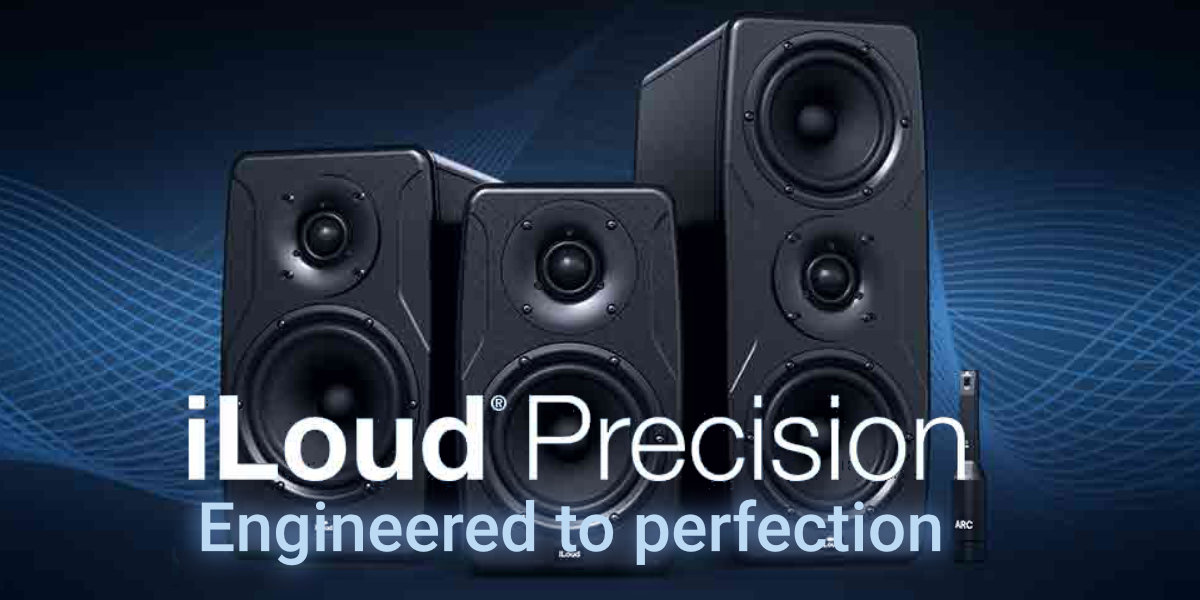
September 1, 2022 – IK Multimedia is proud to announce the iLoud Precision series, representing another breakthrough in nearfield monitoring from the company that revolutionized compact monitors with iLoud Micro Monitor and iLoud MTM.
Available in a choice of 3 configurations – 2-way 5″ or 6.5″, and 2 x 5″ MTM – these handmade works of sonic art reflect IK’s 25+ years of expertise in loudspeaker design and digital signal processing, delivering a level of sonic detail that rivals and even surpass speakers at three times the price, with unique DSP-based features and software workflow enhancements that can’t be found anywhere else.
Best-in-class Response and Clarity
iLoud Precision offers a stunning frequency response from 36 Hz to 30 kHz, with a superior ±1 dB tolerance from 45 Hz up, for precise and uncolored audio throughout the whole listening spectrum. This is guaranteed to be accurate within ±0.5 dB for a unit-to-unit consistency that is simply unmatched, thanks to the monitors’ calibration during the last stage of the manufacturing process.
The iLoud Precision also leverages its unique 96 kHz internal DSP processing, digital crossover, and custom-designed Class D amplifier to deliver true linear phase response above 150 Hz for precise stereo imaging, crisp transients, and incredible detail. The result is a stunningly clear, revealing sound quality that’s absolutely true to life; a feature that simply cannot be found in any other studio monitors with such a degree of precision.
iLoud Precision also sets a new standard for time coherence, or the precise response alignment between woofer and tweeter drivers, reaching nearly the theoretical ideal step response performance. This offers the highest level of time accuracy, without sacrificing frequency response, thus eliminating the ear fatigue that can develop over longer listening sessions on other studio monitors lacking a time coherent response.
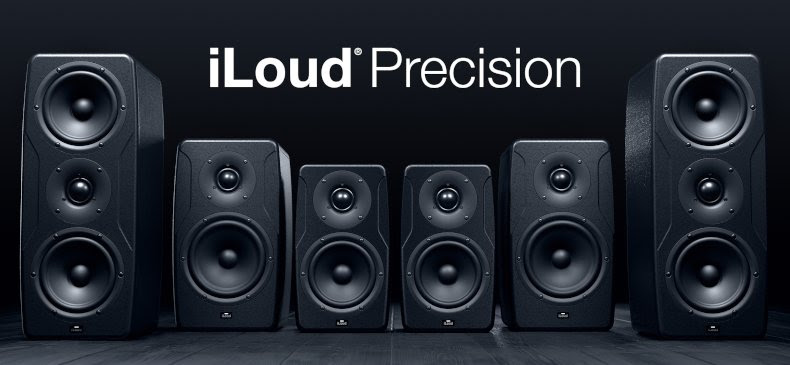
Only IK’s powerful DSP and advanced digital control let the iLoud Precision achieve such a great combination of phase linearity, time coherence, and flat, uncolored frequency response for unmatched clarity and sound.
At the top of the range, the iLoud Precision MTM uses the midwoofer-tweeter-midwoofer configuration to deliver the highest SPL and an ultra-precise, point source sound with incredible stereo imaging. This means users will experience an even more natural, life-like sound, where the speaker cabinets “disappear” and attention can be focused entirely on hearing the music in its truest form, without the coloration that other studio monitors can impart on the source material.
Built-in Acoustic Calibration
With iLoud Precision, there’s less worry about treating the listening environment. Each speaker features built-in calibration based on the acclaimed ARC™ System technology. Just connect the included MEMS measurement microphone and in a few seconds, the iLoud Precisions will tune themselves to any setting, from the mixing room to the living room.
Extended Controls and Voicing Emulation
The iLoud Precision series introduces X-MONITOR, a unique and advanced control application for Mac and Windows that assists with ARC calibration and enables extended acoustic and voicing selection and adjustments, plus convenient access to the settings on the Precision’s back panel. The software is plug-and-play via a simple USB connection with no special setup required.
Even more exciting, X-MONITOR allows iLoud Precision to emulate the frequency and phase response of the most revered studio monitors on the market and classic hi-fi speakers. Over 20 monitor profiles are included, and more will be released in the future, so users can A/B test mixes on a wide variety of reference systems quickly, without ever leaving the sweet spot or needing any other speakers.
Deep Bass, Immersive-ready
With bass extension down to as low as 30 Hz with ARC calibration enabled, iLoud Precision delivers deep, powerful bass that’s nevertheless controlled and balanced. And the adjustable bass roll-off lets iLoud Precisions emulate other playback systems and integrate with a sub, for unparalleled low-end performance in any setup.
In addition to self-calibrating to the listening environment, iLoud Precision features a range of low- and high-frequency management options, including a switchable Full/35/50/65/80 Hz high-pass filter to optimize their performance with Atmos® and other immersive setups.
Isolation Pods and Remote Control
Each iLoud Precision not only includes an ARC measurement microphone, but also a kit of 4 iLoud Isolation Pods that dramatically reduce the propagation of vibrations between the speaker and supporting surface. An optional iLoud Precision Remote Control is also available to quickly switch between X-MONITOR speaker emulations and/or functions like ARC On/Off, Mute, or Dim. The remote also works with ARC to control the measurement/room calibration process, while providing visual feedback on the calibration status and monitor settings.
Completely Made in Italy
Not only are iLoud Precision studio monitors developed in Italy, but they are also entirely manufactured in the country, leveraging the traditional handmade craftsmanship that has made Italian products an iconic reference in the world for quality manufacturing and innovative design.
Pricing and Availability
iLoud Precision studio monitors can be ordered now from the IK Multimedia online store and from IK authorized dealers worldwide at the following prices:
iLoud Precision 5 – $/€899.99* ea. – 5″ Woofer + 1.5″ Tweeter, 135W RMS
iLoud Precision 6 – $/€999.99 ea. – 6.5″ Woofer + 1.5″ Tweeter, 150W RMS
iLoud Precision MTM – $/€1,199.99 ea. – 2 x 5″ Woofers + 1.5″ Tweeter, 175W RMS
iLoud Precision Remote Control – $/€69.99
*All pricing excluding taxes.
Registered owners of iLoud Micro Monitors and iLoud MTM are eligible for special pricing on all Precision pairs. Users can log in to the IK Multimedia online store to see the discounts available to them.
X-MONITOR Mac/PC software will be available in October.
For more information about the iLoud Precision series or to see the studio monitors in action, please visit: www.ikmultimedia.com/
About IK Multimedia: IK Multimedia is a leading music technology company that harnesses advanced software and hardware design to make professional quality tools accessible to everyone – from its ground-breaking AmpliTube, T-RackS, and SampleTank software, to its acclaimed iRig series of music creation tools for iPhone, iPad, Android, and Mac/PC; from the award-winning iLoud reference monitors and AmpliTube X-GEAR effects pedals, to its latest analog hardware synth UNO Synth Pro. With millions of installations and registered users worldwide, IK leads the way for musicians in the studio, on the go, or on the stage. AmpliTube®, T-RackS®, SampleTank®, iLoud®, X-GEAR®, UNO Synth®, Machine Modeling™, and TONEX™ are trademarks property of IK Multimedia.
Dolby Atmos® is a registered trademark of Dolby Laboratories Licensing Corporation.

 TALLMAN, NY, USA: affordable high-quality studio monitors, reference headphones, microphones, and accessories producer Avantone Pro is proud to announce the availability of its BV-1 mkII tube-driven, large-diaphragm condenser microphone — made for anything as a ‘spare-no-expense’ approach to microphone design with every single component chosen for its sound quality, surely set to follow in the footsteps of its beautiful ‘ButterCream’ retro-finished predecessor as an essential element of world-renowned recording studios and home-based setups alike — as of August 30…
As Avantone Pro opted to take a ‘spare-no-expense’ approach to microphone design during the development of the BV-1 mkII tube-driven, large-diaphragm condenser replacement for the discontinued BV-1, its popular predecessor that established itself as an essential element of world-renowned recording studios and home-based setups alike as a result of its hitherto unmatched combination of quality, durability, and value, every single component for the new design was, likewise, chosen for its sound quality. It is for this reason that the affordable high-quality studio monitors, reference headphones, microphones, and accessories producer chose capacitors from no fewer than six different companies — France’s Solen, Germany’s EPCOS, Germany’s WIMA, Japan’s ELNA, Japan’s Nichicon, and the USA’s KYOCERA, even going so far as to directly work with many of them to manufacture custom capacitors specifically for the BV-1 mkII as only the very best could capably deliver the sound quality being sought after.

As such, the BV-1 mkII also features an output transformer custom-designed by Californian company CineMag — originally famed for its tape heads for cinema before moving into in-house manufacturing of audio transformers and inductors — as well as a handpicked, edge-terminated 34mm (AKG) CK12-style capsule, culminating in Avantone Pro’s latest tube-driven, large-diaphragm condenser microphone design demonstrating a huge bottom-end and a smooth yet airy top-end. The proximity effect lends itself to a massive sound that can add both body and a sense of presence to any vocal take — not just BVs (backing vocals)!
Veering off on another note, the BV-1 mkII also comes complete with a suite of all the accessories anyone could conceivably need — namely, a power supply of similarly ‘spare-no-expense’ standing in keeping with the microphone itself, together with an associated ultra-high-quality connecting cable custom-made by SOMMER Cable Germany as one of the very best 7-pin examples existing, thanks to the thicker-gauge conductors for the valve heaters and heater ground that ensures that the vacuum tube is always being provided with the best possible current.
Clearly, such a prized package needs to be protected, which is exactly why Avantone Pro provides a hard-shell briefcase with which to conveniently keep everything together, including a shock mount to hold the microphone snugly and also a pop filter to assist with recording in even the toughest environments — not forgetting, of course, the wood presentation box that safely stores the treasured BV-1 mkII microphone itself.
It is fair to say, therefore, that while the affordable high-quality studio monitors, reference headphones, microphones, and accessories producer’s original BV-1 remains a top-tier contender as a world-class vocal microphone, the expanded versatility of the BV-1 mkII also makes for a clear-cut choice for use with brass, mandolin, percussion, and piano — even guitar cabinets. Clearly, then, the BV-1 mkII is, indeed, made for anything.
The BV-1 mkII is available at Avantone Pro’s US Dealers (https://www.avantonepro.com/en/dealers) with a MAP (Minimum Advertised Price) of $1,099.00 USD. (European SSP — Suggested Selling Price — is €1,099.00 EUR, excluding VAT, with worldwide Distributors listed by country here: https://www.avantonepro.com/en/distributors)
For further information, including its specification, please visit the dedicated BV-1 mkII webpage here: https://www.avantonepro.com/en/products/bv-1-mkii
About Avantone Pro (www.avantonepro.com)
As a producer of affordable high-quality studio monitors, reference headphones, microphones, and accessories, Avantone Pro is a different kind of audio company — a creative vehicle, in effect, enabling its core team to bring to market the things viewed as missing in the industry. Indeed, this could be anything as simple as meeting a particular price point to give excellent quality for reasonable pricing to a product that simply does not exist until built by that team. Far from using the shotgun approach to creating a product line, however, each and every product produced has passion and purpose driving it forward. Regardless of whether attracting a two- or four-figure price tag, attention to design is consistent throughout all Avantone Pro products. Performance comes first, of course, but a great deal of design time is spent creating visually attractive products. Put it this way: the company collectively enjoys classic, timeless designs itself; it is convinced, therefore, that others feel the same way! With its microphones and monitors used in studios around the world — whether, within home-based project setups or world-renowned multi-million-dollar facilities, Avantone Pro is sensitive to the real-world operating budgets of bigger and smaller studios alike but also appreciates struggling songwriters/artists who are passionate about creating great music yet must adhere to budget limitations based on common sense spending. Since it strives to offer products that anyone would be proud to own and have long-term use of in the quest for creating great music, even those on a budget can comfortably access Avantone Pro’s world-class sound.
© 2022 Avantone Pro

 ERFURT, THURINGIA, GERMANY: Black Rooster Audio is proud to release its aptly-named RO-GOLD vintage plate reverb plug-in — authentically modeled after a hardware classic upgraded with a 24k gold plate for the most luxurious vintage reverberation experience, extensively compatible with all major DAWs (Digital Audio Workstations) — available for free as of August 30…
As an effect, reverb remains the quintessential element of modern-day music and sound design production, adding instant depth and atmosphere to any mix. It is perfectly possible to mimic (almost) any space in today’s age of on-tap reverb — all the more so in an ever-widening world of contemporarily convenient effect plug-ins, yet recording with the desired type and amount of reverberation has not always been so straightforward. Step back in time, then, to a different world, when a plate reverb’s original purpose was to emulate reverberant rooms — somewhat crudely, some might say. Saying that, though, when heard through today’s ears, some such solutions have historically become somewhat legendary themselves. The difference between a classic piece of hardware such as the late-Fifties-vintage (mono) EMT 140 Reverberation Unit — a somewhat bulky beast measuring around eight feet by four feet and weighing in at just over quarter of a ton as the world’s first plate reverb (using an electromechanical transducer, similar to that typically found in a loudspeaker, to create vibrations through the plate made from thin steel suspended between tubular steel frames, while pickups, like those found on an electric guitar, would capture those vibrations as they moved across the plate and output them to the console) — or its early-Sixties-vintage stereo successor and most modern, purely impulse response-based plug-ins is immediately apparent to any discerning ear!
Enter Black Rooster Audio’s aptly-named RO-GOLD vintage plate reverb plug-in into that modern-day music and sound design production fray; it is inspired by the aforesaid EMT 140 Reverberation Unit and other classic plate reverbs for maximum modeled authenticity, while still remaining an original Black Rooster Audio plug-in at its creative core. Indeed, its plate simulation approach allowed the German company concerned — best known for its beautifully-designed vintage gear emulation plug-ins — to authentically capture the analog unit’s sound and feel as closely as possible, while still including a few unexpected twists as a beautifully-designed, easy-to-use plug-in package.
Put it this way: while engineers have experimented with foil and metal plates to reproduce expensive reverb rooms since the Fifties, installing and controlling a real metal plate reverb has never been easily attainable, nor has it been readily available to every producer or small studio — all the more so when it comes to real gold plates. It is hardly surprising, therefore, that this type of hardware remained exclusive to a select few elite studios — such as California’s classic Capitol Studios and Gold Star Studios, as well as London’s legendary EMI Recording Studios (subsequently renamed Abbey Road Studios) — for a long time. That said, plate reverberation remains audible in many hit songs recorded throughout the Fifties and Sixties, where engineers extensively used this technique.

Fast-forward through to today, though, and not only does RO-GOLD authentically take the sound of those sought-after hardware classics to all major DAWs, but it also captures the true tone of a solid gold plate, which would cost a sizeable seven-figure sum to recreate in the contemporary real world. While this 24k gem allows anyone to set up their own retro room sound that is both warm and mellow, it has never been easier to achieve an authentic vintage reverb sound, thanks to the following few, simple-to-use parameters: complete control over the reverb decay time comes courtesy of a physically modeled version of a classic damper control, so users can choose between 10 DAMPER positions; purposefully placed after the plate reverb emulation to enable users to modulate the reverb tail with DAW automation, the classic PRE/DELAY (0ms to 500ms) control determines the amount of delay between the dry and wet signals; following the classic approach of send effects that run in parallel with the mix channel, the DRY/WET (0% to 100%) control keeps the effect in-chain within the plug-in, without having to set up additional send/return loops; and the BASS CUT control applies a high-pass filter that cuts the bass at any desired frequency between 10Hz and 1kHz. All are assisted by a lovely-looking VU meter that provides visual feedback for the reverb settings and signals.
DSP (Digital Signal Processing) operations are pipelined using the latest Apple Silicon and SSE2 (Streaming SIMD Extensions 2) instruction sets to ensure that the RO-GOLD vintage plate reverb plug-in benefits from a high-performance operation — despite its very complex computations. Clearly, the GUI (Graphical User Interface) supports high-pixel density on both macOS and Windows systems, providing users of whatever persuasion with the most enjoyable experience, visually, on high DPI (Dots Per Inch) displays.
But best of all, RO-GOLD is free for everyone, so it is really worth its weight in gold! Achieving an authentic vintage reverberation is simply a case of signing up for — or into — a Black Rooster Audio account (here: https://blackroosteraudio.com/en/landing/ro-gold) and activating the plug-in via e-mail. Entering Abbey Road Studios in the UK or Capitol Studios in the USA is entirely optional, but the most luxurious and exclusive vintage room effect meeting modern-day features for the highest-quality sound and optimal usability with RO-GOLD is a given! (Gold Star Studios, sadly, is no longer with us, having closed its doors back in 1984, a fire destroying the building several months after the studios themselves were vacated.)
RO-GOLD is available for free as a 64-bit AAX-, AU-, and VST-compatible plug-in for macOS (10.9 or later) and AAX- and VST-compatible plug-in for Windows (7 or later) by signing up for — or into — a Black Rooster Audio account (and activating it via e-mail) from here: https://blackroosteraudio.com/en/landing/ro-gold (More in-depth info — including some superb-sounding audio and video demos — is also available there.)
Anyone interested in exploring other plate materials and sizes is invited to check out Black Rooster Audio’s best-selling RO-140 vintage plate reverb plug-in, available to purchase — as a 64-bit AAX-, AU-, and VST-compatible plug-in for macOS (10.9 or later) and AAX- and VST-compatible plug-in for Windows (7 or later) — for $129.00 USD via its dedicated webpage, which also includes in-depth information (including some superb-sounding audio demos), here: https://blackroosteraudio.com/en/products/ro-140
About Black Rooster Audio (https://blackroosteraudio.com/en/)
Founded in 2016 by André Kirchner, Black Rooster Audio is best known for its beautifully-designed vintage gear emulation plug-ins for producing, mixing, and mastering audio. Headquartered in Erfurt, Thuringia, Germany, it is passionate about combining the finest of vintage analog sound and modern technology.
© 2022 CUREON

“Chas’ instruments have been a crucial part of all of my film scores, and although I’m a little sad that I will no longer have him all to myself, I am thrilled that he has finally succumbed to years of urging on my part and has at long last collaborated with Spitfire Audio.”
– GRAMMY® Award-nominated composer, keyboardist, record producer, and remixer Charlie Clouser (Saw, Wayward Pines, Nine Inch Nails), 2022
 LONDON, UK: created in close collaboration with hotshot Hollywood instrument-builder Chas Smith, famed for transforming disused metal into Hollywood’s most menacing, most mysterious instruments for forty years (yet still sought after by blockbuster film composers needing to score the awe-inspiring, mystical, the mechanical, and the alien), sound-specializing British music technology company Spitfire Audio is proud to announce the availability of MERCURY — harnessing his unearthly sounds for all by sampling 14 of the hotshot Hollywood instrument builder’s most celebrated acoustic instruments, then fusing, warping, and reinventing them in Solar, Spitfire Audio’s new eDNA-powered synthesizer, to deliver 600+ organic and synthesized textures, tones, and pads perfect for tweaking, twisting, and recombining to unleash the sinister, unshackle the industrial, and unveil the impossible worlds orbiting just beyond reach — as of August 25…

Hotshot Hollywood film composers needing to score the awe-inspiring, the mystical, the mechanical, and the alien turn to Los Angeles-based composer, performer, and instrument-builder Chas Smith. For forty years, he has transformed disused metal into Hollywood’s most menacing, most mysterious instruments. Indeed, his creations painted the unearthly soundscapes of the multi-Academy Award- and GRAMMY® Award-winning Hans Zimmer’s Dune and Interstellar sang heroic anthems for that prolific composer’s Man of Steel and the multi-Academy Award-nominated and GRAMMY® Award-winning James Newton Howard’s The Hunger Games, as well as the textured, tortuous terrors throughout the Saw film franchise scored by GRAMMY® Award-nominated composer, keyboardist, record producer, and remixer Charlie Clouser, formerly of American industrial rockers Nine Inch Nails.
Now, with MERCURY, Spitfire Audio actively brings Chas Smith’s incomparable, one-of-a-kind sound to one and all. As Spitfire Audio in-house composer Dan Keen sees it, “A conversation that I often have with composers is, ‘What can you do to stand out from the crowd to make you sound a little bit different?’ And once you’ve gone round the houses, you really can only arrive at two conclusions: either you take the sounds that you already have, and you put them through effects plug-ins or pedals, or you try and make something that sounds like nothing anyone has ever heard before. And for the likes of Hans Zimmer or Charlie Clouser — these trailblazers, whose sonic fingerprint is everywhere in Hollywood, they always go down the bespoke route. And they always go to Chas Smith, who, for the last forty years, has been bowing, welding, and hitting metallic structures that create otherworldly soundscapes that really don’t sound like anything you’ve ever heard on earth. We’re really proud to put his most celebrated instruments in your hands in the shape of MERCURY — 14 instruments, culminating in over 300 presets and 600 textures, tones, and pads, housed in our new eDNA-powered synthesizer, Solar. There’s a really eclectic mix of sounds in this library — from drones to atmospheres, longs, shorts, warps, distorted elements.”

End game? Getting those 14 unique, handmade instruments into MERCURY meant sampling the celebrated creations concerned: Bertolia — inspired by Italian-born American artist, sound art sculptor, and modern furniture designer Harry Bertolia, Inconel rods with aluminium resonators on a turbine blade are all tuned to 14 tone scales; Dado — machined steel plates that can spin over pickups; Towers — nine titanium rods, tuned to be ‘friendly’ with each other, with titanium plates on each end; Lockhead — titanium parts welded into a structure and a titanium sheet acting as a resonator; Mantis — titanium parts welded into a structure that can rotate; Copper Box — rods, plates, and a folded horn resonator, whereby each rod is 36 inches long and the helix of rods continues under the resonator plates; Paraboloid — a titanium sheet with added rods; The Pez Eater — tuned steel rods and pickups; Sceptre — saw blades, plates, and things that can rotate; AD — springs welded to saw blades over pickups; Bass Steel Guitar — machined from aluminium; and Que Lastas — stainless steel sheet with rods and bass piano strings. It is worth noting that the latter was originally commissioned by multi-award-winning American composer, conductor, and pianist extraordinaire John Williams — widely held as being responsible for some of the greatest film scores of all time — for the inaugural season of the Walt Disney Concert Hall (but later deemed too dark and menacing), before becoming the quintessential sound of the Saw film franchise, composer Charlie Clouser having been moved to tears upon first hearing it.
In order to build unique sonic worlds with which to score something awe-inspiring, it is necessary to discover sounds and instruments that are not easily replicated — exactly why MERCURY takes those exceptional acoustic sculptures handcrafted by Chas Smith and allows its users to experiment and go beyond the usual and familiar. For this reason, MERCURY was built by Spitfire Audio with the idea that truly unique instruments should sound organic — not artificial. A bespoke collection of the most amazing, transcendent, and haunting musical textures and tones possible, in other words. This is exactly why Chas Smith succeeded in creating artistic, evocative, metallic sculptures that also happen to be the secret ingredient in the iconic scores of Dune, Dunkirk, and Interstellar. Indeed, Hans Zimmer himself is on record as saying, “No single human being would be crazy enough to design an instrument as illogical as this.”
Therein lies the magic behind these instruments — insofar as their roars and whispers evoke emotions of the strongest order amongst the greatest film composers in the world. While Chas Smith himself holds the key to the cosmic sounds of cinematic metal made possible by the handcrafted souls of these irreplaceable structures, Spitfire Audio’s latest library likewise harnesses those unearthly sounds by creatively combining two dynamic forces: MERCURY and Solar — one, a collection of pure, organic sounds; the other, a tool for reinventing them. The most up-to-date iteration of Spitfire Audio’s proprietary eDNA technology, Solar is the host to MERCURY’s organic, ethereal samples and the eDNA’s extensive warps — CORE (raw sounds as they were created), AWASH (layers of reverbs diffusing the sound to create lush atmospheres), CASCADE (chains of delays creating evolving textures with just a hint of rhythm), DESTRUCT (Eurorack modular synth modules and outboard effects saturation and destruction), MOLECULE (granular effects completely rearranging and recombining the sound), and WEIGHT (sound design techniques and effects series augmenting the low-end of the sounds) — and preset library.

“It is the kind of library that you can use on its own, and it writes cues really well for that kind of otherworldly sound, but also — as a composition professor once told me — it is quite important sometimes to create the canvas before you paint on it, and this is a really good library for laying down the groundwork and setting yourself up for what is ultimately going to be a much easier scoring experience.” So says Dan Keen by way of a fitting conclusion for a library like no other, one whose groundwork was laid by an individual who was not always a hotshot Hollywood instrument-builder, but rather started out as a union welder and fabricator, metalworking for the film industry, and also received an Academy Award for the structural engineering of the Bulldog™ Motion Control camera crane — proof positive, likewise, that the only limitation is one’s imagination!
The 8.2GB download-sized MERCURY library is available as an AAX-, AU-, VST2-, and VST3-compatible, NKS (NATIVE KONTROL STANDARD®)-ready plug-in that loads directly into a DAW (Digital Audio Workstation) for a time-limited promo price of £99.00 GBP (inc. VAT)/$99.00 USD/€99.00 EUR (inc. VAT) until September 15, 2022 — returning thereafter to its RRP (Recommended Retail Price) of £149.00 GBP (inc. VAT)/$149.00 USD/€149.00 EUR (inc. VAT) — from here:
Spitfire Audio’s namesake Spitfire Audio application allows anyone to buy now and download anytime and is available for free from here: http://www.spitfireaudio.com/info/library-manager/
For more in-depth information, including some superb-sounding audio demos, please visit the dedicated MERCURY webpage here: https://www.spitfireaudio.com/shop/a-z/mercury/
Watch Spitfire Audio’s premiere of MERCURY — including in-house composer Dan Keen’s must-watch walkthrough video — here:
About Spitfire Audio (www.spitfireaudio.com)
Spitfire Audio is a British music technology company that specialises in sounds — sample libraries, virtual instruments, and other useful software devices. It collaborates with the best composers, artists, and engineers in the world to build musical tools that sound great and are exciting to use.
© 2022 Spitfire Audio Holdings Limited