 PAVIA, ITALY: analog saturation circuits digital reproduction specialist Nembrini Audio is proud to announce the availability of Clon Minotaur Transparent Overdrive — magnanimously modeling the ‘transparent’ tone of the highly-collectible Klon Centaur* guitar overdrive pedal, which was hand-built between 1994 and 2009 before becoming preposterously priced, post-discontinuation — as a free effect plug-in as of May 4…
Hand-built by Bill Finnegan in relatively limited numbers, the original Klon Centaur* guitar overdrive pedal found favor with a number of notable guitarists attracted to its ‘transparent’ tone — an ability to add gain to the signal without significantly altering the tone of the guitar, in other words, which has been modeled in Clon Minotaur Transparent Overdrive, offered for free by Nembrini Audio as an effect plug-in (and also available for free in an iOS-friendly form on the App Store: https://apps.apple.com/us/app/clon-minotaur-overdrive/id1562822809).
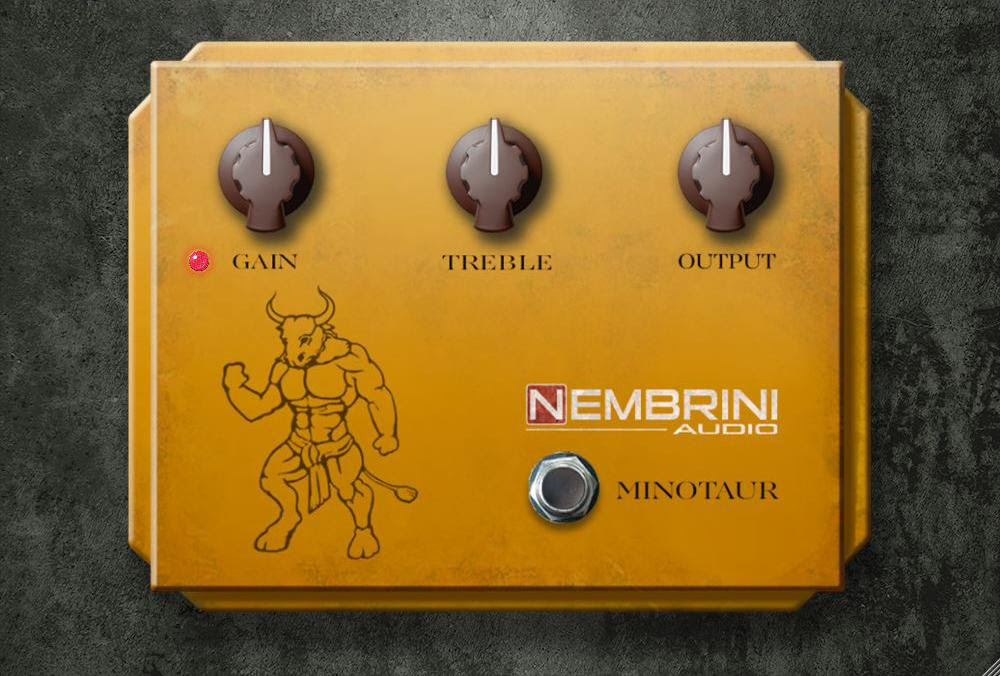
Duly depending on the settings of its GAIN, TREBLE, and OUTPUT control knobs — closely following in the footsteps of the highly-collectible hardware from which it takes its inspiration, Clon Minotaur Transparent Overdrive often acts as a clean boost by adding volume and minimal coloring to the sound, which, in turn, can be used to drive the input valve stage of the virtual amplifier to produce the distorted characteristics of an overdriven guitar amp.
As such, Clon Minotaur Transparent Overdrive controls can be set to distort the sound signal in the plug-in, where two modeled germanium diodes can perform waveform clipping with the GAIN parameter controlling the balance between the diode clipping stage and the clean stage. Thereafter, the two signals are summed together before interacting with the TREBLE and OUTPUT (volume) controls.

Conversely, Clon Minotaur Transparent Overdrive’s magnanimously modeled approach to the ‘pricing parameter’ far from closely follows in the footsteps of the highly-collectible hardware from which it takes its inspiration — after all, original Klon Centaur* guitar overdrives often fetch four-figure sums in today’s highly-competitive second-hand marketplace — making it a no-brainer for anyone interested in its (meticulously modeled) sound!
Clon Minotaur Transparent Overdrive is available for free (as an AAX-, AU-, VST2-, and VST3-supporting plug-in for macOS 10.9 or newer and Windows 7 or newer with no iLok required) from its dedicated webpage (https://www.nembriniaudio.com/products/clon-minotaur-transparent-overdrive), which also includes more in-depth info.
Flexibility further abounds as Clon Minotaur Transparent Overdrive is also available in AuV3 format for iOS for free on the App Store from here: https://apps.apple.com/us/app/clon-minotaur-overdrive/id1562822809

* Please note that all marks and models are all trademarks of their respective owners, which are in no way associated or affiliated with Nembrini Audio. These marks and names are used solely for the purpose of describing certain tones produced using Nembrini Audio’s modeling technology.
About Nembrini Audio (www.nembriniaudio.com)
Nembrini Audio was borne out of the extensive experience of founding namesake Igor Nembrini, with over 10 years of involvement in creating many of the greatest guitar amp plug-ins on the market to his notable name. Needless to say, the company’s exacting emulations always start by perfecting the digital reproduction of analog circuits before being finely tuned by ear to remain true to the original sound. Saying that it is specialized in the digital reproduction of analog saturation circuits, whereby the dynamic behavior of each individual component is carefully modeled and tuned by ear to always achieve the most musical and creamy saturation in the digital world! With that in mind, it does not simply produce musical software but rather musical instruments suitable for every modern musician in search of uncompromising quality — products that work well in any setting and situation to let the creativity of musicians, producers, and mixing engineers flow forth for all to hear!
© 2021 Nembrini Audio SRL

 NEW YORK, May 4, 2021 – Heavyocity Media announces the release of Mosaic Pluck, the fifth installment in The Mosaic Series line of virtual instruments. Mosaic Pluck continues the mission of Mosaic, featuring a complex collection of cinematic sounds, built entirely around what we find inspiring about the sharp transients and playability of organic and synthetic plucked sources. Combining analog synth, organic attack layers, and a range of sampled instruments (including plucked strings, harps, processed chimes, and thumb pianos), Mosaic Pluck delivers all the dynamic plucked sources you’ll need to cut through even the densest of score mixes.

“Plucks have the unique ability to infuse a scene with instant tension and drastic mood shifts,” said Dave Fraser, Co-Founder, Heavyocity. “And Mosaic Pluck does just that, elevating conventional plucked timbres into gripping, cinematic moments.”
And for a limited time, Heavyocity is offering Mosaic Pluck for $99 (Reg. $119). In addition, owners of other Mosaic Series instruments will receive an additional 20% off. Offers end May 17, 2021.
For more info visit here: Mosaic Pluck | Organic & Synth Pluck VST Plugin | Heavyocity
As a “powered-by-Kontakt” instrument Mosaic Pluck offers all playback and sound-shaping functionality through the full version of Kontakt 6 or the free Kontakt 6 Player.
PRICING AND AVAILABILITY
Mosaic Pluck will be available at www.heavyocity.com/mosaic-pluck
Release date: May 4, 2021
Mosaic Pluck – $119 USD
Limited-Time Mosaic Pluck Offer – $99 USD
Limited-Time Mosaic Pluck Offer for Mosaic Owners – $79 USD
Offers End: May 17, 2021
ABOUT HEAVYOCITY MEDIA
Heavyocity Media is a developer of award-winning virtual instruments and effects for computer-based music production, composition, and sound design. Heavyocity’s critically-acclaimed products push the boundaries of creativity, providing new and unique tools for professional composers and producers.
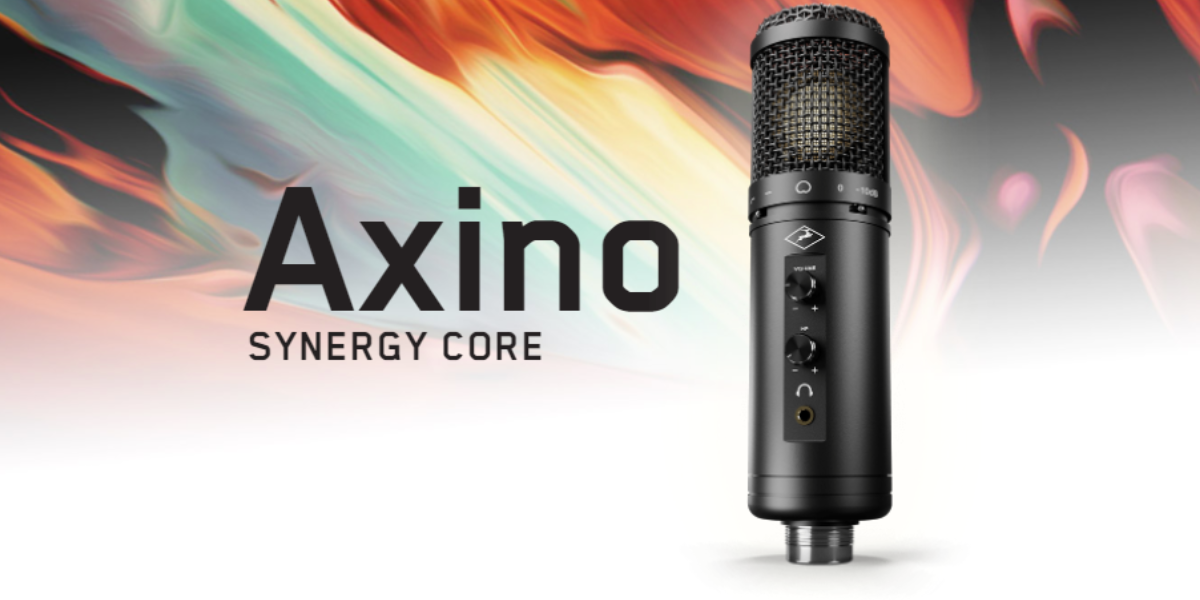
 SANTA MONICA, CA, USA: Antelope Audio is proud to announce Axino Synergy Core — combining a cardioid condenser modeling microphone and a USB 2.0 audio interface to create a compact, all-in-one studio-grade recording system anchored around the high-end professional audio manufacturer’s microphone Modeling Engine, proprietary Synergy Core effects platform, and 24-bit/192 kHz AD/DA conversion powered by 64-bit AFC™ (Acoustically Focused Clocking) technology, providing artists with quality, versatility, and effectiveness when creating at home or on the road — as of May 3…
To the untrained eye, Axino Synergy Core may look like a USB microphone, much like any other on the market. It is, indeed, an outstanding microphone in its own right — replete with a large, gold-spluttered diaphragm delivering low self-noise for clean- and natural-sounding recordings, as well as a cardioid pickup pattern minimizing background noise capture in favor of focusing on the sound source directly in front of the mic itself, yet closer inspection indicates a compact, all-in-one studio-grade recording system. Its inbuilt preamp is a hybrid of the renowned discrete preamps pleasingly put to use in Antelope Audio’s acclaimed audio interfaces and integrated circuit preamps. Put it this way: when it comes to creating a compact, all-in-one studio-grade recording system, there’s more to Axino Synergy Core than meets the eye — much more, in fact, for it features technology present in Antelope Audio’s top-of-the-line audio interfaces.

Moving on from the pristine sound of the microphone itself and into the world of microphone modeling, Axino Synergy Core’s Modeling Engine enables access to no fewer than 18 emulations of legendary microphones, ranging from dynamic designs to rare tube and FET (Field Effect Transistor) large-diaphragm condenser classics. Choose from Berlin 47 FT, Berlin 47 TU, Berlin 49T, Berlin 57, Berlin 67, Berlin 87, Berlin K86, Berlin M103, Berlin M251, Berlin V563, Hamburg 441, Illinois 7B, Illinois 57, Minnesota 20, Tokyo 800T, Vienna 12, Vienna 112, and Vienna 414. Apply any of them in real-time during recording or when mixing in a DAW (Digital Audio Workstation) and experiment with the flexibility and versatility on offer by choosing the microphone that best suits a particular project’s needs, such as vocals, for example. Seeking something brighter and more upfront or maybe more retro and warmer? With Axino Synergy Core there is surely something for everything.

But before even opening the easy-to-use software control panel for macOS and Windows, the microphone itself offers much in the way of hands-on control courtesy of analog VOLUME and HP (headphone) volume controls alongside a -10dB pad switch and a high-pass filter switch. As an engineering feat for all to see and hear, Axino Synergy Core cleverly packs an entire audio interface into a compact, all-in-one studio-grade recording system with DSP (Digital Signal Processing) and FPGA (Field Programmable Gate Array) processing, precise clocking, and outstanding conversion. Indeed, it uses the same AFC™ technology that defines Antelope Audio’s acclaimed audio interfaces; in turn, this governs the AD/DA (analog-to-digital/digital-to-analog) conversion to ensure pristine audio quality at 24-bit/192 kHz playback and recording resolution — rare for a USB microphone. It is this cutting-edge combination of clocking and conversion that forms the foundation upon which the exceptional sound so solidly rests.

Antelope Audio does not stop there; by integrating its proprietary Synergy Core effects platform with Axino Synergy Core, users can apply effects during live tracking and monitor through them with next to no latency as all processing is done inside the microphone with no strain on the computer. CPU (Central Processing Unit) draining effects are offloaded, allowing Axino Synergy Core to offer a level of audio processing not typically possible with conventional USB microphones. Processing with the Synergy Core effects library during post-production and live streaming is also possible, by making use of the two stereo playback channels with effects strips and the included loopback functionality.
The Axino Synergy Core comes complete with the following Synergy Core effects: AURAVERB (reverb); BAE-1073 (three-band EQ with high-pass filter); BAE-1073MP (mic/line preamp); FET-A76 (FET compressor/limiting amplifier); GYRAF GYRATEC IX (dual-tube mic preamp with high-pass filter); MASTER DE-ESSER (de-esser); OPTO 2A (tube optical compressor/limiter), POWEREX (expander); POWERGATE (noise gate); and VEQ-55A (three-band EQ with high-pass and low-pass filters). Antelope Audio’s ever-expanding library of 80-plus expansions already available are created using the high-end professional audio manufacturer’s unique hardware modeling approach, and includes some of the most coveted and hard-to-find analog studio gear from around the world, with the likes of Grove Hill LIVERPOOL — a contemporary fusion of finest American and British compression technologies — and Blonder Tongue Audio Baton — an all-tube graphic equalizer so rare and special that it has an actual album named after it — both benefitting from the Synergy Core treatment.
Also available are renowned third-party effects like Auto-Tune Synergy — a custom-designed plug-in that leverages the next-generation hardware acceleration of the Synergy Core platform to deliver the legendary Auto-Tune® pitch correction and vocal effects with ultra-low latency — and Instinct Synergy — working with Inertia Sound Systems to transport the creative audio processing tools producer’s popular Instinct creative signal processing effect plug-in to its renamed resting place, accelerated by the Synergy Core engine. Expansions start at $55.00 USD and are available from Antelope Audio’s Software Store (https://en.antelopeaudio.com/software-store/).
Merging modeling microphone and audio interface innovations, Axino Synergy Core is equipped with custom-built audio drivers for macOS and Windows optimized for streaming and playback, as well as low-latency recording, while the software control panel permits easy access to settings configuration, signal routing, and effects processing, simplifying the software supplied with Antelope Audio’s acclaimed audio interfaces to truly deliver a compact, all-in-one studio-grade recording system quite unlike any other on the market.
Axino Synergy Core — complete with USB cable, shock-mount, and stand — will be shipping in Q2 2021 at a projected price of $399.00 USD/€399.00 EUR and available through Antelope Audio’s growing global network of authorized dealers (https://en.antelopeaudio.com/dealers/). Or order online directly from Antelope Audio via the dedicated Axino Synergy Core webpage (https://en.antelopeaudio.com/products/axino-synergy-core/), which also includes more in-depth info.
Explore Axino Synergy Core’s included real-time effects here: https://en.antelopeaudio.com/software-store/?device=172705
About Antelope Audio (www.antelopeaudio.com)
Antelope Audio is a leading manufacturer of high-end professional audio equipment. Founded in 2004 and reinventing the industry with its flawless master clock technologies and versatile multi-channel interface solutions, the company has been steadily expanding its portfolio over the years under the guidance of visionary engineer and CEO Igor Levin. Antelope Audio’s products offer the best of both analog and digital technologies. Among its most recent innovations are compact interfaces with discrete mic preamps, hardware-based effects modeled to the component level running on a Synergy Core of DSP and FPGA processing, and next-generation modeling microphones. These are distributed through Antelope Audio offices in Europe, the Americas, and Asia, and highly acclaimed by users all over the world. The company’s customers include GRAMMY® award-winning sound engineers, top-tier producers, world-class artists, and some of the most renowned recording, mastering, and post-production facilities around the globe.
© 2021 Antelope Audio

 ECHT, THE NETHERLANDS: virtual synthesizer, instrument, and effect plug-in developer Rob Papen Inspiration Soundware is proud to announce the availability of DelSane — deviating down an appropriately-named virtual effect plug-in pathway as a stereo delay with ‘Dr. Jekyll and Mr. Hyde’ behavior by swinging between an easy-to-use, lovely-sounding ‘sane’ stereo tape delay and dynamically-changing disruptive ‘insane’ delay types — as of April 28…
As an appropriately-named effect plug-in with a ‘Dr. Jekyll and Mr. Hyde’ behavioral disorder, DelSane makes musical sense when viewed from Rob Papen’s perspective, positioned this way: while it is true that the abundance of delay effects already out there sometimes seems like trying to count the number of stars in the Milky Way, which can be overwhelming,  DelSane was duly designed as a way of staying sane when navigating increasingly-insane modern music production waters as an easy-to-use, lovely-sounding stereo tape delay plug-in. Perversely, perhaps, it could be considered insane if Rob Papen’s latest product did not offer something special, as is the Dutch virtual synthesizer, instrument, and effect plug-in developer’s modus operandi. On the face of it, then, it is called DelSane since it is possible to imagine dropping ‘Del’ in favor of ‘In’ as insane-sounding delay types can also be created!

Central to the insanely creative DelSane is its eye-catching DISRUPT spherical slider. Since said slider is connected to the various delay parameters, it is possible to change multiple parameters in a dynamic way when moved. It is also Spring featured, so can be made to spring back into the Center position in a tempo-based manner, making for very dynamically changing disruptive ‘insane’ delay types — and all without recording innumerable parameters, paralleling trying to count those Milky Way stars!
So think of DelSane as a two-sided — split-personality-style — concept with the first (sane) side being a smooth-sounding tape delay that can be easily used as a stereo or mono delay and the second (insane) side acting as a creative conduit to thinking out of the box with delay effects.
Either way, DelSane is surely set to become a go-to delay plug-in perfectly suited to any music production, thanks to its easy-to-understand layout presented as an easy-on-the-eye GUI (Graphical User Interface) that is resizable from 100% to 200% in four incremental steps.
Further features well worth highlighting here include a cool EQUAL FEEDBACK function — providing the STEREO DELAY with equally smooth left and right feedback tail; DISTORT — adding a bit of a distorted edge to the delayed sound; and FREQ SHIFT — alienating the delayed sound still further.
Easing the delayed sound’s passage into modern music production waters — whether sane or otherwise — while avoiding any muscle pain in the process, activating the LAZY MODE automates the movement of the DISRUPT spherical slider in different directions, duly allowing for the creation of chorus, flanger, or new types of modulation effects, while an AUDIO FOLLOWER function facilitates influencing various delay parameters — including the DISRUPT spherical slider itself! Meanwhile, MIDI & MOD makes for further flexibility when it comes to influencing those various delay parameters.
So ‘sanity’ and ‘insanity’ are available in abundance when working with DelSane — so much so that Dr. Jekyll and Mr. Hyde would surely approve… if involved in modern music production!
DelSane is available as a 64-bit AAX-, AU-, and VST-compatible effect plug-in for Mac (OS X 10.12 – macOS 11) and as a 32- and 64-bit VST-compatible effect plug-in for PC (Windows 7/8/10) — with 64-bit AAX compatibility available for PT 12 or higher (PC) — at a time-limited introductory promo price of €29.00 EUR/$29.00 USD until May 15, 2021 — rising thereafter to a MAP (Minimum Advertised Price) of €35.00 EUR/$35.00 USD — from authorized Rob Papen dealers worldwide or as a download directly from Rob Papen itself for the same pricing from here: https://www.robpapen.com/DelSane.html
While DelSane is not included in the latest version of the eXplorer 6 bundle (https://www.robpapen.com/eXplorer-6.html), Rob Papen is offering DelSane for free to anyone that purchases — or upgrades to — eXplorer 6 between now and May 31, 2021.
A 30-day demo version of DelSane with only one introductory sound bank and all bank and preset loading/saving functionality duly disabled is available from here: https://www.robpapen.com/DelSane-Demo.html
For more in-depth information, please visit the dedicated DelSane webpage here: https://www.robpapen.com/DelSane.html
About Rob Papen (www.robpapen.com)
Self-confessed synth freak and world-renowned sound designer Rob Papen started working with synthesizers at the tender age of 15 when purchasing an analog Korg MS-20 semi-modular monosynth and accompanying analog SQ-10 sequencer. Suitably inspired, he subsequently released several albums as part of Dutch electronic music groups Peru and Nova — the latter featuring the same members as Peru, but with a more commercial slant — with whom he enjoyed number one hit singles in The Netherlands (Nova) in 1982 and Austria (Peru) in 1988. Peru disbanded in 1993, by which time Rob had already established himself as a sought-after sound designer, creating presets for the likes of Waldorf, Access, Ensoniq, and E-mu, before going on to found his namesake company in pursuit of creating a sound designer’s dream synth. That software dream soon became reality when Rob formed the RPCX (Rob Papen ConcreteFX) partnership with music software developer Jon Ayres to develop new Rob Papen virtual instruments and effects plug-ins, starting with BLUE — an exciting-sounding, self-styled ‘Crossfusion Synthesis’ affair (combining FM, Phase Distortion, Wave Shaping, and Subtractive synthesis into one powerful dream synth) — in 2005. Today Rob Papen soundware defines cutting-edge contemporary music production: powerful virtual instruments and effect plug-ins that intermix innovative design, uncompromising sound quality, and musical, production-grade presets to make tracks truly shine, whatever the musical genre… Inspiration Soundware, indeed!
© 2021 Rob Papen Inspiration Software

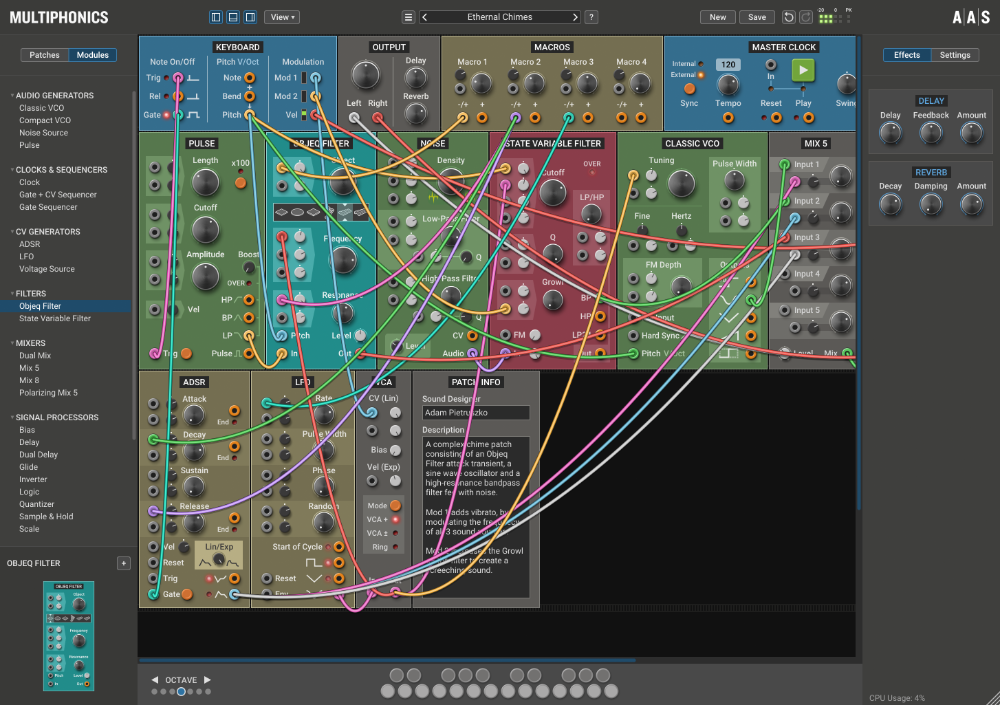
 Montreal, Quebec—April 27, 2021—Applied Acoustics Systems announces today the release of the Multiphonics CV-1 modular synthesizer for macOS and Windows—a brand new space for exploration, experimentation, creation, learning, and fun.
Dive into the mind-bending world of modular synthesis with Multiphonics CV-1, a powerful platform for assembling and playing patches. With a simple and straightforward interface, Multiphonics is a fast and efficient creation tool for musicians and sound designers. It is also a great learning environment for newcomers. Multiphonics ships with a comprehensive library of modules, from the basics to unique and sophisticated originals, and a vast and inspiring library of patches crafted by top sound designers.
“We are thrilled to be back in the world of modular synthesis, a return to our first love!” Benoit Charland, lead product designer at Applied Acoustics Systems.
“Multiphonics was built from the ground up and developed with patching flexibility in mind. We took great care in making sure the modules were thought-out and designed to work together in an optimal manner providing a coherent patching experience. We also wanted all functionalities to be directly accessible from the interface in order to make the creation of patches and the realization of musical ideas as fast and playful as possible.”
Key features of Multiphonics CV-1 include:
For more information visit AAS here: https://www.applied-acoustics.com/multiphonics-cv-1/
Multiphonics CV-1 runs on both macOS and Windows in 64-bit host sequencers that support the VST2, VST3, Audio Units, and AAX Native formats.
Multiphonics CV-1 is available now at a suggested retail price of US$99.
Special Introductory Pricing
Until June 22, 2021, Multiphonics CV-1 is offered at the special introductory price of US$79.
About Applied Acoustics Systems
Applied Acoustics Systems (AAS) was founded in 1998 and is based in Montreal, Quebec, Canada. As a privately-held company, it specializes in software-based synthesis tools for professional musicians and sound designers. Since releasing Tassman, the first virtual instrument based on physical modeling, AAS has come to be recognized as the industry leader in this exciting new field of synthesis.

 TALLMAN, NY, USA: Avantone Pro is proud to introduce Gauss 7 — paying tribute to Gauss greatness by bringing a notable name back to the wider world with an active full-range, two-way reference monitor mixing vintage nearfield old-school snap and new-school-boosted bandwidth and frequency response decades after the much-missed Gauss Speaker Company’s closure — as of April 22…
Gauss greatness comes courtesy of the long-gone Gauss Speaker Company, a well-respected — albeit short-lived — division of Cetex Gauss based out of Sun Valley, California that rose to prominence in the early-Seventies with a high-powered line of loudspeakers that found their way into PA systems, studio monitors, and instrument amplifiers — even guitar giant Fender® offered Gauss speakers as a high-end upgrade for select amplifiers! Although Gauss was well known amongst the very best brands for the extreme engineering, high-quality manufacturing, and tons of power applied to its products, the close of the Eighties sadly sped up the company’s closure as the rapid rise of digital equipment put paid to its tape duplication equipment business. But Gauss remains an ageless classic and Avantone Pro is honored to bring the notable name back to the wider world with its Gauss 7 active (Bi-Amped Class D) full-range, two-way reference monitor acting as the perfect start to doing just that.
The custom, patented-design GAU-AMT tweeter lies at the heart of Gauss 7 by providing the utmost detail — down to the most subtle of waveforms — to deliver incredible stereo imaging while maintaining a small vertical throw. This reduces unwanted acoustic reflections in a room, helping to minimize phase issues in an acoustic environment. Technically, the impressive transient response of the GAU-AMT tweeter comes courtesy of its 65mm PET (Polyethylene Terephthalate) film-folded membrane, the result of which is far beyond what can be achieved in typical dome tweeter designs. Duly chosen as it is the lowest resonant frequency film, PET film also hosts the lowest crossover point — and all while still providing exceptional high-range frequency extension. The tweeter’s coil is aluminum-etched PET film, folded. Furthermore, the assembly is mounted in its own enclosure to prevent backwave pressure from the woofer.

Woofer-wise, Gauss 7’s is inspired by Avantone Pro’s AV10-MLF ‘white cone’ construction, yet was still engineered from the ground up. Ultimately, the woofer cone itself is a pressed design, fabricated from the same proprietary blend of wood pulp and glass fiber found in the company’s CLA-10 series’ AV10-MLF woofer, with majorly increased materials to provide the hard snap and fast transient response of the CLA-10 series but benefitting from the majorly increased low end — no need to hear tighter voicing here, in other words, since providing Gauss 7 with a wide bandwidth for fantastic midrange performance and a low-end reference reaching right down to 30Hz is the order of the day. Digging deeper, the woofer’s motor structure is made of low-carbon 1008 steel, so enables the highest amount of magnetic flux density between the pole pipe and the top plate. Put it this way: with a surround made from a Japanese uni-directional SBR (Styrene-Butadiene Rubber), rest assured that the power and excursion of the woofer is optimized.
On the face of it, then, the high-end frequency response — reaching up to 22kHz — makes for an exceptional reference monitor perfectly primed for handling a wide range of sound and musical materials. Moreover, ‘air frequencies’ are not just audible, but supremely smooth. Saying that this not only provides for an exceptional-sounding reference monitor but one that is built to listen to for hours on end. And a rear-firing bass port gives Gauss 7 a controlled yet punchy low end with a tight response — without exhibiting the typical ‘over-hyped low end found in other monitors in its price range.

Rounding out its impressive specification — edited highlights of which include a 7” (178mm) Ferrite Motor GAU-7MLF low-frequency driver, 2.5” (65mm) GAU-AMT high-frequency driver, 120W low-frequency amplifier power, 60W high-frequency amplifier power, 103dB (Peak) SPL (Sound Pressure Level), and 0.5% THL (Total Harmonic Distortion) delivered from a beautifully executed enclosure measuring 381mm H x 235mm W x 212mm D (15” H x 9.25” W x 8.35” D) and weighing in at 8.2kg (18 lbs), balanced XLR and ¼” TRS inputs make connecting Gauss 7 a breeze. But it takes a little more than that to create a studio-strength reference monitor — hence its back panel providing powerful, yet easy-to-use controls for fine-tuning the system to work well within whatever room it is installed, such as a three-position Acoustic Placement switch (allowing anyone to optimize Gauss 7 to boundary spaces within that room), an adjacent three-position High Trim switch (helping to refine additional room issues), and last, but by no means least, a Gain control (for proper system calibration).
Clearly, Avantone Pro has done itself proud by bringing a much-missed notable name back to the wider world with its inspired Gauss 7 active full-range, two-way reference monitor. It is, indeed, an honorable thing to do!
Gauss 7 will be shipping globally in early June 2021, available at Avantone Pro’s US Dealers (http://www.avantonepro.com/us-dealers.php) with a MAP (Minimum Advertised Price) of $799.00 USD per pair. (European SSP — Suggested Selling Price — is €799.00 EUR, excluding VAT, with worldwide Distributors listed by country here: http://www.avantonepro.com/worldwide.php)
For further information, please visit the dedicated Gauss 7 webpage here: http://www.avantonepro.com/gauss7.php
About Avantone Pro (www.avantonepro.com)
As a producer of affordable high-quality studio monitors, reference headphones, microphones, and accessories, Avantone Pro is a different kind of audio company — a creative vehicle, in effect, enabling its core team to bring to market the things viewed as missing in the industry. Indeed, this could be anything as simple as meeting a particular price point to give excellent quality for reasonable pricing to a product that simply does not exist until built by that team. Far from using the shotgun approach to creating a product line, however, each and every product produced has passion and purpose driving it forward. Regardless of whether attracting a two- or four-figure price tag, attention to design is consistent throughout all Avantone Pro products. Performance comes first, of course, but a great deal of design time is spent creating visually attractive products. Put it this way: the company collectively enjoys classic, timeless designs itself; it is convinced, therefore, that others feel the same way! With its microphones and monitors used in studios around the world — whether within home-based project setups or world-renowned multi-million-dollar facilities, Avantone Pro is sensitive to the real-world operating budgets of bigger and smaller studios alike but also appreciates struggling songwriters/artists who are passionate about creating great music yet must adhere to budget limitations based on common sense spending. Since it strives to offer products that anyone would be proud to own and have long-term use of in the quest for creating great music, even those on a budget can comfortably access Avantone Pro’s world-class sound.
© 2021 Avantone Pro

 LONDON, UK: Spitfire Audio is proud to announce the availability of SPITFIRE SYMPHONY ORCHESTRA PROFESSIONAL — returning to where it all began by completing its definitive anthology that provides the tools to create blockbuster symphonic works for film, games, and television with additional choice and control above and beyond the musically matured four-year-old original SPITFIRE SYMPHONY ORCHESTRA release recorded in the hallowed (Lyndhurst) Hall at London’s legendary AIR Studios, supplemented with (up to) eight microphone positions capturing strings, brass, and woodwinds warm embrace with that room’s reverberative lushness like no other, together with three expertly engineered mixes by the award-winning Jake Jackson to create an exhaustively-sampled single package extended in both name and execution, effectively bursting with an encyclopedic offering of techniques that is surely set to prove popular as another standout collection of libraries loved by many professional composers, comfortably priced to readily represent a 50%-plus saving over purchasing its included libraries individually — as of April 22…
An appreciation of why AIR Studios’ Lyndhurst Hall has found favor in film scoring circles will, without doubt, help foster an appreciation of what went into making SPITFIRE SYMPHONY ORCHESTRA PROFESSIONAL what it is and why it is that Spitfire Audio makes sounds for film composers. Company co-founder and composer Paul Thomson is perfectly positioned to lend a helping hand in making that musical connection, clarifying why the fabric of Lyndhurst Hall is woven so tightly throughout the sound-specializing British music technology company’s completed blockbuster symphonic anthology with more techniques therein than any of its other libraries: “Architecturally unique, the acoustic properties of the interior of AIR Lyndhurst Hall were spotted by Sir George Martin, and he created a recording studio in this location that has been the destination of choice for film composers from all over the world for many years. Many of your favorite scores will have been recorded in this beautiful room. Players love playing in this room because of the acoustic feedback that they get from the surroundings. There is a gentle reverberation in the room that just adds beauty to literally anything you play in there. It could be a single instrument, or it could be a small chamber group that expands and blooms inside the space. When you have a full orchestra going in there, such as on How to Train Your Dragon by John Powell, you get the most enormous, epic, thunderous, colorful sound. It’s a very beautiful acoustic space.”
 By building upon the core SPITFIRE SYMPHONIC STRINGS sample library that was initially individually available as of 2016 before becoming part of the SPITFIRE SYMPHONY ORCHESTRA anthology a little later, SPITFIRE SYMPHONIC STRINGS PROFESSIONAL — produced with 60 of the world’s finest strings players performing over 175 articulations, including 59 shorts and 94 longs, captured in situ courtesy of AIR Studios’ signal path par excellence featuring priceless valve and ribbon microphones, Neve ‘AIR Monserrat’ preamps feeding a Neve 88R large-format console, and recorded digitally at 96kHz via two-inch Studer tape, before being presented as individual sections and ensembles with multiple layers and round robins, not forgetting five legato patches programmed by British film composer Andrew Blaney — is included in SPITFIRE SYMPHONY ORCHESTRA PROFESSIONAL as a new professional-level library packed with 152 GB of additional content, featuring Fine, Medium, and Broad curated mixes by award-winning engineer Jake Jackson to offer an immediate and recognisable blockbuster sound. Such mix perspectives, crafted using single voices per note for low CPU (Central Processing Unit)/RAM (Random Access Memory) usage, are indispensable for realizing readymade mixes that work across the entire orchestra. Of course, it is perfectly possible to create custom mixes using the 11 signals featuring eight classic microphone positions providing a diverse range of palettes from a single room, including four alternative (ALT) microphone signals — namely, a microphone placed close to the leader of each section (L), warm close ribbon (Cr), close stereo pair (St), and spacious gallery (G), as well as adding outrigger signals to the common close tree ambient (CTA), creating CTAO for facilitating access to the classic Spitfire Audio setup. Says Paul Thomson: “I’m often asked, ‘What are outriggers?’ They are a kind of sideways extension of the Decca Tree that stands just behind where the conductor stands, above the conductor’s head — three microphones that capture the whole soundstage of the full orchestra. Many engineers will add the outriggers to the Decca Tree as a matter of course, but we’ve kept them separate here because it’s sometimes one of those things that you want to add to taste.”
Watch the SPITFIRE SYMPHONY ORCHESTRA PROFESSIONAL premiere with Spitfire Audio co-founders Christian Henson and Paul Thomson here:
Equally extended is SPITFIRE SYMPHONY ORCHESTRA PROFESSIONAL’s included SPITFIRE SYMPHONIC BRASS PROFESSIONAL library, tastefully formed from the 2016-released SPITFIRE SYMPHONIC BRASS — created using AIR Studios’ signal path at Lyndhurst Hall with the world’s finest brass players — with 173 GB of additional content, 10 signals featuring seven microphone positions, and also featuring Fine, Medium, and Broad curated mixes by Jake Jackson to offer an immediate and recognizable blockbuster sound suited to those looking to creatively channel their inner John Williams or Hans Zimmer zeal. Similarly, SPITFIRE SYMPHONY ORCHESTRA PROFESSIONAL’s also-included SPITFIRE SYMPHONIC WOODWINDS PROFESSIONAL library — leaning on the world’s finest woodwind players, presented with essential and versatile microphone positions — brings a new level of customization to bear upon the also-still-available SPITFIRE SYMPHONIC WOODWINDS which first saw the light of day in 2016, thanks to 167 GB of extra content, 10 signals featuring seven microphone positions, plus Fine, Medium, and Broad curated mixes by Jake Jackson to offer every articulation for every ensemble and section in a single encyclopedic compendium. Clearly, working with real-world woodwinds can afford composers — film scoring or otherwise — the luxury of reaching deep down into the lowest of lows wherever and whenever deemed appropriate, an attribute that has been enhanced still further when working, for example, with SPITFIRE SYMPHONIC WOODWINDS PROFESSIONAL’s thunderous ContraBassoon (CTAO) patch. Posits Paul Thomson: “When we go right down to the bottom B-flat, that really resonates the room when the player plays loud — like a kind of amp signal or something like that. It really is a fantastic effect, lower than the string basses can go — even with the C extension; the ContraBass Clarinet and the ContraBassoon can get you a whole tone lower.”
 Lending further flexibility for those seeking a chamber strings-led sound, as opposed to SPITFIRE SYMPHONIC STRINGS PROFESSIONAL’s sizeable — 16 1st violins-, 14 2nd violins-, 12 violas-, 10 cellos-, and eight basses-based — symphonic string section, the simultaneously-released SPITFIRE SYMPHONY ORCHESTRA CHAMBER STRINGS EDITION PROFESSIONAL package pairs SPITFIRE SYMPHONIC BRASS PROFESSIONAL and SPITFIRE SYMPHONIC WOODWINDS PROFESSIONAL perfectly with SPITFIRE CHAMBER STRINGS PROFESSIONAL, hitherto only available on its own as of 2018.
An appropriately affecting closing commentary aimed at potential SPITFIRE SYMPHONY ORCHESTRA PROFESSIONAL purchasers comes courtesy of an understandably proud Paul Thomson: “The room is bound to the sound of the players; the players respond to the room; the instruments vibrate in sympathy with the room. It’s really one wonderful, virtuous circle. And when you’re after this epic scoring sound, the room that you record in has such an enormous effect on the end result, so a no-expense-spared production with the same players playing through the same mics, the same preamps, and the same desk through onto tape will get you the sound of The Crown, The Dark Knight, and Gladiator. If that’s the film score sound that you want then this is absolutely the collection for you.”
SPITFIRE SYMPHONY ORCHESTRA PROFESSIONAL — comprising SPITFIRE SYMPHONIC STRINGS PROFESSIONAL, SPITFIRE SYMPHONIC BRASS PROFESSIONAL, and SPITFIRE SYMPHONIC WOODWINDS PROFESSIONAL — can be purchased at an RRP (Recommended Retail Price) of £1,299.00 GBP (inc. VAT)/$1,499.00 USD/€1,499.00 EUR (inc. VAT) — representing a 50%-plus saving over purchasing all of those titles individually at their respective full pricing — from here: https://www.spitfireaudio.com/shop/a-z/spitfire-symphony-orchestra-professional/
Watch Spitfire Audio co-founder and composer Paul Thomson’s ‘traditional’ walkthrough of SPITFIRE SYMPHONY ORCHESTRA PROFESSIONAL here:
SPITFIRE SYMPHONY ORCHESTRA PROFESSIONAL needs Native Instruments’ KONTAKT PLAYER (5.6.8 or higher) — a free version of the KONTAKT sample playback engine (included in its purchase) — to run as a fully NKS (NATIVE KONTROL STANDARD®) supporting plug-in instrument for Mac (OS X 10.10 or later) or Windows (7, 8, or 10 — latest Service Pack, 32/64-bit), while Spitfire Audio’s free Download Manager application allows anyone to buy now and download anytime.
SPITFIRE SYMPHONIC STRINGS PROFESSIONAL, SPITFIRE SYMPHONIC BRASS PROFESSIONAL, and SPITFIRE SYMPHONIC WOODWINDS PROFESSIONAL can be individually purchased at time-limited introductory promo pricing of only £599.00 GBP (inc. VAT)/$659.00 USD/€659.00 EUR (inc. VAT), £539.00 GBP (inc. VAT)/$599.00 USD/€599.00 EUR (inc. VAT), and £479.00 GBP (inc. VAT)/$539.00 USD/€539.00 EUR (inc. VAT), respectively, until May 30, 2021 — respectively rising thereafter to an RRP of £999.00 GBP (inc. VAT)/$1,099.00 USD/€1,099.00 EUR (inc. VAT), £899.00 GBP (inc. VAT)/$999.00 USD/€999.00 EUR (inc. VAT), and £799.00 GBP (inc. VAT)/$899.00 USD/€899.00 EUR (inc. VAT) — from here:
https://www.spitfireaudio.com/shop/a-z/spitfire-symphonic-strings-professional/
https://www.spitfireaudio.com/shop/a-z/spitfire-symphonic-brass-professional/
https://www.spitfireaudio.com/shop/a-z/spitfire-symphonic-woodwinds-professional/
SPITFIRE SYMPHONY ORCHESTRA CHAMBER STRINGS EDITION PROFESSIONAL — comprising SPITFIRE CHAMBER STRINGS PROFESSIONAL, SPITFIRE SYMPHONIC BRASS PROFESSIONAL, and SPITFIRE SYMPHONIC WOODWINDS PROFESSIONAL — can be purchased at an RRP of £1,299.00 GBP (inc. VAT)/$1,499.00 USD/€1,499.00 EUR (inc. VAT) — representing a 50% saving over purchasing those titles individually at their respective full pricing — from here: https://www.spitfireaudio.com/shop/a-z/sso-chamber-strings-edition-professional/
SYMPHONY COMPLETE PROFESSIONAL — the full symphonic package comprising SPITFIRE SYMPHONIC STRINGS PROFESSIONAL, SPITFIRE SYMPHONIC BRASS PROFESSIONAL, and SPITFIRE SYMPHONIC WOODWINDS PROFESSIONAL paired with MASSE, SPITFIRE HARP, ORCHESTRAL GRAND PIANO, and SPITFIRE PERCUSSION — can be purchased at an RRP of £1,799.00 GBP (inc. VAT)/$1,999.00 USD/€1,999.00 EUR (inc. VAT) from here: https://www.spitfireaudio.com/shop/a-z/symphony-complete-professional/
About Spitfire Audio (www.spitfireaudio.com)
Spitfire Audio is a British music technology company that specializes in sounds — sample libraries, virtual instruments, and other useful software devices. It collaborates with the best composers, artists, and engineers in the world to build musical tools that sound great and are exciting to use.
© 2021 Spitfire Audio Holdings Limited

 PAVIA, ITALY: analog saturation circuits digital reproduction specialist Nembrini Audio is proud to announce the availability of Shimmer Delay Ambient Machine — sending shimmers down DAWs (Digital Audio Workstations) by combining reverb, pitch shifting, and feedback to create out-of-this-world soundscapes and spaces as a plug-in promoting getting lost in the creative production and electronic music facets of the ambient spectrum, drawing deeply from creative techniques developed by early-Eighties studio engineers — as of April 19…
Prominently popularised by British musician Brian Eno — effectively responsible for naming the genre itself with his 1978-released Ambient 1: Music For Airports album (comprising compositions created by layering tape loops of differing lengths, designed to be continuously looped as a sound installation with the intent of defusing the tense, anxious atmosphere of an airport), ambient music is typically thought of as a style of gentle, largely electronic instrumental music with no persistent beat, used to create or enhance a mood or atmosphere. No need (necessarily) to go anywhere near an airport terminal to work with Nembrini Audio’s self-styled ambient machine, although it is perfectly possible to achieve a truly ambient atmosphere almost anywhere since Shimmer Delay Ambient Machine is also available in an iOS-friendly form on the App Store.

No need (necessarily) to work without beats when working with Shimmer Delay Ambient Machine. After all, the plug-in promotes getting lost in the creative production and electronic music facets of the ambient spectrum, drawing deeply from creative techniques developed by early-Eighties studio engineers. Equally adept at working with guitars, keyboards, synthesizers, and vocals, it combines reverb, pitch shifting, and feedback to create out-of-this-world soundscapes and spaces via an easy-to-use interface implemented as an equally easy-on-the-eye experience, emphasizing user control and playability. Indeed, it is designed to be tweaked in real-time with no-nonsense controls clearly guiding the way with some self-explanatory sections acting as their helpful home — namely, IN (input level metering); SWELL (auto-volume swell commonly used with electric guitar, similar to the sound of a violin being bowed); DELAY (main delay); down OCTAVE (manages a down octave); SHIMMER (manages the shimmer effect); DRY/WET (manages the dry/wet signal blend); and OUT (output level metering). Moreover, all controls have a smoothed response to avoid clicks when changing settings or applying automation, while the highly-optimized main delay algorithm allows anyone to achieve huge delay sounds without straining their CPU (Central Processing Unit).
Ultimately, Shimmer Delay Ambient Machine more than lives up to its apt appellation — and all without straining the finances of anyone wishing to take a (purchasing) plunge into the creative production and electronic music facets of the ambient spectrum!
Shimmer Delay Ambient Machine is available for purchase (as an iLok-protected AAX-, AU-, VST2-, and VST3-supporting plug-in for macOS 10.9 or newer and Windows 7 or newer) at an attractive introductory price of only $29.00 USD until May 3, 2021 — rising thereafter to a regular price of $79.00 USD — from its dedicated webpage (https://www.nembriniaudio.com/products/shimmer-delay-ambient-machine), which also includes more in-depth information.

Flexibility further abounds as Shimmer Delay Ambient Machine is also available in AuV3 format for iOS at an introductory price of $4.99 USD until May 3, 2021 — rising thereafter to a regular price of $8.99 USD — on the App Store from here: https://apps.apple.com/us/app/shimmer-delay-ambient-machine/id1559249944

About Nembrini Audio (www.nembriniaudio.com)
Nembrini Audio was borne out of the extensive experience of founding namesake Igor Nembrini, with over 10 years of involvement in creating many of the greatest guitar amp plug-ins on the market to his notable name. Needless to say, the company’s exacting emulations always start by perfecting the digital reproduction of analog circuits before being finely tuned by ear to remain true to the original sound. Saying that it is specialized in the digital reproduction of analog saturation circuits, whereby the dynamic behavior of each individual component is carefully modeled and tuned by ear to always achieve the most musical and creamy saturation in the digital world! With that in mind, it does not simply produce musical software but rather musical instruments suitable for every modern musician in search of uncompromising quality — products that work well in any setting and situation to let the creativity of musicians, producers, and mixing engineers flow forth for all to hear!
© 2021 Nembrini Audio SRL

 DUESSELDORF, GERMANY: DAW (Digital Audio Workstation) plugin and audio DSP (Digital Signal Processing) developer Fuse Audio Labs is proud to announce the availability of its DOZER DRIVE plugin — powering a flexible fusion of two of the most iconic guitar pedals of all time as an authentic-sounding single-entity emulation encompassing fuzz, overdrive, and distortion — as of April 14…
Readily ranging from subtle boosts to the point of the saturation-driven seventh heaven, DOZER DRIVE is musically modeled on a legendary circular fuzz from 1966 and a 1979-vintage monstrous little green overdrive. On one side, its FUZZ channel covers all bases for creating classic dirty sounds; SCREAMER, on the other hand, hits a home run when it comes to delivering the typical mid-pronounced tone that became the industry-standard overdrive of choice. Creatively, DOZER DRIVE offers flexible channel routing for those that like to tweak — SCREAMER after FUZZ, FUZZ after SCREAMER, or both in PARALLEL.

The FUZZ channel provides an NPN vs. PNP switch that lets users choose between the typical clipping characteristics of silicon and germanium transistors, as well as a switchable DOOM MOD for conjuring up ultimate grind, while the SCREAMER channel’s FAT MOD switch shifts the mid-focused tone towards a much stronger bottom end. Finally, the MIX controller allows for fine-tuning the fuzz/overdrive ratio in PARALLEL MODE.
“Whether you want to sound like Jimi or Stevie Ray, or prefer to find your own perfect tone, DOZER DRIVE will become your best friend,” says Fuse Audio Labs CEO Reimund Dratwa. “It’s super versatile, yet only takes a few seconds to dial in amazing drive sounds for your guitar — or other instruments, if you dare! Dive into classic tones, tweak them to your heart’s content, and make them your own.”
Created in collaboration with Honest Amp Sim Reviews, DOZER DRIVE is available at an attractive price of only $19.00 USD directly from its dedicated webpage (https://fuseaudiolabs.com/dozerdrive.html) on the Fuse Audio Labs website, which includes more in-depth information.
Note that 14-day trial versions of all Fuse Audio Labs plugins without any restrictions are also available to download for free from here: https://fuseaudiolabs.com/plugins.html
About Fuse Audio Labs (www.fuseaudiolabs.com)
Fuse Audio Labs was founded in 2017 by Reimund Dratwa. Prior to joining Black Rooster Audio in late 2016, he worked for Brainworx for many years, during which time he was responsible for creating analog modeling titles for brands such as ACME Audio, Black Box Analog Design, Elysia, Millennia, Vertigo, and several others available through Plugin Alliance and the UAD-2 platform. The company was initially intended as an engineering entity to develop DAW (Digital Audio Workstation) plugins and audio DSP (Digital Signal Processing) applications for various partners but soon served as a channel for its own exciting product ideas.
© 2021 Fuse Audio Labs

 GRENOBLE, FRANCE: virtual instrument- and effect plug-in-specializing software company XILS-lab is proud to announce the availability of KaoX — a virtual instrument inspired by a legendary FM (Frequency Modulation) synthesizer, albeit bolstered by virtual analog sound synthesis and additional chaotic algorithms in an advanced two-layer architecture allowing for a powerful sound creation tool to fuel DAW-driven synthesizer dreams with a much more easily understood signal path than its iconic FM forefather — as of April 12…
To appreciate its iconic inspiration is to truly appreciate the power of KaoX, XILS-lab’s latest virtual instrument. Indeed, the early-Eighties synthesizer market was dominated by analog synthesizers using analog circuits and analog signals to generate sounds electronically, which, when made available as programmable polysynths with patch storage, were costly with limited polyphony. Putting paid to that dominance, an Eighties-dominating 16-voice FM synthesizer changed course — changing the course of musical history in the process — by generating sounds via frequency modulation, a form of sound synthesis whereby the frequency of a waveform is changed by modulating its frequency with a modulator.
Mass-manufactured using very-large-scale integration chips by a Japanese giant of a company who had licensed the technology from Stanford University, California — composer, musician, and professor John Chowning developed the digital implementation of FM synthesis while there, the world’s first commercially successful digital synthesizer subsequently sold over 200,000 units within three years — around 20 times more than the most iconic analog synthesizer of all time sold in its impressive decade-long lifespan — and its preset sounds soon became staples of the Eighties pop pantheon with E PIANO 1 purportedly ending up on 40% of the US Billboard Hot 100 chart-toppers throughout 1986.
Therein lay the rub. Really complex menus and a lack of conventional controls meant that few learned to program the comparatively keenly-priced instrument in depth — despite FM synthesis lending itself to creating brighter, glassier sounds, as well as imitative acoustic sounds so much better than its instantly unfashionable analog adversaries, programmable polyphonic or otherwise. Of course, fashions change with time and technology; the instrument in question has long since fallen out of favor. Although analog synthesizers — somewhat ironically — are now more commonplace than they ever were with a perceived warmth of sound and appealing hands-on control working in their favor, the convenience of an ITB (in the box) workflow with DAW-driven virtual instruments and effect plug-ins has far from lost its appeal for today’s music-making masses.
Time to revisit the wonderful world of FM synthesis with a modern-day twist? Knowingly, KaoX does  just that. After all, as a virtual instrument- and effect plug-in-specializing software company, XILS-lab loves to create tools that inspire its users to create more imaginative music than they ever dreamed possible!
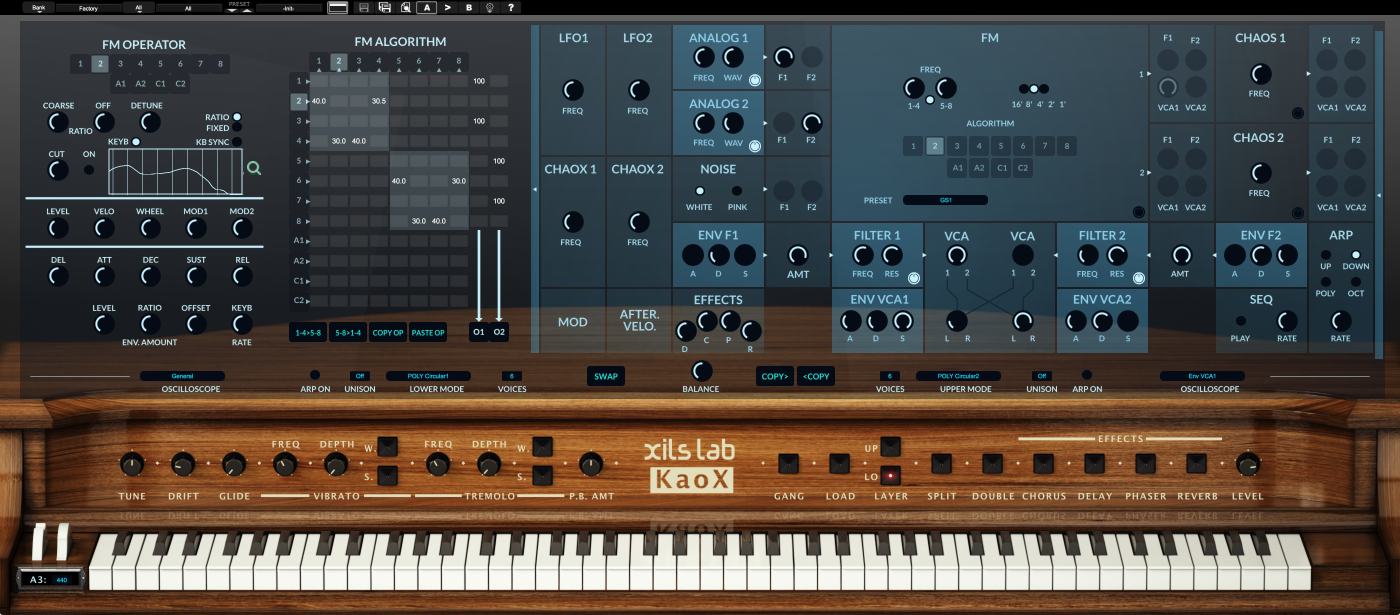
Put it this way: with KaoX, XILS-lab has created a virtual instrument inspired by that legendary FM synthesizer, albeit bolstered by virtual analog sound synthesis and additional chaotic algorithms in an advanced two-layer architecture allowing for a powerful sound creation tool to fuel DAW-driven synthesizer dreams with a much more easily understood signal path than its iconic FM forefather since the said signal path is easily understood through the use of illuminated modules in a GUI (Graphical User Interface) that is equally easy on the eye. KaoX’s knowing nod towards the preset-powered popularity of its iconic FM forefather is immediately obvious for all to see and hear in an easy-to-tweak simplified view allowing its UP (upper) and LO (lower) synthesizer layers — each with independent synthesis modules — to be combined in three different ways.
Working in single mode, only the selected layer is active and heard, while both layers are active and heard in SPLIT and DOUBLE modes — the lower part of the keyboard playing the LO layer and the upper part of the keyboard playing the UP layer in the case of the former, while both the UP and LO layers are simultaneously played across the keyboard in the case of the latter. Limited controls are available in this simplified view, including TUNE, DRIFT, GLIDE, VIBRATO, FREQ (vibrato frequency), DEPTH (vibrato), W (wheel), TREMOLO, FREQ (tremolo frequency), and DEPTH (tremolo), plus CHORUS, DELAY, PHASER, and REVERB effects, enabling users to easily play presets and to tweak them accordingly — adding vibrato and tremolo or switching effects on and off, for instance.
Alternatively, activating an advanced settings view brings the wonderful world of KaoX into full view, allowing more adventurous users access to the virtual instrument’s internal modules to tweak or change any parameter therein, aided by contextual help windows, while active modules are helpfully illuminated. FM synthesis options are available on each of the two available layers with eight operators grouped in two banks with independent pitch-perfect for creating chorus-like FM sounds or punchy stereo patches — and two outputs (O1 and O2). Each FM OPERATOR features one LFO (Low-Frequency Oscillator), one envelope, WHEEL and VEL (velocity aftertouch) access, two user-definable external modulators (assignable to any KaoX modulation source), KEYB (keyboard follower) 2D pad, RATIO or FIXED frequency selection, and a lowpass filter.
Furthermore, virtual analog synthesis options are also available on each of the two available layers with two continuous waveform analog oscillators (ANALOG OSCILLATOR 1 and ANALOG OSCILLATOR 2), two zero-delay-like analog filters (FILTER 1 and FILTER 2), four D-ADSR envelopes, and four VCA outputs for bringing a depth and warmth to the sound creation table. That said, KaoX also allows its users to create sounds that they had never thought possible, thanks to two chaotic oscillators (CHAOS OSCILLATOR 1 and CHAOS OSCILLATOR 2) and two chaotic ring modulators (CHAOX 1 and CHAOX 2). And as if that was not enough to keep committed sound creators seriously satisfied, KaoX comes complete with a flexible four-track step SEQUENCER, where each track can be assigned to the UP or LO layer with independent sustain and gating or used as a modulation source.
Sound-wise, KaoX comes packed with 500-plus presets programmed by world-class sound designers Mikael Adle, Soundsdivine, Status, Nori Ubukata, Tom Wolfe, Xenos, Yuli-Yolo, Zensound, and many more — more than enough to point anyone of any ability in the general direction of where they might musically want to go. Getting there is made much easier with its integrated single-window preset manager making finding the right patch for the task, managing presets and sound banks, as well as creating custom tags, an efficient easy-going experience that could barely be dreamt of back in the early Eighties. Today the time has clearly come to revisit the wonderful world of FM synthesis with a modern-day twist and appreciate the power of KaoX, XILS-lab’s latest virtual instrument par excellence — from France with love… and all without the need for very-large-scale integration chip mass manufacture!
KaoX is available to purchase as an iLok (2 and 3 dongle hardware or software) protected plug-in priced at an introductory promo price of €99.00 EUR until May 15, 2021 — rising thereafter to an MSRP (Manufacturer’s Suggested Retail Price) of €179.00 EUR — directly from XILS-lab via the dedicated KaoX webpage (https://www.xils-lab.com/products/kaox-p-168.html), which also includes more in-depth information.
KaoX can be directly downloaded as a multi-format AAX, AU, and VST (Mac OS X 10.8 and later) and AAX and VST (Windows 7, 8, and 10) plug-in from here: https://www.xils-lab.com/products/kaox-p-168/download.html
About XILS-lab (www.xils-lab.com)
Based in Grenoble, France, XILS-lab is an audio software company, created, and managed by Xavier Oudin. Having created some of the best-known virtual instruments and effects plug-ins on the market for various companies over the last 20 years, today he focuses on bringing his passion for audio, instruments, and music to bear on his own company. Working with highly skilled professional musicians and sound designers, the company collectively believes that a virtual instrument or effect is not simply a series of mind-boggling mathematical algorithms designed and scrutinized over by bookish Ph.D. engineers but rather a useful and useable musical tool made for musicians. Moreover, XILS-lab loves to create virtual instruments and effects that inspire its users to create more imaginative music than they ever dreamed possible!
© 2021 XILS Audio sarl